Wednesday, December 18, 2013


Aymeric de Tapol - Méridiens (Tanuki)

Two sets of field recordings, the first from Senegal and Mali in 1999, the second from Istanbul in 2012.

Aymeric de Tapol (no idea if that's a nom de musique or not) used a dictaphone for the African recordings which I'm guessing contributes to an aspect I find quite compelling, that it to say the uneven and occasionally clipped quality of the sound. In one sense, the venture is a kind of archaic survey--you get the sense of traveling around from place to place, capturing something of what you're experiencing (he concentrates most often on scenes which involve music to some extent), a kind of fractured travelogue. But it works beautifully. Something about the choices made, the sequencing, the roughness and, of course, the inherent beauty of the songs, whether sung intimately or heard from a distorted PA speaker. The music is often embedded within the street sounds, footsteps, conversations and goat bleatings; it's part of the landscape, not isolated.

The Istanbul tapes cover "street musicians, Gypsies wedding and Adnan [muezzin calls]". The recordings are much clearer, rendering the result more in line with traditional "world music" offerings, though at times one can still here the environment in which the sounds are occurring almost on par with the music, particularly the interior booming sound in the room where the wedding is taking place, and there are plenty of rough cuts between segments. Plus, well, the music is pretty great! It's a bit strange, veering from listening to the music as such and being conscious of the taping, disorienting in a good way. It ends in the streets.

Excellent work, highly recommended for any number of reasons.


Plochingen - 266 minuscules récepteurs paraboliques (Tanuki)

Information is tough to come by, either on the individual going by "Plochingen" (Belgian, co-founder of the collective, martiensgohome, 1996) or the whys and wherefores of this cassette, apart form the hints given by its title and a brief description from label owner, Patrick Thinsy: "Creates his own pure data patches to rework field recordings and home recordings, in this case guitars".

The music is easily digestible, the guitar-sourced tones quite smooth and arrayed in a semi-rhythmic manner here, spacier there. Not sure about what those 266 receptors are up to--occasionally you hear ambient sounds but the vast majority of sounds seem to emanate, quite tonally, from the guitar. There's throb aplenty and it's entirely too spacey for my taste--there's probably a term for that "wow" sound that's more appropriate than thinking of the synth line in "Lucky Man" but it's an unfortunate concordance for me. Pleasant enough, just without the requisite meat and grain.


Tanuki


Tuesday, December 17, 2013


Klaus Lang - Organ Works Vol. 1 (God Records)

Two very different works for organ from Klaus Lang, a decent portion of whose oeuvre (everything that I've heard, which is a limited sampling) deals with that instrument.

Side One contains "17 symmetrien", a 2012 composition that entails the hands and feet of five musicians, here Lang, Aleksej Vylegzhanin, Ja Young Baek, Adam McCartney and Kelvin Ng, who manipulate the manuals, pedals and stops of the organ in the Mariahilferkirche (Church of Mariahilf) in Vienna. It begins with a fairly complex and dense weave, shimmering tones of varying timbres and only gets more complex and dense from there over its 25 minute span. It seems cliché to use a term like "prismatic colors" but it's hard to avoid that sensation. There's a long duration throb of sorts in effect; the dynamics subside for a short time then return with renewed force and several new sound palettes. Lang stats, "I put my music into the space. I don’t want to send any messages, I think of nothing and I don’t want to purport any meanings. The listeners hear what they hear and behave to the music as they feel." and "17 symmetrien" lives up to that idea, filling the space (one can only imagine how it sounded in the church) and just residing there, respirating. It's large enough that you, as the listener/viewer, seem obliged to get up and circle it, pierce it, to experience even a minute percentage of its corpus. I think there's much going on that's not immediately apparent, elements that add to the overall effect even as they're masked by the hugeness of the sound. The closing minutes have a bell-like sheen, very beautiful and mysterious, and a fine cap to an impressive piece.

aside from "Ed Wood", I'm not the biggest Tim Burton fan around, so the title, "mars attacks" (for which Emanuel Schmelzer, in 2004, manned the organ of the Stiftskirche in St. Lambrecht, Austria) gave me pause...The piece is constructed of short, dull stabs at the keyboard, barely glued together by, at first, high, almost sine-like pitches. As the composition progresses, lower, richer held tones enter, forming a substrate in which those isolated pulses are planted. The drones begin to break apart, some decaying into shards, others acquiring a growling aspect, the piece as a whole fragmenting into disparate elements drifting out from the briefly held center. If there's a allusion to invading aliens, I can't hear it (thankfully) but the work is not only a fine tonic to "17 symmetrien" but absolutely held my attention throughout, not so much for any inherent beauty in the sounds but for attempting to track the constituent parts as they wandered through space.

Strong work.


Winfried Ritsch - Woodscratcher (God Records)

"The woodscratcher is a composition and sound generating machine, which cuts a 2-5 cm thick disk of a wooden trunk in a circular line along the growth rings of the wood."

A side each is devoted to oak and larch undergoing this process, each slice lovingly (and beautifully) depicted on the vinyl itself--that's oak above. And...its sounds pretty great. The motion of the saw is circular and the sounds thus obtained have that feel as the loop again and again, always slightly different and gradually changing as the bits gnaws further into the wood. Four pick-up mics are used at different physical points in the process, the resultant noises forming a thick layer of varying textures and depths. The oak side is more guttural--you even getter a sense that the wood is a bit damper, throwing out shavings that glom the process later on. The larch feels crisper, airier. The tracks, each about twenty minutes long, simply go on until they stop, the machine operating without intervention. It's rigorously minimalist; Riley or Reich, with more imagination, should have done something like this. And the material presence is excellent, no nonsense, rendering the kind of situation you might have been lucky enough to find yourself in at one time, with the luxury of just being able to sit there and bathe in the sound. I'd also recommend some DIY mixing by playing this recording simultaneously with the YouTube video and creating your own multi-rhythms.

A unique and rather wonderful recording, even if it only needs to be done once.


Duo Adé - Freilassing (God Records)

"Freilassing" is a one-sided LP played on one piano by two pianists, Gottfried Krienzer and Christoph Uhlmann who together comprise Duo Adé.

Following 43-second track called "Adjustment" where the pair appear to check the instrument's tuning, they launch into the title piece. The music is a kind of maximal minimalism, somewhere along the stretch of road where Louis Andriessen and John Adams used to live. Rhythmic in a way that approximates the mechanical (intentionally) with flourishes and filigrees abounding. Halfway through, the pace slows, still rhythmic but looser and ambling. There's clearly a good allowance for improvisation and this section has a nice sense of falling apart, even careening out of control while still being stuck in a kind of rut in the road--I envisage an ancient wagon, perhaps that of an old snake oil salesman, covered with banners and swinging lamps, pots and pans, trundling along that gouged dirt road in front of the Andriessen residence. Is that the crumbling Ron Geesin cottage I see up the way?

Good fun.


Robert Lepenik - poSTepeno (God Records/Entr'acte)

Lepenik, on the set of "poSTepeno" pieces that occupy the first of the two LPs here, concentrates on an area adjacent to that explored by the likes of Alvin Lucier--the juxtaposition of acoustic instruments (here, piano) with sine waves. But whereas Lucier will typically write long, drone-like passages wherein the instrumentalist attempts to approximate the exact pitch of the sine waves (an impossible task, resulting in those wonderful perturbations), Lepenik writes slow, often processional-sounding lines for the piano with a fluctuating sine wave alongside, so that the interaction varies quite a bit, the sounds sometimes treading independent pathways, sometimes interweaving.

"Grete vor dem Haus" takes up the second disc and is basically an expanded variation on a similar theme, though the writing for piano is a bit more robust in parts, making clearer allusions to contemporary Western music styles of the late 20th century. Again, the meshing of held notes and sine waves is quite delicious and, as before, there's quite an assortment encountered along the way. There's a strangely mesmerizing quality to all of this music, an odd sense of drawing the acoustic phenomena "out of the air", which of course, is what's happening. Fascinating work with a substantially different effect on ones ears and brain than, say, Lucier.

God Records

Entr'acte


Monday, December 16, 2013


Bernhard Lang/Philip Jeck - Tables Are Turned (God Records)

[Very mysteriously, all of the cover images I can find of this album show text (artists and titles) but when I copy to my computer, the result is solid black. Odd]

After I duly familiarized myself with the Amon Düül song that served as inspiration for this release, I sat down and listened to the Italian ensemble, Alter Ego (Manuel Zurria, flutes; Paolo Ravaglia, clarinets; Aldo Campagniari, violin; Francesco Dillon, violoncello; Oscar Pizzo, keyboards; Eugenio Vatta, sound projection) tackle the work. It wasn't immediately clear exactly what I was hearing. Without previously having read about the nature of the piece, I might at first have gleaned that the group was engaged in some aspect of acoustically looping material, even that said material's source was a snippet, or a number of snippets, from somewhere else. But the song, I presumed, had been sliced thinly enough to render any sort of recognition beside the point. And if Jeck was actually participating here (rather than having supplied the Düülish kernels from which Lang derived his score), I couldn't tell. So, I began to listen to the piece as music, regardless of its origin.

Then, some twelve minutes in (the release is two LPs, about 76 minutes total), a new set of sounds emerged, electronic in nature--a sliver of the song or several slivers, looping and echoing in the space--we were in a different area. There's a good mix between the turntables and the ensemble, a nice give and take as the acoustic instruments roughly imitate the fragments of the song, Jeck's sounds swirling behind and through them. The work shifts focus every so often, presumably isolating various segments of the Amon Düül piece, but there's always pretty intense activity in place. Interestingly, the original song, to my ears, had tinges of 60s era Terry Riley and parts of the Lang composition, say toward the beginning of Side C, are very reminiscent of "In C"--my favorite portion. There's a major shift about 50 minute in with a short section of forthright, unison playing after which a more drifting, smokier section ensues, arguably coming the closest thus far to the feel of the song. Side D returns to a stop and start, more fragmented reading, the pace slowing, even grinding. About four minutes before the work's conclusion, another sprightly, almost Bartokian line springs up, sending everyone hurtling to the finish.

Was it worth the 76 minutes? Not entirely, to my ears. While the music is never uninteresting, there's not enough depth to sustain matters over the length; 15-20 minutes might have sufficed. The basic conceit can't bear much more than that. Unless there is wealth undreamt of by me in Amon Düül.


Bernhard Lang - Mondologie XII (God Records)

Inside the album gatefold, one sees images culled from John Conway's "Game of Life" leading the listener to guess that aural versions of cellular automata might be in play here. How one actually hears that is another question though one can imagine a relationship between that program and Leibniz' concept of Monadology which, i take it, serves as the source of the title (a series of works--I've not heard the preceding ones). The composition, in three sections, is performed by Klangforum Wien, a ten-piece acoustic ensemble (winds, percussion, accordion, piano) conducted by Johannes Kalitzke. The titles of the parts imply themes outside of game theory and rationalist philosophy: "The Ritual of Tearing Out the Heart", "The Awakening" and "Sweet Revenge".

As for the music--from what I gather, Monadologie XII carries much more of a jazz tinge than is normally the case for Lang. The prominence of saxophone (Gerald Preinfalk) and percussion (Björn Wilker and Adam Weisman) contribute to this feeling, though more in apparent nods to the European free improv tradition than to post-Coltrane conceptions. The first track, which occupies Side One, contains much fluttering playing by the winds, a kind of lyrical abstraction that might recall some Elliott Carter, though with refreshing bursts of rudeness. The phrases are parceled out in discrete sections (with minimal space between), most clearly toward the end, making it easy to create analogies with modular automata if one wishes. If not, it's still a fairly pleasurable, bubbly ride. The percussion in "The Awakening" makes clear reference to jazz--one can almost imagine an ensemble like the ICP Orchestra. It's a difficult balance--there's some tension between winds and percussion (including piano), but also between the nods toward improvisation and what I take to be a notated score. But that tension can be both frustrating and the source of some real excitement, the latter occurring about three quarters of the way through this cut, leading to a fine, troubled coda for accordion which in turn segues into some surprising double bass work that sounds for all the world like Malachi Favors. The composition ends with "Sweet Revenge", possibly the jazziest of the sections, featuring the trumpet of Anders Nyqvist propelled by accordion, piano and percussion; I found myself recalling Krzysztof Komeda a bit.

I'm not entirely convinced but Lang avoids many of the pitfalls that often beset this kind of melange, including the pall of academic aridity, keeping matters lively and relatively raw. Fans of ICP or Vienna Art Orchestra and the like will doubtless enjoy it.

God Records

Sunday, December 15, 2013

A passel of LP releases from God Records over the next few days...


Peter Ablinger - Regenstücke Vol. 1 (God Records)

Peter Ablinger - Regenstücke Vol. 2 (God Records)

I'm inexcusably late in getting to Ablinger's music, having only heard the merest smidgen before; much catching up to do.

Volume 1 contains two works. Side one holds "Ohne Titel/3 Klaviere (1-6)", a 1993 performance by pianists Hannes Gill, Isabel Pérez-Requeijo and Elisabeth Väth-Schadler. Part of the composer's description of the piece reads, "The piece involves microrhythms and the localization of similar sounds in space. A piece in 6 parts, each like beginning rain." Rain ("regen") is the operative idea for all the works on these two discs. Here, the three pianists (no instrumentation is specified in the score) play mostly high-end, light, stuttering rhythms that indeed strongly bring to mind the semi-random rhythm of raindrops, falling from the sky or dripping from objects. The six portions are similar/different; Ablinger draws inspiration from visual art like Monet's multiple views of the same subject. I'm curious if he actually transcribed raindrop patterns for the score--wouldn't doubt it at all. Even the rapid arpeggios that ripple through the drops now and then might be heard asan overflow tipping past a gutter's restraint. It's delightful, almost as much as listening to the source.

"Regenstück 1-6/6 (3) Schlagzeuger" is here performed by Brian Archinal on percussion (in San Diego, 2012) and resides very much in the same ballpark. If anything, the sounds, which seem to involve struck glass, bear a more raindrop-like tone than the pianos. In the second and fifth iteration, brushes (I think it's brushes--sometimes it sounds like breath through tubes) are introduced. The drip-rate seems to slacken ever so slightly toward the end. Equally as enjoyable, perhaps more, than the first composition. Some of that enjoyment, no doubt, comes simply of the unforced verisimilitude of the patterns to that of random drops; how this was notated, I can't begin to fathom. One could, of course, listen to the real thing but there's nonetheless something magical about this.

Rain on its own makes several appearances in Volume 2. "Stadtoper Graz, Regenstück" finds the Ensemble Zeitfluss Graz, led by Nassir Heidarian and Edo Mičić, apparently out in the rain,, though I think the latter is an overlaid field recording. As above, her the light string pizzicato and piano emulate raindrops, even as they're all but smothered by the mass effect of several million of them. Just near the end, the rest of the orchestra, brass and woodwinds, makes a furious, urgent entrance only to be snipped off abruptly as though the tape was cut. The skies have opened once again for "Das Buch der Gesänge" ("The Book of Songs"), in the backyard (hinterhof), in the car, tapping the roof and windows. Just rain and ambient sounds. Absorbing. Yet another ensemble, the Bruckner Orchestra, Linz, under the direction of Pérez-Requeijo, is unable to find shelter from the inclemency, the various instrumental factions jostling each other for cover. I think the same kind of patterns are used for this piece, though the effect of flutes and french horns imitating rainfall is strange....A torrent arrives, scattered applause, a bit of chatter.

Finally, "Membrane, Regen", an installation in which eight glass tubes are, if I'm not mistaken, activated by water drops. They're extremely reverberant and differently tuned. This, combined with regular rhythms of varying pace, makes for a kind of aqueous chime system or some ghostly melange of several drunken Balinese ensembles. Percussionist Adam Weisman is credited here; I was confused as to how he contributed until viewing this video. A lovely piece and a good, simple structure that still allows for irregularities.

Two very fine albums!

Godrec

Saturday, December 14, 2013


Lionel Marchetti/Yan Jun - 23 Formes en Élastique/The Only Authentic Work (subjam)

The basics: a book and a CD. The book is a very handsome object, hardcover, a soft grayish-green, very sensual texture, with an obi. It contains a series of short texts by Yan Jun, with illustrations, The first half of the book is in Chinese, the second half, the English translations, the same illustrations repeated in each half. The CD contains 23 tracks by Marchetti, 77-minutes worth, composed between 1987 and 2011. I think some, perhaps all, have been previously published, though I'm not sure about this; I have a number of Marchetti works and while I don't immediately recognize anything, it wouldn't surprise me to find out I have some tracks here and there. Maybe not.

Yan Jun's writings range from personal stories to philosophical musings, often involving self-reference and occasionally wryly amusing. He opens with a wonderful account of the origin of Lao Yang's untitled release, consisting of a steel saw blade in a CD case, and the willfully naive insertion of same into a computer drive by the poet Hsia Yu. Much of the writing deals with Marchetti and related musical/theoretical ideas including musique concrète, collage, Godard, Blanchot, classic Chinese art and much more, ending with a blissful evening spent in a seedy bar in Suzhou, with scant patrons and extraordinarily noisy drilling coming from next door. It's open, honest, sometimes thought-provoking and a pleasure to read.

I think it's been a while since I've really heard anything substantial from Marchetti but, given the caveat above, this might be my favorite sampling of his work. Very wide-ranging in sources, there's a tendency toward the quiet (if often rough) and relaxedly contemplative, though it begins with a rather harsh, primitively mechanical, repeating sound ("Météores"). Shards of tape collage mix with voices, found music, a woman's voice listing years, slowed speech, scratches, blurred rockish extracts ("Mysteria"), accordion dirges and countless other aural snapshots that manage to work themselves into a stream that flows by almost comprehensibly. It's difficult to describe in other than cinematic terms, a free-associative documentary consisting of concrete, if skewed, images arranged in a sensitively poetic manner that conveys elusive meaning. I should just say I like it a lot spent much time immersed in the sound, imagining the contexts, immediate and wider, connecting it back to Yan Jun's texts.

A fine release all-around--search it out.

subjam

Wednesday, December 11, 2013


Bryn Harrison - Vessels (Another Timbre)

A 76-minute work for piano, performed by Philip Thomas, drawing inspiration from Howard Skempton's string quartet, "Tendrils". Given this, the reference I daresay most will make is to the late Feldman piano works, doubtless an unfair one. Harrison notes this fact in the interview on the label page, citing the differences in conception, but it's still a tough thing to purge from one's mind.

There's a consistent pace and feel to the work, a kind of meandering (not meant pejoratively) within a circumscribed area. Unlike Feldman, the tempo doesn't seem to vary much nor, at least as played here, is there the kind of subtle dynamics of touch employed, say, in Tilbury's realizations. So while one can appreciate the tendril analogy, the gentle unfurling, there is something of a sameness in effect, kind of a tonal white noise, if you will wherein the actual notes, sequences, chords, etc. change but one perceives a steady state. At least this one does. Harrison says, "I like the way this creates a sense of movement but without a goal. I’ve compared this before to being somewhat like a waterfall, where there is motion but without an end point". That strikes me as another valid analogy; I might extend it back to Feldman by comparing his work to a wandering stream, a similar sameness/difference in composition (water, the space within which it flows) but the listener/follower ends up, quite magically perhaps, in another place. Perhaps it comes down to deriving equal pleasure from remaining fixed while something, the Harrison-generated notes, wash over you and depart--not an unpleasurable sensation, to be sure--versus ambling along beside, even being ferried and encountering extra-musical (extra-acqueous!) sensations along the way.

I'm stretching this too far, no doubt. Among other things, it raises interesting questions about stasis and ability/desire to grasp large scale works containing minimal (of a sort) activity, though maybe that simply revolves around the kind of activity, however scant, one finds absorbing. I can recall sinking into Sachiko M's "Bar", which consists of three sine tones over the course of an hour, lasting approximately 40, 15 and 5 minutes each--no problem, loved it. Perhaps that was enough progression to sustain me. With "Vessels", it's also not a problem to listen--the music is certainly attractive enough--it's just grasping for a structure that at first seems elusive but eventually comes to be thought of as not there at all, in the way that waterfall has midair, varying structure in one sense but not in a way that rewards continuing observation; the infinite number of quasi-similar states cancel each other out. The music is clearly constructed with a purpose that would be done a disservice by listening to it as part of the environment. I feel I should be concentrating on it wholeheartedly but have great difficulty doing so. Any random slice is very enjoyable, however, the semi-repeated kernels of melody sliding over and under each other, and I can well imagine listeners cottoning to "Vessels" in its entirety much more fervently than I've been able to.

Another Timbre

Ingrid Lee - Mouth to Mouth (Another Timbre)

Lee is part of that splendid torrent of ex-Cal Arts students who worked with Michael Pisaro, James Tenney, etc. and whose own music has evolved from there. One of Lee's abiding interests is in "ideas of contagious movement and its social implications: the spread, replication, and mutation of ideas, memes (‘going viral’), between groups and individuals". Her music, as represented here (her first release) exposes these processes very clearly, somewhat akin (in a limited sense) to Richard Glover's approach as indicated on his contemporaneous recoding on the same label, though Lee's result is very different. As with the lineage which served as a source of inspiration for Glover (Tom Johnson, Lucier, Tenney), there's the risk of "only" (with all the complexity that term implies) reproducing sonic phenomena, making the leap of faith that beauty, in some form, will emerge. To my ears, Lee's work succeeds about half the time, though it's fascinating to try to discern why, for me it does or doesn't.

The first piece presented here, "Of Monsters", for accordion (Merima Ključo) and piano (Lee) is also the most overtly approachable and, perhaps, successful. Sumptuous accordion swells ooze between single piano notes (sometimes using preparations), the overtones mixing with clarity and serenity. Traditional (and lovely) tonality is nicely dampened by those thudding notes where a string has been waylaid as well as by the chordal variations played by Ključo, that wander away from the initial lushness. There are all manner of fine balances here, between the superficially attractive and deeper beauty, between pure tones and rudely compromised ones and more. This generates a welcome mystery, all the better when the elements are laid out so plainly, causing the listener to wonder at the complexity that emerges. For myself, "Of Monsters" would make the disc more than worthwhile.

"Cells" is for two amplified snare drums (Lee and Rowan Smith) and, again, the process is right up front. A sympathetic vibration is initially caused by a reaction to a pre-recoded, amplified snare and this resultant vibration, already on the first go-round increasingly buzzy, is reintroduced several times, each iteration producing a fuller, noisier outcome, generally speaking related to the classic "I Am Sitting in a Room" procedure though again, with wildly differing results. I'm not sure what Lee and Smith are actually doing during this, I must say, but no matter. One hears, then, several sections of an accumulating feedback/buzz, often quite harsh. It might well be due to the recording, but I found the sound field to be somewhat flat and lacking in the kind of varied detail I'd expect to hear; the sensation may well have been different in the room. For me, this piece fell on the other side of that divide mentioned above--it's interesting, in a limited way, to see/hear what happens but after it does, I'm left with not so much unlike the Lucier piece, say (granted, an unfair comparison) where entire sound worlds miraculously emerge.

"Beads, Spit" is for electric guitar (Max Kutner), percussion (Tony Gennaro, I think on bowed crotales and, perhaps celesta or glockenspiel) and piano (Lee), the first two creating tones that "are derived from overtones extracted from the piano chords, creating sounds that emerge, sustain, and end at different points". We hear the slow back and forth between the instrumental elements, solo and duo, each sequence lasting about eight to ten seconds. The piano becomes a bit more forceful as the composition continues, its companions also shifting their attack slightly, gradually adding subtly different colors. The frequency of the chords increases, setting up clearer rhythmic cells, eventually achieving a level of urgency that borders on the strident. As in "Of Monsters", the processes form the basis of extra-procedural aesthesia, a good thing. Here, the strongly plucked guitar reminded me a bit of Michael Gordon's music form back when ("Thou Shalt!/Thou Shalt Not!", for instance) but much better. I prefer "Of Monsters" but this is also a strong piece.

"Another", the longest work here, almost 18 minutes, is for sextet: violins (Erik KM Clark and Andy Studer), viola (Heather Lockie), cello (Melody Yenn), bass (Jake Rosenzweig) and vibraphone (Tony Gennero). It deals with shifting tunings, ideas of dominance and the simulation of naturally occurring acoustic phenomena by intentional playing. I've been listening to this a lot, trying to find a way in. Not that it's difficult or unattractive on the surface--that's not the issue--it's more determining for myself the whys and wherefores of the piece, especially over its duration. The strings perform microtone-encountering glissandi, up and down though with an overall downward trend, I think, often over a relatively steady vibraphone pulse. These occur in two to three minutes segments and the layering between the strings and vibes seems to vary, overlapping at different points, sometimes not at all. I've no doubt there are subtleties of tuning that are escaping me, but by the work's end, I'm feeling that little was encountered that hadn't been in the first few minutes. It did open somewhat for me upon repeated listenings, but still left me unsatisfied--perhaps that's the point or that my ears simply require more exposure.

Overall, then, I come out half and half on "Mouth to Mouth" but leave open the possibility that the music will more clearly reveal itself to me over time. And I am very interested to hear further work from Lee.

Another Timbre

Sunday, December 08, 2013


Johnny Chang/Angharad Davies/Jamie Drouin/Phil Durrant/Lee Patterson/John Tilbury - Variable Formations (Another Timbre)

A sextet improvisation realized at Cafe OTO in February of this year, following three prior sets (Tilbury, solo; Chang/Drouin, duo; Davies/Durrant/Patterson trio). A nice notion given that each musician had never before played with at least two of the others. In a way, it still breaks down, in my ears, to three units: Tilbury, Chang/Davies and Drouin/Durrant/Patterson, the strings often combined, in my head, into a duo, the three electronicists similarly in a trio. As in any risky improvisatory endeavor, there's no reason to expect that it will work; much of the interest is simply hearing how this given combination, on this evening, unfolded. Any moments of emergent beauty are almost icing on the cake and there are several scattered through this particular adventure.

Tilbury is, well, Tilbury and he's prominent enough in the mix so that one can, if so choosing, hear it as a mini-concerto of sorts. For the first ten or so minutes, I tend to do that, the pianist patiently doling out two-note figures, the rest scurrying/droning alongside. At that point, there's a break, the music shifting to a kind of simmering, out of which surface sad string cries and single, sharply struck piano notes. Indeed, after a few minutes, it seems that Tilbury is once again the contributor around which the sounds gather. Perhaps it has to do with the fact that he's inevitably, unavoidably himself, with such a developed personality--a single, well-struck note from him bears much weight. I hasten to say that this doesn't, for me, detract form the music at all, it just casts it in a slightly different light than what you might expect. About halfway through its 41 minutes, a fine low, vibrating buzz enters amidst what sounds like (but can't be) swirling, stroked cymbals and soft flutters--lovely. There's a bit a meandering about, less than you might normally encounter, though and eventually, the sextet really pulls it together over the final eight to ten minutes, generating a fine seethe, Tilbury either laying out or quietly working off the keyboard, until re-entering just before the close with some fantastic, slightly muffled and sour notes. That last section is worth the trip and the rest of the drive isn't bad either.

It's the type of the performance that will have some quibbling about the necessity of release but I've always been of the mind, and am once again in this case, that I love hearing documentation of attempts by musicians in whose work I'm interested, regardless of their success. There's enough "success" to warrant it anyway, as far as I'm concerned. Check it out for yourself.

Another Timbre

Saturday, December 07, 2013


Ferran Fages - Radi d'Or (Another Timbre)

A piece that's more unusual and, I suspect, more involved than is apparent at first blush. A single, 36-minute work, it seems to be a composition though I guess one could be forgiven, if not paying close attention, for thinking of it as just another fairly quiet, steady-state improvisation but there's more going on. I wish I had the score to check on this; for that matter, I wish I could figure out a translation of the title. If French, it needs an "s" to become "gold radish". I tend to think of it as a corruption of "radii", transliterating it into "golden arms".

In any case, we have the Ferran Fages Ensemble, a quintet consisting of Olga Ábalos (flute, alto saxophone), Lali Barrière (sine waves), Tom Chant (tenor and soprano saxophones), Fages (acoustic guitar) and Pilar Subirà (percussion). It opens with crickets, then the ensemble creating low sounds that have an outdoors feel, including (I think) rubbed, deep drums. There's feedback, usually contained, occasionally yawping, long flute and saxophone lines, all kind of swirling gently together, beginning to congeal. For a while, the strands slowly circle one another--flute, scraped guitar, those rubbed moans, the sine waves acting as a tenuous cohering factor. Ultimately, matters coalesce and we have a kind of drone situation, though complicated and ever-shifting, with ringing tones and harsher buzzer emerging from the mix. The work resides here for its second half, a kind of shimmering, opalescent pool in which lengthy, plaintive, descending tones often appear. Towards the work's conclusion, there are small eddies of disruption, the individual elements regaining some separate character though they've moved, since the piece's inception, to a different territory. It has a very strong character of its own, subtly unique.

"Radi d'Or" is a release that grew on me upon multiple re-listenings as I became more convinced that there was some governing principle(s) at work which I still can't truly discern. Fages has revealed several facets of his musical personality in the past, from outright noise to virtual song-forms and more; this is yet another addition to that profile, and a welcome one. I really hope to hear more in this direction and from this ensemble generally--sounds like a really strong group.

Another Timbre

Friday, December 06, 2013


Richard Glover - Logical Harmonies (Another Timbre)

In the interview on the Another Timbre site, references are made, with regard to Glover's music, to that of Tom Johnson, James Tenney and Alvin Lucier. These seem quite reasonable though, at least on the basis of this recording, my first experience with Glover (unless I'm forgetting something, always a strong possibility), his work stands apart in very beautiful ways. While process oriented, the pieces here are entirely acoustic which might tend to align him more with Johnson but there's also a clear concern with sonic beauty, in an almost classical sense, that's at odds with Johnson's list-making that adopts a more remote stance. I also detect subtle allusions to classic forms, again just a step or two to the side of the almost clinical presentation that can occur (not without its own attractions, certainly) in a piece by Johnson or Lucier.

That said, these are seven extraordinarily wonderful compositions.

The disc is constructed alternating four solo works with three for ensembles, bookended by "Logical Harmonies 2" and "Logical Harmonies 1", performed by Philip Thomas on piano. Without any external knowledge, and given the steady, stately tempo of the work, I heard it as a kind of processional, connecting it to compositions by Satie in his Rosicrucian period (the Ogives, for example) or even certain Skempton pieces. But for all its regularity in pacing, the shifting chords inject absolutely absorbing harmonies that almost flitted by, one after another, always changing subtly, sometimes sweet, sometimes sour. It wasn't until I located the score that I realized the structure of the work did indeed follow a rather strict and simple pattern, but one that (crucially, I think) allows the pianist leeway in choosing whether or how to invert the triads as prescribed, which Thomas does brilliantly. The effect, for me, again recalling the processional feeling, is of walking through a large church-like interior, the light through the stained glass windows changing ever so slightly as one proceeds, one's perspective always shifting, being very aware of the orthogonals and hues. An insert is included with the disc showing a color wheel, divided into eight shades, rotating an eighth of a cycle each turn against a background of the same colors, an apt enough visual analogue. "Logical Harmonies 1", which closes the disc, is essentially the same except that the roles of the hands have been exchanged, the left doing the wandering instead of the right. Thomas takes it at a somewhat slower tempo, every bit as lovely as the first. I can listen to either or both for hours.

"Beatings in a Linear Process", for clarinet (Mark Bradley), violin (Mira Benjamin) and cello (Andrea Stewart) is more in line with some of Lucier's experiments in gradual and slight pitch shifting. The score calls for the strings to hold one note, the clarinet entering at a given pitch and the strings to, slowly, adjust as closely as possible to it while maintaining those original notes. This is repeated five times, the clarinet lowering his pitch one step each iteration in microtonal increments. The harmonics thus generated are utterly immersive, as is the tension between the held and moving lines occupying such close proximity. I can't locate a score for "Cello with Clarinet and Piano" (Seth Woods, Jonathan Sage and Thomas, respectively) but it seems to work on similar principles, though here in blocks of about 25 seconds separated by silence. The piano strikes a firm note and holds it as the cello plays a steady line. Several seconds in, the clarinet enters at a slightly lower pitch and the cello seems to adjust to it. The isolation of the sections almost necessarily encourages listening as a series of images, each related but carrying different shades. It also coveys a vague emotional impact, especially in the final sequence, where the downward bent feels quite melancholy. [I later located a score for "Violin with Clarinet and Piano" which appears to be basically the same work] Both are fantastic compositions and, I should mention, recorded incredibly well, each layer of grain audible.

Having only my ears to guide me, I think "Contracting Triads in Temperaments form 12-24" is performed (here, by Bob Gilmore) inside the piano, delicately and with supreme precision, plucking at sets of three strings. The effect is harp-like, very pure. As with the solo piano music, the chords, similarly paced, waver giddily between traditionally comfortable and almost justly intoned--several times I felt associations with Partch's kithara-type instruments but also koto and kayagum music. Again, by (not so) simply cycling through a pattern, Glover manages to reveal something very special. While listening to this piece, I tended to think of a catalogue of crystals.

There's a score for Gradual Music on-line, though it renders vertically on-screen. The septet (musikFabrik: Marco Blaauw, trumpet; Christine Chapman, horn; Bruce Collings, trombone; Ulrich Löffler, piano; Axel Porath, viola; Hannah Weirich, violin; Dirk Wietheger, cello) manifest as a large, pulsating cell, glissandi drifting slowly into and across one another. It sounds like an enormous organ chord encompassing dozens of clearly held, fluctuating notes, almost electronic (ebows on the piano are called for in the score; I take it they're employed here, though not cited in the credits). I pick up something of Feldman's large ensemble works ("For Samuel Beckett", say) but as orchestrated by Eliane Radigue in a particularly robust mood.

I've saved my favorite for last (though I love each and every composition): "Imperfect Harmony" (score) for solo double bass, played insanely well by Dominic Lash. As with the piano pieces, Glover gives the performer ample ability to choose his/her pathway toward the intended goal and while I've only heard this rendition, I have to think it's a credit to Lash's sheer musicality that it feels so rich and natural. The "steps" are taken in a loosely regular sequence of arco passages that last about five seconds each with perhaps two seconds between them. Low strings, just so luscious, often quavering with an intensity that has you worrying about sympathetic vibrations with your speakers or other household objects, not to mention the body of Lash's bass. I can't tell you how often I've placed myself between those speakers and just luxuriated. I detect a bit of background sound as well which enhances the sound even more, cementing it in the real world, where it belongs. While the four dyads are evenly split between ones moving upward and downward, I also feel a general down trajectory here, imparting a kind of forlorn quality. A stunningly great work.

As is the entire release. Easily one of my favorite albums of the year, of many years.

Another Timbre


Thursday, December 05, 2013


Common Objects: John Butcher/Rhodri Davies/Lee Patterson - Live in Morden Tower (Mikroton)

A live set from earlier this year, well-paced, with quite varied sound fields--all around, excellent. I'm not sure how long this trio has been extant but adding Patterson to the existing, occasional duo of Butcher and Davies is such a good fit. While each of the elder members has an extensive range of this own, Patterson adds spices that compliment each of them beautifully, maybe even draws them out. Davies, while often engaging in his gorgeous drones, is a bit more rambunctious here than I've often heard (in, of course, exposure limited to discs that find their way here), doing more actual plucking of the harp strings than I expect while Butcher, though often as vociferous as he can be, subsides into soft contemplation more often than in my recent experience with him, live and on disc. The structure of the album is three fairly short solo pieces followed by a half-hour plus of the trio. A fine Davies track containing the kind of soft but acid-tinged drone one might expect begins things, soon augmented by a lovely harp tinkle, just stunning. Butcher's up next, juxtaposing flutter-tonguing with feedback tones and much else, quite a tour de force. Patterson brings things down to a rich, edgy simmer, revisiting the drone Davies left off on, adding small, hard objects to the mix, eventually dissolving into some finely awkward clunks and thumps--a wonderful piece.

The trio set is more disparate, sometimes entering harsher territory than one might expect, especially near the end, Davies (I think) sawing violently at his harp--it's very exciting. Prior to that, about midway through, there's a great section of dronage, really rich. There's a lumpy, almost lurching quality to the music as a whole, something that initially put me off a bit but eventually, as I did a better job of discarding my expectations, I enjoyed quite a bit. The title given, after all, is "Breathless, Sodden Trash" and with Patterson's crackles leading the way, it winds down in the gutter, a mournful Butcher howling with feedback.

Good, head-clearing work.


Margareth Kammerer - Why Is the Sky So Blue (Mikroton)

I keep wanting to like the avant-song movement that, among others, involves Kammerer and Christof Kurzmann much more than I end up liking it. This is a 2006 session, Kammerer and Kurzmann accompanied by three other fine musicians, Axel Dörner, Burkhard Stangl (vibes in addition to guitar) and Werner Dafeldecker, who is really good here. Percussionists Big Daddy Mugglestone [sic] and Marcello Silvio Busato also appear. My problem is a combination of not entirely getting into the vocals combined with the feeling that the song structures uncomfortably straddle the area between more traditional composition and a kind of looseness they apparently strive for but, to my ears, miss both. Here, lyrics often taken from existing standards or poems are set to music by Kammerer, arranged by Kurzmann.

Kammerer's voice reminds me a bit of Astrud Gilberto in the sense of having a limited range but whereas the latter had a voice that I can happily lose myself in no matter its sameness, Kammerer's wears me out rather quickly. Elsewhere, I recall Julie Tippett but without the bite. That sameness pervades the compositions as well. They're languid, relaxed to the point of sliding to the floor. It's rare that I really have any desire to hear a hook but damned if I didn't feel that way several times during this disc. There's a zone that can exist intermediately, to be sure--Ashley mines it regularly to great effect--but for these ears, there's too much shapelessness, too much similarity in the vocal lines. Studio atmospherics, including echo, are overused. It is a very intimate recording and if one thinks of the music more as a casual, living room performance, it has its charms.


Michael Thieke Unununium - Nachtlieder (Mikroton)

A really enjoyable and, in some ways, surprising album. Entirely coincidentally, it also offers an approach to song form that the Kammerer recording might have benefitted from. Thieke (clarinet, zither, field recordings) assembled a septet with Luca Venitucci (accordio, amplified objects), Martin Siewert (guitar, lap steel, electronics), Derek Shirley and Christian Weber (basses) and Steve Heather and Eric Schaefer (drums, percussion). Nine tracks, five by Thieke, three group improvisations and a cover of Mayo Thompson's "Dear Betty Baby".

The disc opens with a brief recording of a street scene (a mall? the track is called, "Buy Berlin") with an accordionist lustily singing which segues easily into Venitucci's own squeezebox on "Nachtlied". Thieke seems to be picking up on some of the directions implied by his duo with Kai Fagaschinski, weaving melodic material into structures that refer implicitly to song-form, kind of an abstracted, more classical Radian (fitting enough, given Siewert's inclusion). "Nachtlied" is like a very slow, tired and beautiful lullaby, low arco basses carrying nervous accordion and percussion, obscuring a melodic line that nonetheless makes its presence felt. Long, keening lines from clarinet and guitar are joined by percussive pulses in "Silent Bob", referencing classic jazz rock (early Mahavishnu?) without descending anywhere near its bathos, subsiding into a gorgeous glow. When they veer into louder, closer to rockish free jazz (a softer edged Last Exit), as on "The Joy, Joy, Joy of Meeting Somebody New" (heh), they're efficient but, to my ears, play against their strengths. The cover of the Thompson piece, which I didn't know beforehand, is a great example of one way to accommodate a pop song-form without condescending or overly fawning. Beautifully arranged for layers of electronics and clarinets, a strong muffled pulse that sits just this side of a leaden backbeat, rich harmonies and and overall sense of simplicity and adherence to the theme, actually drawing more out of it than I heard while checking out the original on YouTube. It's quite pretty, a kind of prettiness that someone like Bill Frisell could only dream of. "And Smite" gets into a little Badalamenti territory while the two closing improvisations again evince something of a Radian aspect, especially the drumming. All these references may give the impression of a lack of originality--in some sense, I suppose that might be the case, but the performance and conception is handled so well here, that, to my ears, it doesn't matter.

A thoroughly enjoyable, surprisingly accessible effort.


Ilia Belorukov/Kurt Liedwart - Obwod (Copy For Your Records)

Ilia Belorukov/Kurt Liedwart - Vtoroi (Mikroton)

A pair of recordings from Belorukov (prepared alto saxophone) and LIedwart (ppooll, objects, field recordings), the former from spring of 2011, the latter from the fall of 2012.

The general approach on "Obwod", the subtle, soft melding of enhanced alto with electronics, brings to mind the Cathnor release from Graham Halliwell and Tomas Korber of a few years back, though this one contains perhaps a smidgen more rudeness. The four tracks don't diverge all that far from one another, tackling slightly different timbres, always long, shifting tones, usually very attractive on their own in a sour fashion, quiet throughout. In essence, it's not anything we haven't encountered along the way at times, but it's extremely well handled, carefully considered and well worth hearing.

While I enjoyed "Obwod" well enough, I was at the same time very please that "Vtoroi", a live recording, is substantially different. Not that you couldn't guess the same perpetrators are involved, but the palette has been widened a decent amount, allowing for sharper, more irregular elements to enter that steady tone-stream. It's still quiet (though there are a couple of moments of rambunctiousness) but sections have become a bit more fragmented, calving into shards that float alongside the longer, underlying lines as well as falling off into periods of near silence. Toward the end of the third track, "Ikkemesh", thanks shatter completely into a welter of fractured field recordings and electronics. While, when all is said and done, I may prefer their quieter side, I'm pleased to hear the willingness to venture elsewhere.

A good pairing, I think--curious to hear where they go from here.

Mikroton

Copy For Your Records

Wednesday, December 04, 2013


Jamie Drouin/Olaf Hochherz - Every Ting Thing (Infrequency Editions)

Very, very, very quiet. In the notes to the release on the Infrequency site, Drouin (I assume) mentions borrowing a stethoscope from school at a young age with the intention of investigating the hidden worlds in trees, anthills, etc. (he got as far as his dog). That image, of holding up a sensitive recording device to a thick, opaque object--say, a tree--and just barely registering the sounds within, the termites chewing, the worms softly gnawing, the internal architecture of the tree itself slightly bending and creaking, is a pretty apt one for the experience one has during the hour or so of infinitesimal activity from Drouin and Hochherz. It's extremely easy to forget the sounds are there, to let them simply provide the merest addition to wherever you're listening. The scant chittering (tiny mandibles at work), the bumpy rolling about of an object on a barely resonant surface, the even fainter hums of some exterior world, the imagined gentle trudging of sextets of pincers/feet on sand--all can easily blend in to the point of disappearing. Plus, I'm listening to it as a download on my Macbook, so there's a limit to the volume I can achieve, though I'd say that overly pumping it up would defeat what I perceive to be the purpose. That said, it makes it a hard one to evaluate in the routine sense (not a bad thing!) insofar as concentrated listening goes. I go back to thinking of it as non-intentional natural phenomena, listening in on those trees, with no guarantee of constant "interesting" goings-on, requiring the state of mind to find any activity as inherently fascinating. You find yourself leaning in to the speakers, trying to decipher what you've heard or think you've heard, aware, uncomfortably or not, that you're missing events occurring deeper in. I like it a lot.

And, as always, a beautiful illustration and package design from Lance Austin Olsen.

Infrequency Editions

Monday, December 02, 2013


Eva-Maria Houben - Piano Music (Irritable Hedgehog)

On first blush, "difficult" isn't a word you'd immediately apply to Houben's piano music. The notes and chords are not unusual, indeed they're resolutely tonal; no extended technique is employed. But where there's the merest surface similarity, in that respect, to Feldman, she offers fewer handholds in the form of connective tissue, instead dealing more forthrightly with silence. This places a considerable demand on the listener, forcing him to listen differently, to pry his ears away from the associations with Romantic or post-Romantic Western music those notes tend to otherwise connote. William Robin's excellent liner notes herein allow one to better understand the structure and ideas behind both pieces. "abgemalt" ("painted out") and "go and stop". Still, as with Feldman's longer works, grasping the overarching form is no easy task, particularly with "abgemalt" (almost 40 minuets long) and its extended silences.

I imagine a decision was made by R. Andrew Lee (who, as ever, performs these works with great sensitivity and depth) whether or not to record in a pristine studio environment or in one where external sounds were allowed in. He chose the former so it's up to the listener at home to integrate this music into the aural activity occurring in and around his/her abode. I find this a bit tough, I think because, again, what the notes imply, to me (the basic, if abstracted, Western Romantic nature) tugs against the idea of rendering them equal to the ambient sound world, insists of focussing my attention. But, of course, this is great, posing a fine challenge which, in the moments where I think i achieve the balance, is quite beautiful, more delicious for not having been handed to one on a platter. Different listeners will doubtless find this more or less difficult, or not at all so! The chords, slow but fairly bright, are offset by single low notes and, of course, silence. The deep tones have occasion to repeat every so often, and now and then some very high one are struck--the pattern holds for lengths of time, then shifts unexpectedly. It's a bit disquieting as you've been lulled into one state, maybe were just getting comfortable. About 15 minutes in, there's a lovely sequence that opens an entirely new door. The difficulty isn't so much in the music as such, it's accommodating the outside world into its shifting form. A challenging problem and a fascinating piece of music--after six or seven listens, I'm still enjoying tackling it anew each time.

"go and stop" seems more conducive to grasping, its pairs of slightly descending chords, the tones generally sustained for a hood while then abruptly terminated, the chords themselves, as the title implies, often ending at unexpected points. As before, the sheer, traditional beauty of the chords acts to build certain expectations of progress and resolution that are always thwarted. There's a sense of coming back and "trying again", only to find that the goal, such as it is, remains elusive. The clear answer being to rethink one's goals. (Parenthetically, just wanted to mention that the chord sequence reminds me of Gil Evans' marvelous "Zee Zee", clearly coincidental). Here, the sheer attractiveness of the music obviates the need to do anything but bathe in it, mindful of those sharp, terminating edges perhaps. Very beautiful.


David McIntire - Landscape of Descent (Irritable Hedgehog)

Christmas bells, eh? I likely wouldn't have guessed that sound source in particular but it seems reasonably clear that the sonic range encountered here might all derive from a single root, however digitally stretched, skewed and otherwise transmogrified it was. I'm less concerned with the specifics than the effect of the resultant music as a whole. For the first third or so, I found the layers of bells a bit flat with a same-y sense about them, regardless of how they'd been altered. Perhaps this owed a little to simply being aware of the source, something maybe I'd rather not have been. But then a shift takes place and the whole sound field takes on a different character, much deeper and mysterious; there are several points where I'm almost convinced I'm hearing tiny choirs (I admit to conjuring up the Mothra girls there momentarily...). It draws you in much more, hints at layers unheard. This is more or less the condition in the last 40+ minutes of the work, as it slowly ebbs and wanes, rather amorphous in structure (though I feel I might be missing something there), a large, finely layered mass that very, very slowly fades away, or descends into the nether world.

I don't think I've heard McIntire's work before and am curious where this fits into his canon. As is, I wanted to feel more of a structure that complimented the sound manipulation though the sensual output itself was very enjoyable on its own.

Irritable Hedgehog

Sunday, December 01, 2013


Casey Anderson - mothlight (Khalija)

Two uncompromising, rather difficult cassette sides from Anderson (heard by myself on CDr). The severity of some of the usic raises interesting questions about perceived intentionality on the part of the listener, trying to determine (if it's worthwhile considering) how much, if any, is random, how much purposive. It begins with the kind of sound that, in my head, registers as "cracked electronics", the staticky sizzle that one heard on occasion with Voice Crack and more recently, just to site one example, Bonnie Jones. The sound masses move--I get the impression of two strands winding about each other, coming into uncomfortable contact, being repelled within a confined space, bouncing back. Given the title of the release, one almost automatically things of a mic'd moth buffeting against a hot bulb. Sometimes it sounds manipulated, sometimes "natural". It shouldn't matter, though it's curious how one (at least, me) tends to qualify the results depending which angle is used, somehow finding it more satisfying the less I think the actuator is actuating. Perhaps the nearest point of comparison is the Rowe/Sachiko M opus, "contact", though Anderson, however the sounds are being generated, is busier, less concerned with placement, more with linear, if hesitant, flow.

The second side opens in adjacent territory, with a fuller range, mid- and low tones surrounding the crackle, the odd oscillator loop springing out. There's a sense of a conduit having been opened, allowing several kinds of energy strands to course through. The acoustic space finally opens out in the last portion of this side, the sizzle, accompanied by lower, more mysterious bumpings and gurglings, now taking place in an aerobic environment, a welcome situation after the tight intensity of the prior music. It's a fantastic seven or eight minutes, something one could wallow in for quite a while, admittedly feeling like a kind of "reward" for having weathered the preceding 20 or so minutes.

A good, tough effort. Very curious to hear where Anderson goes from here.

Khalija


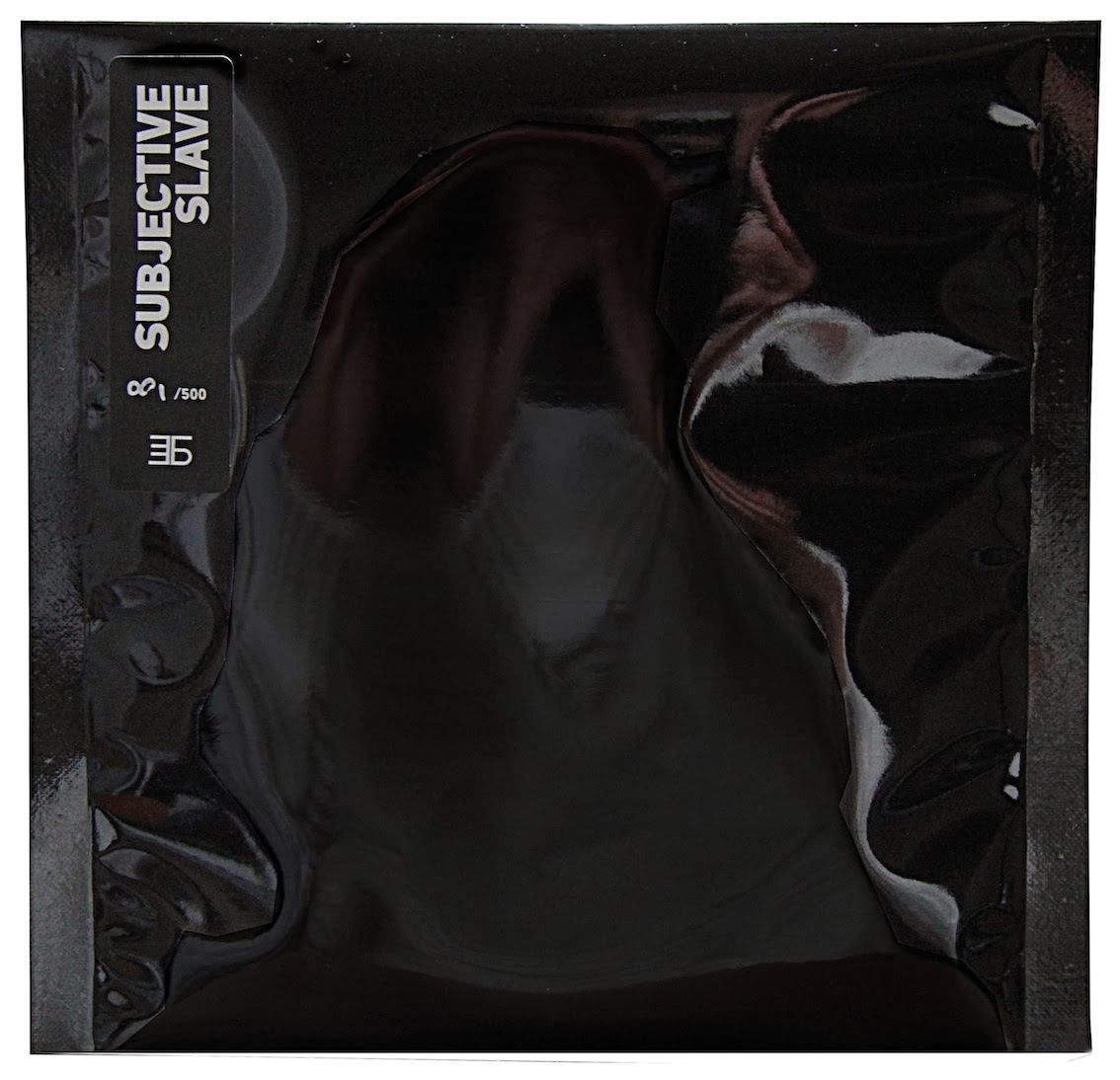
Cédric Dambrain - Subjective Slave (Roughledge)

Ten tracks of computer-generated material designed to convey human being's "inclination to create [in] themselves the conditions of their own alienation" would seem to promise some dark, bleak soundscapes and, more or less, that's what Dambrain delivers here. After an initial all-out assault that will scour any latent cobwebs from your auditory tubules, the tracks vary in intensity, several quite quiet, but all carrying the shiver of the, well, alien. A chilly air circulates through the pieces, whether they softly twitter or hurtle past, heedless of reception. Arthur C. Clarke's "Rendezvous with Rama" comes to mind. The overall cast is so steely-gray and so few footholds are offered that I find it difficult to really get into, appreciating the craft but, perhaps, not finding the value in the alienation. If I really disassociate myself from it, not the easiest thing, i find that it "works" in the sense of creating its own pod of existence, even if it's opaque to me. More hardcore computer music fans, especially those with leanings toward noise, might find it right up their alley, though.

Roughledge

Friday, November 29, 2013


Jack Harris/Samuel Rodgers - Wasted Five Years (Organized Music from Thessaloniki)

There are certain sounds for which I'm just a complete sucker. One is urban hum as heard in a large, empty room which is, I think, pretty much what you hear at the outset of this fine set. Hell, there's even a passing plane. But just that thrum of individually indistinguishable traffic sounds, noise from the buildings power systems, elevators and what not is something I can bathe in for quite a while. Harris and Rodgers, in an abandoned office space, gradually make their presences known through quiet rattles and tappings that could almost be murine (look it up). It's well integrated but, to their credit, they don't just let things lie. Instead, swirling (still subtle) electronics emerge accompanied by a thin, metallic flicker (a poked fan?) and dripping water. This activity briefly wells up into the foreground with near Niblockian power, subsides into that wonderful hum. Throughout, there's a fine back and forth between soft and quite loud but the element Harris and Rodgers contribute manage to remain delicate and defined, a tension that goes a long way toward the success of this set. They grow increasingly active and dense (though "dense" seems the wrong word, given the dry, sandy nature of the sounds) toward the conclusion, when a surprise book interview appears (over the radio?), feeds into the ambience for a minute, disappears as those faraway hums regain their space.

Excellent work.


Yparxei Provlima Amalia - Kona Kai (Organized Music from Thessaloniki)

And then there's this. I've little notion what's going on here aside from gleaning that the rascally Kostis Kilymis is involved, but it's oddly delightful. Ten tracks over a mere sixteen minutes, said cuts seemingly derived from a road trip, quasi-random snatches of sounds, interactions with encountered persons, bits of conversation, etc. Opening at an implied dawn with roosters and traffic, merging into a jingle-like ditty on vibes or electro-gamelan, or something. Seatbelt instructions in front of a really cool sounding, semi-funky piece (from the radio?)--I begin to feel all Lambkin-y. A pretty hilarious, echoey recounting of some guy's Detroit adventure seeing the Stones in 1975: "About the best frigging show I ever saw in my life". Same dude launching into a whiny C&W number. I'm imagining Kilymis as the performer, an image that will haunt me. Crickets, sirens. drills. It finally ends in the cavernous interior of a train station, where an itinerant band is playing "O Sole Mio" or is that the theme from The Godfather? Or both? A coda made up of a brief collage of voices, radio, guitar strums.

A release that embraces its slightness. And it's great fun.

both are cassettes, available from Organized Music from Thessaloniki

Thursday, November 28, 2013


Domenico Sciajno et. al. - Sonic Shuffle (Bowindo)

How to even begin? First off, I should express the caveat that I helped Domenico with the English presentation of the copy included in this release and on the website.

I therefore knew the general idea involved but resisted hearing any advance examples until I received the card. So yes, this is a card you insert into a USB port on your computer. The card contains a program that deals with 48 sound samples contained therein. These samples are contributed by (deep breath): Yasuhiro Morinaga, Carlos "Zingaro", David Brown, Francesco Giomi, Franz Hautzinger, Chris Brown, Lawrence English, Toshimaru Nakamura, Phill Niblock, Frank Bretschneider, Günter Müller, Oren Ambarchi, Lionel Marchetti, Kim Cascone, Asmus Tietchens, Ivan Zavada, Vladislav Delay, Alvin Curran, Daniel Schorno, Michael J. Schumacher, Elliott Sharp, Philippe Petit, Kazuyuki Kishino (KK Null), Lukas Ligeti, Thomas Ankersmit, Lucio Capece, DJ Olive/Gregor Asch, Cat Hope, Robin Fox, David Chiesa, John Duncan, Constantine Katsiris, Matthew Ostrowski, Yannis Kyriakides, Tim Hodgkinson, Marc Behrens, Gert-Jan Prins, Anne Le Berge, Anthea Caddy, Nikos Veliotis, Benoit Maubrey, Tom Recchion, Luciano Chessa, Thomas Lehn, Idrioema, Zimoun, Axel Dörner and the late Laurent Dailleau, to whom the release is dedicated.

When you click on the application, the program loads, giving you two screens: a mixing board and a randomized display of the 48 tracks. If you're lazy (like me) and do nothing else, eight of these tracks will load and begin playing simultaneously. They're each five minutes long. When they're through, if you've set a parameter to continue, they'll very nicely meld into the next set, and so on. This is Sonic Shuffle at its most basic and, I have to say, it's pretty fantastic to listen to just like this. But wait, there's more. I imagine the mixing area isn't too dissimilar to others available (I've no experience in this area)--you can adjust the volume of each track, use anywhere from one to eight tracks at a time, change the tracks available, etc. In other words, you can "conduct" this ensemble as you see fit, mixing and matching. You can also import any audio files you like, including your own, if you've always wondered how you might sound in a trio with Lehn and Nakamura. More technical details are available at Bowindo. I'm pretty sure I've only skimmed the surface here.

Given that there are, almost literally, an infinite number of possible results when using Sonic Shuffle, I can offer only general impressions of what I've heard over some five or six hours of listening thus far. What's most remarkable to me is how clearly the tracks layer into one another; there's never a sense of muddiness or overcrowding. I'm not sure if Sciajno culled particularly (somehow) appropriate passages from what he was given or if there are any buried algorithms that manage to sift among possibilities that more or less insure a well-rounded outcome (I doubt it) but, I have to say that, most of the time, had I heard this "blindfolded", I doubt the notion of a computer-generated ensemble would have occurred to me.

This gets to one of the more interesting issues a work like this raises: human pattern recognition. As far as I'm concerned, it's impossible not to, without trying, mentally reform these randomly layered sounds into a purposeful pattern. You find yourself saying, "OK, this sound has just lowered its volume to reveal that duo nesting over there. Now this layer is worming its way in, complementing that one. Ah, hear how nicely these textures grind against those", etc. Partly, as implied above, this may due to the transparency of the recordings. They're also quite varied, ranging from abstract noise to drones to the rare pulse track. Often, when one of these latter appears, it automatically functions as a kind of backbone for its companions. After a while, you begin to recognize some offerings (though that's rare enough); I heard Nikos Veliotis' high pitched cello two or three times, emerging like an old friend. At this moment, Marchetti and Caddy are having a bit of a drone/scrabble square-off--sounds great. Is it always great? Of course not. Is it ever less than intriguing--I haven't found that to be the case yet.

Naturally, this project is problematic on several levels. First, as far as even semi-related ideas go, I'm more partial to that undertaken by Rowe with his "sight" conception for MIMEO where, even though the music was created remotely, the musicians were instructed to perform their five or so minutes over an hour as if they were in a live performance with their partners, attempting to anticipate and imagine what the others would be doing, having come to know their proclivities well enough over the years. I find that element, of isolated attempts at empathetic communication, to be inherently more interesting. There's also the practical aspect of a release like this: how often is one going to listen? There's more than enough material contained herein to occupy one for years, even without making one's own contributions. Clearly, no one will do that. I do find that it's a more than reasonable substitute for playing itunes on shuffle, a frequent activity in those rare moments when I don't have to listen to something that requires writing about. Sonic Shuffle does that job very well; I've had it on for hours and enjoyed it greatly.

Will this sort of approach become more common? Hard to imagine, but who knows? In the meantime, I'd urge people to snatch one of the only 50 copies available of Sonic Shuffle. Not just for the current uniqueness but because it's really good.

Bowindo


Wednesday, November 27, 2013


Ralf Wehowsky/Anla Courtis - Aseleuch Tendrradero (Noise & Hate/Ultra-Mail Prod.)

I never really got around to listening to Reynols, just a snatch here and there, so Courtis is pretty much an unknown to me. And my knowledge of Wehowsky is limited to "Tulpas" (which I like a lot) and the odd collaboration (Drumm, Korber, etc). Perhaps bear that in mind when I extol this release--to me, it's extremely fresh and exciting, though I've no idea where it sits in their mutual canons. Using guitars, electronics, tapes, etc., they construct collages of a sort, often with abrupt and unexpected breaks, using a language derived from classic tape manipulation but with a significantly different palette, though I'd be hard-presed to describe just what that palette is. The tracks are largely between three and seven minutes long (in addition to two around 30 seconds), allowing for each to exist as a self-contained composition. I'm almost tempted to say "song", though there's nothing melodic or beat-drive here. Still, I can imagine a voice over much of this material; through the backwards tape, the modulations of (I think) wind howls and such, you can just about reconstruct vestiges of a buried and decaying song.

There's an enormous apparent depth to the layers and the elements within are widely varied in composition, color, dynamics and velocity, making for an entirely absorbing listening and repeat-listening experience. There's also no sense of posturing of showing off--everything seems purposive, several ideas per track, rich but not cloying. They avoid that difficult-to-describe tipping point between excessive activity and...intensive activity, the kind one would find in a handful of soil. Wonderful usage of silent gaps in a piece like "Bal Lileste Ajtdorbeg" where the last half doesn't so much as ebb away as fracture into sparse shards. (btw, I think the titles are in a made-up, almost Borgesian language, though sometimes they seem related to Spanish).

I'm not doing a great descriptive job here, I realize. All I can say is, if you loved "Tulpas", you'll likely love this, though I have little idea what fans of Reynols will think--though I'm guessing most of them will as well. It stands apart, at least a bit, from the general trend and it does so in a very exciting way.

Neither Love & Hate nor Ultra Mail Prod. seem to have a working website, but your can use this one to order:

Discogs

You can also treat yourself to a taste here


Richard Garet - Blank Tape Positive (Contour Editions)

Garet's latest involves the manipulation of modified magnetic tape playback machines, digging into its internal mechanisms, causing the machines to operate irregularly and beyond their original capacities. The results, in two tracks of about 30 and 27 minutes, is somewhat reminiscent of Lescalleet's now classic tape recorder set-ups in that there are various pulses coursing through the pieces because of iterative properties of the device but these are buried and often masked by the noise elements atop which range from juicy thrums to raspy pops and much in between. That sense of propulsion provides cohesion but can also become a bit insistent over these longish pieces. There's substantial change in the colors involved, though the forward drive rarely wavers. Even when things grow a bit spacey, as in the ending minutes of the first track, there's still something of a push in force until it finally collapses, a lonely hum/hiss all that remains. Track 2 begins in a more diffuse, abstract manner, but settles into a chittering semi-repetition, a but more intense and harsh than the first, with some fine, obtrusive clacking elements and some excellent, wild intrusions latte in the track, high-pitched tape gone nuts. It's one of those dicey propositions that depends on how much fascination the listener finds in the kind of sounds employed, in that there's a similar sheen overall. I go back and forth, sometimes immersing myself pleasurably, sometimes wishing I was hearing this in situ, where I'd truly be surrounded by the activity. Garet's music has often accompanied video by himself or others and I could see 'Blank Tape Positive' serving that role very well.

Contour Editions


Rodolphe Loubatière/Pierce Warnecke - Non-Lieu (Gaffer)

Snare and electronics ruckus, most of the time very active and in skittering mode, Loubatière whipping around the snare (presumably with various implements and attacking from different angles) while Warnecke has an unusually light touch on electronics, more or less approximating the snare's pitch and sound range. Moments of quietude, when they occur, are welcome and very well handled. But overall it's spiky, squeaky, non-stop improv. At it's best, as in much of "Espace Occulte" (my favorite track by far), they achieve a kind of combustible quality that's crunchy and fine. As with many a release, however, I found myself searching for moments of respite and consideration, pieces that might enhance their best, more energetic playing.

Gaffer

Loubatière

Tuesday, November 26, 2013


To state the obvious, there's been a proliferation in music being put on-line for download or streaming as opposed to physical discs and I receive my share. It's virtually impossible to keep up with, much less write about--I simply haven't the time. But I *do* listen and figure I can at least point others to things that are freely available. A case in point is this bandcamp page from Arthur Lacerda, a Brazilian musician who has worked with Mattin among others. Do check it out if you can--some fine, gnarly, rough-edged sounds are contained therein.

Edu Comelles - A Country Falling Apart (Audiotalaia)

The country in question being Spain, where all the sounds here were recorded under a set of rules which required that no conventional instruments be used. So essentially these are field recordings though I believe some of the sounds have intentional human agency. The elements on each track are described clearly, from chairs being pushed around in a university to the activities of flies around a dead fox to abandoned trucks to railroad friction and much more; all "are related somehow with issues such as dereliction, abandonment or misuse". You almost get the sense the works are composed--the chair piece, for instance, doesn't sound all that far from a contemporary work for string orchestra; there's a sense of orchestral structure at play. The flies serve as a kind of pizzicato over moans from a watermill that carry an amazing feedback quality, again with a real sense of composition. This is the case throughout, making the designation "field recording" feel entirely off the mark. And these are strong, muscular structures as well, quite plastic and forceful. Crucially, Comelles always retains a fine sense of air and space, even if that air is ozone- and mildew-tinged. It allows the pieces to rotate smoothly, to consistently offer different aural vantage points. Really impressive and moving; my qualms about field recordings fall by the wayside when they're as strongly reconfigured as is the case here.

An enclosed code also gives you access to a few excellent downloadable files from the label site.

If you have the slightest interest in this area, don't let "A Country Falling Apart" pass you by.

Audiotalaia