Sunday, March 24, 2013


Lander Gyselinck/Esther Venrooy - Point Break (Entr'acte)

This disc required a bit of coming to terms with. Initially, I was a bit put off by the juxtaposition of drums and interpolated dialogue (from film sources) on two of the four pieces. Gyselinck's drums are quite, um, drummy, though the more I listened the more I felt a connection between his work and some of the more interesting, if relatively unheralded Euro free percussionists like Gunter Sommer. But a big, if very personal, breakthrough was when, with the help of Google, I discovered that the source of the first bit of text was Hal Hartley's film, "Trust" and that one of the speaker was Adrienne Shelly. I had happened to meet Shelly a couple of time sin the early 90s when she appeared in some theatrical work by my friend Richard Harland Smith and found her to be quite and impressive and lovely person. A bit over six years ago, she was horribly murdered in her Manhattan apartment. Hearing her voice in a context like this was startling (I don't know by any means whether or not Venrooy, who I take it was responsible for the sample, is aware of Shelly's history). In any case, this refocused my attention (along with a subsequent extract from "American Psycho"), somehow allowing me to hear the drums and electronics in a different light.

The first track is all about ringing bell tones (possibly Tibetan bells, struck with a soft mallet), the vibrations allowed to suspend for several sections, I think entwined with subtle electronics from the start, although I'm not positive, but eventually segueing into a low, quavering drone; very attractive. "Is it real?", the track with the "Trust" extract, bubbles up with popping, foaming percussion before the conversation enters, as well as some cracked electronics. Its added layer of resonance for me (or anyone who knew Shelly) provides enough spark to lift it out of the ordinary though I'm not sure if it would otherwise, the basic contrasting of the text and percussion being a bit obvious. Similarly with "Keep your eyes open", where the psychotic babbling is to an extent mimicked in the rhythms of the drums (and some electronics) and brings to mind, unfortunately, some of those 80s David Moss pieces. "So it goes", the final track, returns to pure sound, flutelike tones abutting rubbed surfaces, rhythmic pops over soft drones, subsiding to a lovely burble prior to some drum explosions, forwards and backwards, that punctuate the work, ending with a small storm of harsher electronics. Simple but effective.

A mixed bag overall, for this listener, but the better portions bear hearing.


Giuseppe Ielasi/Enrico Malatesta - Rudimenti (Entr'acte)

A similarly oriented duo here, though with quite different results, Ielasi deploying electric motors an field recordings, Malatesta manning the percussion, in a single 26-minute track. The motors are tiny and necessarily remind one of Taku Unami's work form a few years back, producing a gentle, skittering sound, mechanically rhythmic but soft. Malatesta interacts on the same low level, sliding between the motors, injecting a good variety of rhythms and pitches. The field recordings, to the extent I can pick them up, are kept low in the mix, tingeing the simmering clatter (as ever, I have a tough time distinguishing between water droplets and fire crackle!). The work is segmented (it was put together from a couple of sessions); toward the end there's an upsurge in both volume and density, a small climax if you will, followed by a really lovely coda of sorts, a dry, slowly surging pulse against those possible drops, really very beautiful. On the whole, a very intriguing piece, alternately absorbing and ignorable (not a bad thing) and rather different from other music I've heard from Ielasi in recent years.
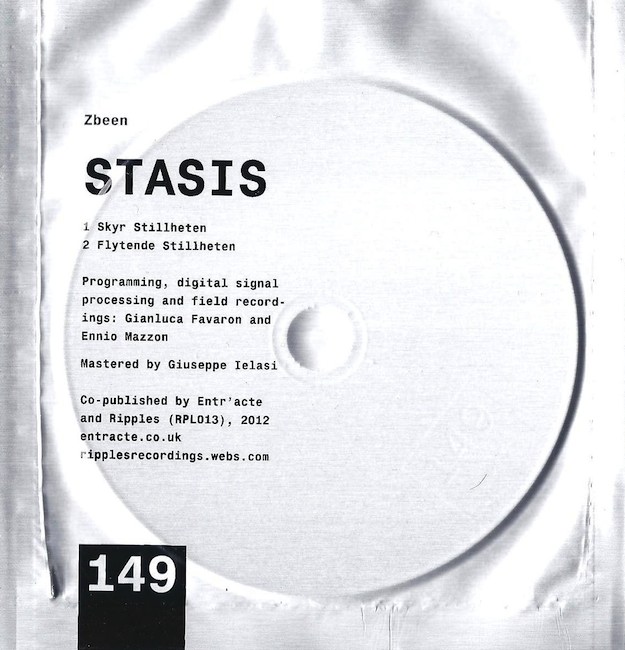

Zbeen - Stasis (Entr'acte)

Zbeen being a project from electronicists Gianluca Favaron and Ennio Mazzon. The first of the two cuts, "Skyr Stillheten" covers fairly common territory in its 32 minutes: an undulating, tonal drone-like pattern is laid done, beguiling and comely, over which all manner of small life forms creep, like the environs of a warm pond, scuttling, flitting and swimming about. Part of me senses an easy gambit--what could go wrong?--but I gave the pair credit for extending it at some length. It's quite easy to lose oneself in; whether or not there's any lasting nutrition supplied is another story. "Flytende Stillheten" is substantially the same, the activity sparser (nighttime on the pond, perhaps). Again, the duration actually helps the piece establish itself though, as before, it goes down a bit too easily, pleasant but forgettable.


Jean-Baptiste Favory - Unisono (Entr'acte)

Interesting idea here, in four stages. First, eight musicians, playing virtual synths, play the same initial score but individually modify certain functions, allowing the piece to splay out in unpredictable directions. The same thing is done in the second piece, with a more complicated score. The third uses the same score as the second, substituting virtual instruments (flute, oboe, English horn, two celli, violin, viola, bass) wherein the parameter shifts enable these "instruments" to far outstrip anything that could be achieved with them in "reality". Lastly, pieces two and three are simply combined.

All well and good, but how gripping is the music produced? Well, making allowance for the necessity of hearing it on stereo as opposed to in situ (where one can easily imagine, at the least, an immersive effect), I don't get so much from it. "Unisono I" quickly gets to a point somewhere between whistling wind and distant air raid sirens, oddly soothing and, again, likely more effective with the sounds aswirl about you but a bit flat here. The second version is indeed more complex and more interesting as well, though some of that complexity is at the cost of introducing very "synthy" sounds, bloops and bleeps, that I have a bit of trouble digesting. Still, it possesses a kind of nervous urgency that's very compelling, courtesy of some shuddering sounds and needling tones. It's fascinating how the introduction of synthesized instruments (which, by and large, do sound very much like their acoustic counterparts) ratchets up the interest level though they're more or less performing the same music. But the colors are much richer, the long, shifting lines much more variegated, really solidifying the work quite beautifully. The combined version reincorporates the pure synth sounds and is fuller thereby, very good, but I prefer the more pared down variation with only the pseudo chamber ensemble.

Entr'acte

Friday, March 22, 2013

(The music below has been issued on cassettes. Patrick Thinsy was kind enough to provide me with CD burns)


Patrick Thinsy - Disappearances (Yanuki)

Two fine electronic tracks form Thinsy, a new name to me. The first shimmers vaguely into existence, the merest wave, gradually developing a slow pulse. A higher pitch is added, almost in sync with the previous pulse but just enough off to provide a delicious quaver. A harsher layer is applied, that pulsation becoming deeper on the one and, generating quasi-beeps on the other. A concise piece that does what it needs to do in 12 minutes and then retires; excellent. The second begins with a lower, deeper thrum, again undergoing a slight additive process. But about four minutes in, a rhythmic tapping emerges, a spare but complex dance between semi-metallic strikes and paired pneumatic sighs. Very effective, very eerie. More so when a calmly speaking female voice enters (in French), eventually, slightly, splitting, becoming the sole element as the piece ends. An impressive, unusual release--try it!


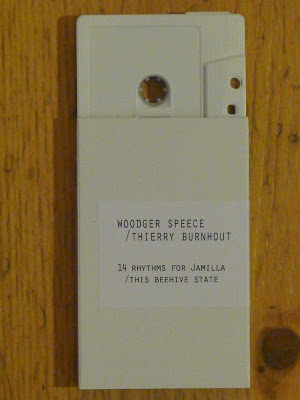
Woodger Speece/Thierry Burnhout - 14 Rhythms for Jamilla/This Beehive State (Tanuki)

Woodger Speece is Pauwel de Buck. His pieces flicker between electronic noise and fractured semi-dance rhythms, all subject to deterioration. The sounds tend toward the sharp and thin, often cackling and yielding high-pitched whines and wheezes. There's a mechanical feel, as of some rickety, jerry-rigged contraption run amok. One sometimes imagines whole crews of miniature street workers with inch-long jackhammers. Not quite up my alley but engaging enough at times. Thierry Burnhout's "This Beehive State" commences with a lovely, low drone adorned with discreet pops; given the title, one is hard-pressed not to think of a hive's hum with the pops representing individual arrivals and departures of worker bees. This continues throughout, the drone changing pitch and timbre periodically, sliding into an organ-y area. It's very comfortable music, not so demanding but an enjoyable wallow, the clicks adding just enough grit to offset any potential cloying aspect. Nice work, would like to hear more from him.


L.E.G. - The Dogs in You (Tanuki)

Spacey hip-hop (trance-hop) by a Belgian group. Well outside my ambit so I'm reluctant to say much. I was a big fan of early 2000s Anticon product and I can hear something of a relationship to that sensibility here but not enough for my taste, a little too much posturing. The effects are sometimes winning, diverging substantially from what one might expect, the last portion of the second of the two tracks traveling especially far out, though it also hits on some excessive wooziness. I'm afraid I can't say much more, though excerpts of this and the previous two releases are available on bandcamp and soundcloud, so hear for yourself.

tanuki


Thursday, March 21, 2013


Insub Meta Orchestra - Archive #2 (Insubordinations)

Admittedly, an ensemble this large (36 by my count, presuming all play on each of the two cuts) that creates music this restrained has me half won over from the get go. In fact, it's hard to believe so many are involved with the first track, "line 1", a steady state piece that maintains an amorphous, organ-like tone throughout, accentuated by very delicate percussive sounds and string scrapings. The sublimation of all the instruments to that sound is quite impressive and the piece acquires a fine, breathing sense of life. Would have loved to have experienced this in a good room. "line 2" begins in a good deal more agitated fashion, a-flutter with whispers, mans, scuttling but again, pitched at a low dynamic and never feeling overly busy. Eventually it works its way back to a situation not so far removed from the previous track but with a more sonorous, ringing tone spread through the orchestra. A bit less satisfying than the first but still tasty. A good effort here, worth hearing.


Abdul Moimême - Mekhaanu - La forêt des mécanismes sauvages (Insubordinations)

In which Moimême subject two prepared electric guitars to simultaneous improvised assaults. In his notes, he refers to industrial working conditions and the sounds to which they often give rise and this sensibility is clearly heard on the seven pieces presented here. They're quite guitar-ish, no attempt at hiding the origins of the sounds, very resonant (one track in which the guitar is laid inside a grand piano) and "stringful", bowed, plucked or scraped. I have a tough time getting a grip on anything more than the surface sounds here, the echoing, chiming kind of tones that I associate with, for example, the freer portions of Frith's first solo recording. The last cut, "Atmosphère Méchanique", manages to transcend these issues, I think by pure dint of effort, almost willing the music beyond the surface limitations, to begin to inhabit and interact with the space in which it was created, to become a powerful form. Listened to thusly, as a search for that moment, the album has an enjoyable (if listener-imbued) narrative. I'd like to hear more in the direction indicated by the journey's conclusion here.


Queixas - Eye of Newt (Insubordinations)

Abdul Moimême (prepared guitars, objects), Cyril Bondi (floortom, objects), D'Incise (laptop, objects). re: the above write-up: I'm often forced to wonder how much the recording details contribute to that sense of "in the space" that I found a bit lacking there. Here, it's not an issue at all, everything seems as though the air in the room is integrated perfectly with the sounds, as if they emerge from the space and aren't imposed on it. Low level but active improvisation is the rule here with a wide range of tones and textures. Bondi has been an asset in every context in which I've heard him and definitely provides substantial starch here, his pulsing, almost-on-rhythm low bangs propelling matters beautifully. On the whole, the music doesn't particularly stand apart from the field but is quite strong, vibrant and alive; often, that's all I need. Solid stuff, worth a listen.

Insubordinations

Wednesday, March 20, 2013


Sarah Hughes - accidents of matter or of space (Suppedaneum)

The first release on this promising new label (which etymology I just researched to find that it's the name of the foot support for a crucified person) arrives affixed to a sheet of heavy paper some 12 x 14 inches, scoffing at my compartments for oversized disc packages. It's put to good use, however, with a side given over to the score of the work and another sheet harboring a fine essay by Dominic Lash, presented in a form that mirrors the structure of the musical work (both in vertical columns and in the spacing of words horizontally, if I'm not mistaken) or, more accurately, three of the four tracks here. The first piece, "Criggion" is a recording of Hughes improvising on zither in the transmission station in the Welsh village of the same name. It's fantastic, an absolutely gorgeous integration of instrument and soundscape, dark rumbles, distant, hollow bangs, penetrated by slender, resonant string plucks. Really, one of the finer examples in this area I've heard in a long time.

The three realizations of (can never exceed unity) are tougher goes, but very rewarding, performed by Rhodri Davies (harp), Neil Davidson (guitar), Jane Dickson (piano), Patrick Farmer (electronics) and Dmitra Lazaridou-Chatzigoga (zither). The score is a kind of meditation on Zeno's paradox, wherein one instrument plays "a continuous tone or sound" for the length of the piece and the others, entering in turn (? I think), play freely but each for a total of half the time of the previous person. SO if the composition lasts 20 minutes, one plays continuously, the second creates ten minutes of sound (spaced freely, I believe), the third, five, the fourth two and a half and the fifth, one minute, fifteen seconds. I may have this wrong!! As they can place the sounds where they will, this results in some silences, or near silences (which would seem to be the case if that first person was playing very quietly. I find I tend to disregard the structure and just listen. The pieces are spare, the sounds often barely glimmering here, roughly buzzing there, with an appealing sense of random overlap. They're oddly knotty, the silences sounding very much "set off", somehow, without the smoothness one, for some reason, expects. This is a good thing. A beautiful recording.


Chen Brothers - Ally (Suppedaneum)

Hitherto unknown in these parts, the Chen brother are, well, brothers, hailing from upstate NY who approached this project in a rather unusual manner. One, Jeremy, created the visual design and determined the number of tracks as well as their titles and durations. Jonathan then put together the sounds to conform to these strictures. In this instance, Jeremy's apparent penchant for brevity (seven cuts, 18 minutes total) seems to match with his sibling's obsession with feedback, as all of the pieces howl, vibrate and screech with such. The general sonic area isn't really my cuppa, granted, but it's one of those sets that I think might work fine in situ, where one could be swathed and/or battered by the assault, something that tends to flatten out on disc. The abandon is there, the depth not so much. Noise fans may well disagree.

Suppedaneum


Socrates Martinis - On motion, stasis and the geometry of desire (antifrost)

A short (17 min.) cassette release containing four fairly impenetrable tracks apparently made up of field recordings, rough enough ones that you could almost mistake them for cracked circuit electronics. On "Unfinished lines of her footsteps", they appear in succession, a different recording occupying several seconds, then ceding way to another, not worlds apart, always urban (I think), gravel-colored. "Flintlock" seems to be similarly constructed though the sources vary more, have a wider tonal and dynamic range; it still sounds more or less industrial but includes gentler areas, like a lovely pseudo-flute episode with vibrating metal in the background at the track's conclusion. Side B of the cassette, "The bronze dress", things continue apace, bell sounds appearing but through a static haze. The last track tends a bit more toward the smoky and soft, but never losing that rough edge entirely. This particular method might pall over a longer stretch or series of recordings, but at this brief length, it's perfectly delectable.

antifrost


Thursday, March 14, 2013


Toshiya Tsunoda - The Temple Recording (edition.t)

Toshiya Tsunoda - O Kokos Tis Anixis (edition.t)

Tsunoda released these two double-disc sets as a pair and I think considers them pendants of a sort, though they're quite different from one another.

"The Temple Recording" is the more immediately entrancing of the two. The idea is simple but resonant: Take stethoscopic microphones, augmented with an additional mic faced toward the environs, affix them to one's temple and concentrate on the landscape at hand. Do this with two persons. The inward mics pick up the individual's blood flow muscle movements and such, the others provide an indication as to what he's experiencing, to some extent causing those interior reactions, resulting in "a record and evidence of our real experience of the landscape". and indeed ones hears s low, soft pulse, presumably the blood coursing through the temples of Toshida and Koichi Yusa, his partner in contemplation, as well as, marvelously separated, birds, breezes, mic movements and other sounds, crisply limned in stereophony, one observer per speaker.

That's all. But as with many of Toshida's projects, there's so much more, ineffable though it tends to be. The tracks total about an hour, the environs shifting, though not enormously so; the comings and goings of the bodily sounds, to the extent one can recognize them, seem to be more affected. But what pervades is an extreme sense of clearly perceived but very, very calm mental acuity, much as if you were participating in the activity and doing so seriously and with relaxed concentration. I like listening to it at low volume, blending in, so that when a sound like the gentle moan (the wind?) in the third track on Disc Two emerges, one is momentarily confused. Not sure what else to day. Ever since "Scenery of Decalcomania", Tsunoda has been responsible for, to my ears, much of the very best field recording work around. This is another.

"O Kokos Tis Anixis" is a different kettle o' fish. A set of eight pieces, total over 144 minutes, wherein the basic units of sound are field recordings (descriptions of which are found in the titles, such as, "the sounds of ashes bursting in the fire built by fishermen"). But Tsunoda has taken tiny slivers of them and formed loops, some quite brief, some longer and re-inserted those loops into the original recording, rather like creating intentional glitches. Just before writing about this, I saw a post from Gerardo Albatros referencing a wooden chest, carved so as to appear as though seen on a glitch-filled video screen. This is something of the feeling I get from these works: a "normal" scene interrupted by electronic brambles made up of fragments from that scene. Admittedly, on first listen, not knowing precisely what to expect, I leapt from my seat, fearing the disc had destroyed my CD player.

It's a toughie. Tsunoda varies the kind of glitch quite widely; I'm not sure if the same burp repeats throughout the set. It's hugely disorienting (when overt--sometimes the insertions are subtle enough to bypass easy notice) and, given the general lush pleasantness of the recorded sounds, one's initial reaction is likely to be displeasure, resenting the "rudeness". I was first concerned that the attack would pall over such length, would be reduced to a kind of gimmick but, rather surprisingly, found that the longer the set lasted, the more I accommodated myself to the interference. Like much of my favorite field recording work, the sounds began to make a kind of sense that was next to impossible to quantify, those sounds here including Tsunoda's manipulation.

Both releases are mysterious and fascinating, wonderful work that should surely be heard.

Available via Erst Dist

Tuesday, March 12, 2013


Tetuzi Akiyama/Jeff Gburek - respect (Spectropol)

One never quite knows what to expect from any project involving Akiyama but this one, a duo with the always intriguing Jeff Gburek, is pitched decidedly toward the quite and contemplatively sad. Akiyama is on acoustic guitar, Gburek on the same plus prepared slide guitar and electronics. The four pieces unfurl slowly and gently, plaintive tones squeezed out like tear, referring to blues traditions but in a way that's perhaps in the Connors lineage but removed a step or two, hazy in the distance like the tree line on the disc's cover. Polish cold marsh blues. Gburek is nicely chary with his electronic insertions, discreet sounds that sizzle on the edges of the guitars. The tone is consistent over the tracks, a welcome aspect, though the details vary more than enough, ensuring that each possesses an individual character. The music is genuine, quite approachable and just a pleasure to experience. No nonsense, heartfelt playing. Recommended.


Andrea Borghi - Musica per Nastro (Tape Music) (Spectropol)

Many a time I hear contemporary electronic music that immediately catapults me back to the classic work of the 60s (Riijmakers, Koenig, et al). I often wonder if I'm being too hasty making those connections. Well, Borghi is explicit about it, so I'm on solid ground, at least about that. Ten short pieces using real-time editing software. Borghi's music is refreshingly subdued and subtle bearing none of the flashy, cool sounds for cool sounds' sake that often infects the genre. While the referents may often ring a bell, the way they're deployed and tinged lend the desired 21st century aura to the work. It's interesting the way it (unintentionally) relates to the Akiyama/Gburek release above: a very similar contemplative sensibility, a fine insistence on non-stridency and inhabiting an indentifiable zone while finding great variety therein. Borghi's incorporation of electric bass into the proceedings serves him well, allowing the gentlest of pulses to buoy the fragile sounds atop. A fine recording, recommended too!

Spectropol


Heddy Boubaker - Dig! (Petit Label)

ok, unfortunate album title; same goes for several track titles...but it's a fairly enjoyable recording. I'm guessing it's solo saxophone, possible alto and baritone, though enough of the sounds could well have been generated via different means. Overall, however, it oddly enough fits in alongside the above two releases, at least in the quiet and contemplative sense. Boubaker, one senses, has a bit of the rascal in him ad their are waggish nods towards birds, dogs, bugs, etc. but it's mostly a considered exploration of his axes, using various extended techniques that, while more or less familiar, are nonetheless well carried out and sustained. Bubbles, buzzes, breath, taps; not as tired as one might guess. "Lazy Unicorn Drips" closes the disc out really nicely with a whole forest of miniature sounds (electronics here for sure, if not elsewhere). A tough row to hoe, but pretty well done, worth a listen.

Petit Label

Tuesday, March 05, 2013

Thought it might be wise to re-post my current mailing address for those inclined to send things and who may have missed the earlier announcement:

Brian Olewnick
3 Rue Henri Dubouillon
Paris 75020
France

thanks!

Monday, March 04, 2013


Kawaguchi Takahiro/Choi Joonyong - Suncheon Hyanggyo (Balloon & Needle)

I'm given to understand that "The Suncheon Hyanggyo [a temple/Confucian school] was constructed in 1407 (7th year of Joseon’s King Taejong) and was moved several times before finally arriving in Suncheon in 1801 (1st year of King Sunjo)". Kawaguchi and Choi conducted an event there in August, 2011. There was news coverage of the occasion and it's well worth watching the video to get a better idea of what occurred than can be gleaned from the recording. What's striking to me is the balance between and art event and a kind of elaboration on "ordinariness" that eventuates. The calm, accepting manner that the duo maintains throughout, constructing loose agglomerations of material, not all of which have to do with sound, is as much a part of the performance as anything else. A metronome is a consistent presence, though not always heard; other sounds include air blown through a long pipe, plastic bags inflated via small motor, little fanlike gizmos (a la Rowe) beating against the metal of a large pile of folding chairs that was the central object, or at least the largest one, passing planes.

As ever, the vast difference between being present at the event (a handful of bemused visitors sat politely and seemed, guessing at their post-happening reactions caught in the newscast, to have more or less enjoyed it) and listening to the audio capture at home raises questions. Had I not seen the video, I'm sure I would have more or less enjoyed the disc but would have had a stronger than usual sense of missing something. It's less concentrated than much of the work from the Seoul crew, clear to see why after viewing the video. Once seen, that relaxedness, the idea of equivalency between empty and full(er) space takes precedence in my mind, and I find myself deriving great enjoyment.

An unusual, (non)thoughtful idea. :-)

Balloon & Needle

Available from erst dist

Friday, March 01, 2013

Yan Jun was kind enough to send me a passel of releases from China, not the most common source of this end of the music spectrum. I was fascinated to hear all these things, regardless of whether I "liked" a given disc or not and thank him very much. Below some all too brief comments:


Intelligent Shanghai Mono University - 7.9 (SubJam)

A band of four Shanghai electronics musicians who go by the monikers, B6, cy, Susuxx and Zoojoo. This is a 2003 release, 14 tracks, about an hour. I might relate it to Otomo's work from the early 90s in that much of the music mashes together shards of noise, found sounds, etc. with more or less rock-based melodic fragments and rhythms. There are spacey interludes; "Tunes by" consists of a woman's voice dreamily chanting, "Fuck you, fuck me" for instance, and also bits of dance hall electronica ("Sand") and a 7-minute blank track. "M1" has a nice Barry Adamson vibe; all of the final four tracks, M1-M4 are essentially warped pop forms. Overall, maybe a bit dated (even in 2003) but a good deal of exuberant fun to be had here.


Ronez - Try It On for Size (SubJam)

Apparently mine is not one of the first 300 copies as there's no enclosed condom, alas. Ronez is Zhou Pei and this is a 2002 collection of 26 tracks not so far removed from the above release in the mixture of noise and rock forms. Again, Otomo seems to be a reference but there's a certain coldness here that causes the tracks to sound more clinical than one would like. Some odd Wayne Horvitz-y sounds here and there. But the basic sounds, rhythms, etc. are kind of thin and mundane. Not so keen on this one.


DDV - Live in China (Kwanyon)

Have to say, I love the cover. DDV seems to be made up of DDV on electronics & voice, Yilichi "on" hanggai (a Chinese folk groupor, one assumes, recordings of same) and the SubJam Jam Band. There's a good bit of throat singing near the beginning, possibly the aforementioned Hanggai, supplemented by ambient noise and someone crooning, "I like the way you mooove...". his 2005 recording is a good bit grimier (in a positive sense) than the two above, sometimes venturing into Lescalleetian realms of wobbly power ("Tribute to Vel"). The distorted groans and sludgy pounding take their toll after a while, though. Fans of the more dismal reaches of the noise scene might enjoy--and I liked a good half of it--but at 70+ minutes, it eventually wore out its welcome.


Yan Jun - Mars Tour Diary (SubJam)

What the title says, as near as I can tell and quite enjoyable, Yan Jun presenting 20 tracks, field recordings if you will, from a 2010 tour, encased in very handsome booklet filled with casual photos from same (Otomo popping up in one). "Zhucago Duo", pits abstract electronics vs. a regular snore. Others seems to capture nothing special but, in their lack of intentionality, are quite winning. Then you'll have pieces like "Hypnotizing Lu Bai" which is hard to imagine being sourced from surrounding environs, sounding more like an excellent piece utilizing electronics, with keening, fluctuating, ear-slicing layers of whines oozing across one's sonic membranes. The variety is excellent, nearly nothing to fairly noisy, tons of tone, almost every track containing something that makes one smile in recognition. If loose field recodings are your thing (and why wouldn't they be?), this is a fine exemplar and right up your alley.


Laurent Jeanneau/KINK GONG - Soundscape China (Kwanyin)

I'm given to understand that Jeanneau (who also goes by KINK GONG) is an accomplished recordist of southeast Asian traditional music, including some of the Vietnamese releases on Sublime Frequencies. This 2001-02 recording simply enough combines swatches of music and sound from the Yunnan region of China with abstract electronics, and does in quite well indeed. Lecturing voices mingle with those of children, interfered with by harsh tones (as in bad radio reception) and more globular, ringing ones. A single, hour-long track that held my attention throughout, the sourced material always balanced with the electronics, the approaches varied, the sound mix often luscious. An excellent recording that makes me want to hear much more from Mr. Jeanneau. Special stuff.


Tim Blechmann - timbre (Kwanyin)

A single 41 minute piece, steady-state, featuring a hollow drone, vaguely metallic, with multiple striations within. Midway through, grainier elements seep in, bits of detritus rolling around in a great, windswept tube. Not sure of the recoding date here; it's similar to other ventures in this neck of the woods but really well done at that, enough that I don't find it particularly tired or cliched. Good focus, good attention to detail, nice sense of forward thrust. As can be seen in the cover graphic, the volume gradually swells; also, the clatter increases as well as some deeply buried harmonics. Enjoyable piece.


Jun-Y Ciao - The Beginning of the Beginning of TheBeginning (Kwanyin)

Ciao plays clarinets and bass clarinet and this is a solo recording. While he uses approaches that are very Braxtonian, he doesn't really sound like Braxton, tending more toward a music very akin to any number of European improvisers from the 80s on. Lyrical, in a very loose, free sense. But nothing really stands out, makes one sit up. And nowhere near the amount of structure or other important qualities to stand alone.


Vavabond - Yellow (Kwanyin)

Vavabond is a young, female laptop artist, formerly known as Wei Wei and associated, among others, with the band Vagus Nerve. That's all I know. The music here is harsh, glitchy and hyperactive, skittering about, bumping into walls, shattering. No pulse, instead several layers of mechanical, rapid rhythm. But as with the Jun-Y Ciao issue above, there's nothing particularly special about it. It has a routine aspect, little sense of exploration, excitement or surprise and, over the course of the disc, the sounds take on a same-y quality and wear thin.


Yan Jun - V (Kwanyin)

Electronics as opposed to the field recordings of "Mars Tour Diary". Quite varied, from wisps to thick torrents of sound, sometimes fading to icy near-silence, all engagingly handled. Unlike the above release, one gets a sense of a firm, underlying structure, of a reason for the sounds (however unquantifiable), implying substantial thought in their dispersal. Some really nice ultra-high frequency work as well in the last few cuts, frosting the room. Good work.


Yan Jun - Music for Listening on the Moon (Kwanyin)

An hour of very spare, though slightly spacey electronics that indeed have something of a selenic aspect. The source is apparently an ongoing installation "in Yan Jun's washroom" (lending an alternate possible meaning of "moon) and one can, in fact, translate many of the sounds into attenuations of drip noises. It's consistent over it's length, all variation occurring within a narrow range, but it works wonderfully, integrating into the room, tickling the vacuum. A fine recording.


Li Zeng Hui - Live at Waterland Kwanyin (Kwanyin)

Solo saxophonics (baritone and, I think, alto) from 2008, very much in free jazz expressionist mode a la Brotzmann et. al. Well outside my range of interest, to be sure and not much I could latch onto even allowing for my antipathy to the area. I remember (unfair, I know) a solo Hamiet Bluiett performance at Environ in 1977, half incredibly angry and raging baritone, half equally angry verbal raging at the loft scene and conditions for musicians generally. Now that was something harrowing and special. This doesn't get anywhere close.


(Various) - Big Can (Kwanyin)

There was this large, abandoned, cylindrical metal object, maybe an oil tank. In 2009, several people cam to the site and made some noise. They were Otomo Yoshihide, Ryu Hankil, Yuen Cheewai, Yan Jun, Sachiko M, Yang Ge, Xian Qiang, Hong Qile, Gogo J, Olivier Heux and Junyuan. The sounds chosen are refreshingly non-obvious, no fist-banging on the interior walls. There are soft clocks and drips as well as a number of sustained sounds--whistling, moaning, keening--that don't sound voice-derived but perhaps are. It's also very open, not overcrowded as might be feared from eleven participants. There's a 27-minute main track then a fun single minute of the troupe waling away...good job.


SubJam/Kwanyin


Monday, February 25, 2013


Kostis Kilymis - More Noise Ahead (Entracte)

An aspect often missing in experimental electronic music is a sheer joy in the manipulation of sounds, a kind of serious playfulness. The ten short tracks (total disc time: 36 minutes) that Kilymis has assembled here abound in this feeling, giving the picture of a (very talented) kid in an extremely well-stocked sandbox. Using all manner of electronics, software, cassettes and "anticipation", he fashions pieces that are almost songs, in a way, though bearing no vestige of melody, rhythm or anything like that, but a kind of lyrical sensibility nonetheless. Another element they're happily deficient in is any overt reference to 60s-style tape music, a quagmire that seems difficult to avoid judging by much of what has passed this desk. The music here reads resolutely modern. It's not spare, not at all, but Kilymis manages to find new creases in a well-worn fabric. A track like "Tiny Vices, Part 1" contains a pulse, grinding metallic sounds, electronic blisters and more, all arrayed into a structure that's both solid and flexible, giving the impression of a potentially large field still to be explored. Where vague song-like formations do coalesce, as in "A Crutch", the result is also clear and vibrant, no Fennesz-y like smudges or Radian-ish quicksteps. Even the urban field recording which ends the disc (sporting the odd title, "Old Tape Worms Direct") has an openness and freshness to it that many things in this area lack.

In sum, tremendous fun to be had here and beneath the fun, some serious sound investigation. Get it.

Entracte

Erst dist is also carrying it.


The Sheriffs of Nothingness - A winter's Night at the Crooked Forest (Sofa)

The direly named Sheriffs of Nothingness are Kari Rønnekleiv (violin) and Ole-Henrik Moe (viola). The music is resolutely harsh, traditional tonalities only surfacing intermittently between the far more frequent raw sound of grainy bow on strings. It's quite dry; one can easily imagine rosin dust surrounding the players. Often, a raspy, seesawing drone underlies slightly more rapid playing but the overall character is relentlessly astringent--makes your ears pucker. On "Dysfunctional Folklore with Brian O." (Hey! wait a sec! I knew I reviewed their previous recording a couple ears back and made an allusion to the Scandinavian fiddle tradition, but I take it that it's another Brian O.) they get into a lopsided folk tune that's a bit of fun, though of a limited kind. The title track also swirls around rather nicely, but it's the sort of idea I'd love to hear developed for more than the 3:21 allotted here. "Blizzard:, clocking in at 14 minutes, supplies the length, consisting of cascades of rapid buzzsawing of varying dynamics and works well enough though here, one would have liked a bit more variation. I love singleminded intent but the object of focus needs, to these ears, to have more that's capable of being wrung out of it. The final track, "You are walking on a sleeping summer", whispers a bit (maybe talking in their sleep); the moaning, wispy nature of the strokes is very fetching and, again, seems to indicate a pathway worth exploring at greater length; it has an intriguing vocal quality, very nice. A mixed bag, though...

Sofa

Sunday, February 24, 2013


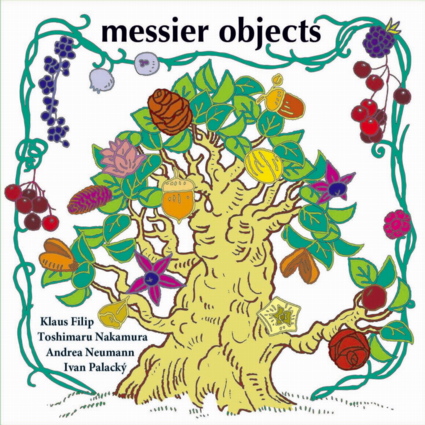
Klaus Filip/Toshimaru Nakamura/Andrea Neumann/Ivan Palacký - Messier Objects (meenna)

Messier objects, as we're all aware, were astronomical detritus that gave the appearance of comets but weren't, aggravating comet hunters like Charles Messier who compiled a list of the things, numbering 45, so as not to confuse him in further cometary quests. Their actual nature varied widely, including several pretty spectacular nebula such as the two titular ones here, the Carb and Trifid.

I'm hesitant to draw any overt connections between a ppooll/nimb/inside piano/Dopleta 180knitting machine colabration and a vast aggregation of starstuff, but there is a really strong sense of structure hear, of tendrils expanding into the void. The mix of sounds is wonderful, Neumann (I assume) early on summoning gamelan-like tones from her stringboard, with rough, grimy rumbles, dry scrapings and other material circulating around and through. The music doesn't dwell more than a few minutes in any particular area, shifting, often abruptly, from relative smoothness to a blocky, harsh sequence, static pops against brutally struck, non echoing strings, for instance. Both tracks, 40 and 16 minutes, the first live the second recorded at Amann Studios on two successive days in October, 2011, embody a kind of improvisation I greatly enjoy, wherein the listener needs to hear the piece in its entirety, mentally calibrating and reconciling it in retrospect, grasping the form and relationships after it's over. The range of sounds is quite impressively enormous here but at the same time there's a cohesion and constant sense of purpose and direction. This is all blurry sounding, I realize, but it's quite hard to describe; the sounds themselves are quite coherent and identifiable but it's their mix and the implied propulsion these mixes provide that gives the music such force and staying power.

Excellent stuff, mandatory purchase.


Katsura Yamauchi/Toshimaru Nakamura - Yokutojin (ftarri)

Things start out well enough, on low simmer with Yamauchi reining in his alto and Najkamura creating some fine, eerie tones and washes, but some eight minutes into this 1/2 hour recording, the pair launch into a wailing, free-jazz explosion that doesn't sit too well. Toshi can be interesting when he works loud (as with Rowe on the sunspot track on 'between') but here it's an unwelcome distraction. They settle down after five or so minutes but have at that point begun to establish more of an episodic set than a cohesive one. A few of the segments work well enough as discrete units but more of them suffer forms saxophonic over-exertion and the whole just never comes together for me.


Katsuyoshi Kou/Satoshi Hironaka - state, state, state (ftarri)

Four tracks of guitar and drums. On "State", Hironaka offers some quite fascinating percussion work, sounding like he's using tuned drums of some kind in an off-kilter, quasi rhythmic manner, almost as if someone had taken a slice of Xenakis' "Rebonds' or 'Pleiades' and irregularly looped it. As it happens, drums and guitar were recorded separately and very brief blank spaces were inserted post-production into the drum tracks, creating beats that are "off" just a bit. Kou's contributions are more staticky noise with the odd pure note, a decent enough offset though it was the drums that held my attention. "sTate" (you get the titular idea), the longest track at 27+ minutes) begins in quietude before moderate guitar squawks appear and that turns out to be more or less the path--small squalls of guitar (it's a solo) really not creating enough tension or filling up of (or emptying) space to quite justify its length. Again, it was treated after the fact, adjustments made to "confound listeners' expectations"; well confounded, perhaps, but not so moved. Then "stAte" returns to the propulsive drumming (solo, overdubbed), here with more of a rock feel, screeching in the distance that I would have guessed was guitar but I suppose is of a cymbalic nature and things work just fine, like a lost Material cut. The final cut, "staTe" (unaltered duo), finds a slightly different path, the drums lighter but still rhythmically skittering, the guitar continuing its oblique, metal-scraping-metal commentary, not bad but leaving me a bit unsated.

Tough album to recommend, just too few really good ideas to latch onto, but curious to hear further music, especially from Hironaka,

ftarri

also available from erst dist

Friday, February 22, 2013


Satanic Abandoned Rock & Roll Society - Bloody Imagination (Mikroton)

Said Society consisting of Tetuzi Akiyama (high-frequecy-resonator guitar with samurai sword. heh), Naoaki Miyamoto (mid-high frequency-electric guitar), Utah Kawasaki (mid-low frequency-analog synth) and Atsuhiro Ito (low frequency-optron). One track, 52 1/2 minutes. It's pretty much a layered hum. As indicated by the frequency distribution, it's separated into four, fairly clear strata, high to low. some ways in, a two note bass figure appears, which is about as close to anything rock and roll that happens. If you can imagine the closing hum of a vigorous track by some particularly noisy band stretched out to this length, you wouldn't be far off. It's the kind of piece that doubtless would be far better served in a live setting, amidst the swirl of tones, where the listener is able to move at least his head, if not walk around. As is, it's a fine slab of sound but one that I have trouble really plunging into. Not satanic enough, perhaps.


Alessandro Bosetti/Chris Abrahams - We Who Had Left (Mikroton)

Intrigued expectations before my first listen. I've had many problems with Bosetti's output over the past few years but, on the other hand, I've greatly enjoyed much of Abrahams'. What would transpire? Actually, something, or things, very different from what I'd heard of either. "We Also Dress Today"combines pointillistic, one-note piano with light electronic clatter, sounding like a pot of small cans being gently stirred. Low, rough tones nudge but the piece stays put; odd and attractive. The following ifs more of a jazzy excursion, something along the lines of late 60s or Circle-era Corea, perhaps, with hostly, swirling electronics behind. Bosetti's voice, something I wasn't looking forward to, makes the first of two appearances on "We Cannot Imagine", iterating a line slowly, often in a very slightly sing-songy manner, Abrahams' delicate piano supporting. It eventually gets to a point not all that far from those mid-70s Mantler adaptations of Beckett, like "No Answer", Bosetti eerily echoing Jack Bruce here and there; good piece. There follows a track akin to the second, but spacier; pretty but a bit hollow. In another oddly allusive cut, "When They Are Overheard" venture into Charlemagne Palestine territory, Bosetti employing very subtle electronics within the piano cascade; strong if, again, a touch to referential. The duo closes with that standard in the eai community, something one hears at every other concert, Bill Evans' "Waltz for Debby". :-) Bosetti sings, near-falsetto but movingly, once more weaving his silvery, flitting sounds between the fine and straightforward piano accompaniment. Well, it's a beautiful composition of course and, I have to say, I'd rather hear this than a rendition by any contemporary "straight" jazz duo I can imagine.

An unusual recording, but overall a winning one.


Barbara Romen/Kai Fagaschinski/Gunter Schneider - Here Comes the Sun (Mikroton)

A 2008 recording with Romen (hammered dulcimer), Fagaschinski (clarinet) and Schneider (guitars). Interesting to hear the dulcimer (often sounding like one) in this kind of context. The music is soft, gray and somber, bearing strong tonal underpinnings, freely improvised but in a pastoral sort of way. I might even go so far as to say that some portions, much of "Feelings Without End" for instance, could constitute an ECM-ish branch of eai...Which isn't to say that it's all pastels. It's highly listenable throughout, some nice pulses feeding in here and there, the colors always clear and refreshing. Fagaschinski, as ever, is wonderfully warm and controlled. I can't recall if this is my first real exposure to Romen and Schneider, but both offer subtle, not overly-instrusive contributions. This said, there's nothing terribly memorable here either, though the final track, "plainchant and Goodbye", manages to transcend the rest, it's calm resolve evoking a mysterious forward motion that's very attractive. It emerges, passes, one experiences a short pleasant sensation and that's it. Maybe enough.

Mikroton

Thursday, February 21, 2013


Just a couple of notes on my first few days in Paris, music-wise.

On Sunday, hooked up with my old friend Jacques Oger (who, happily, lives only a ten-minute walk away) and it turned out that The Ames Room was playing that evening, in a wine cellar of a bar near the center of the city, so off we went. Much fun to surprise Will Guthrie, who I hadn't seen in about five years, maybe. Seeing the trio live made clear the structures they use--not sure if it was apparent on the recordings and I've just missed it. Each player constructs brief phrases, perhaps 2-6 seconds long, and more or less repeats them a varying number of times. This results in a kind of brutalist/cubist effect, a modular interlocking, the phrases being of unequal length, iterated a differing number of times, being essentially different (but always rhythmic in some sense), thus enabling a very exciting, propulsive music, really very different from free jazz for all the surface similarity. Jean-Luc Guionnet was extremely brutal, with short, choppy lines that recalled Roscoe Mitchell at his harshest while bassist Clayton Thomas more often chose calm, deep patterns that reminded me of Malachi Favors. Guthrie was a monster, really an unbelievably furious, intense and exact drummer, creating motif after motif, sometimes with delicious hesitations.

They did two pieces in this fashion for the first set and then loosened the bolts just a tad for the second round, elevating the music significantly. If I have a caveat, it's that part of me thinks, "this is a fine idea for a piece or set of pieces, but do I want to hear this attack time after time or does it reach a point of diminishing returns?" I'm guessing it would pall on me after a while, though I leave open the possibility that by pounding away at it, they could find themselves breaking into some unexpected area, something that could surprise the trio and audience alike. Hard to say.

Fortuitously enough, Les Instants Chavirés was hosting the Eddie Prevost/Sebastian Lexer/Seymour Wright trio last night, providing more than enough impetus to make my first visit to that fabled venue. Nice room! NYC should be so lucky. Had the additional pleasure of meeting Lucio Capece, something I've been looking forward to for many years. With regard to Prevost and Lexer, the music was about what I anticipated: Prevost spent the vast majority of this time bowing either his large gong or hand-held cymbal--he does it so beautifully but I often longed for some different sounds--while Lexer logged many minutes inside the piano, sometimes electronically filtered. Again, wonderfully done but those moments where he returned to the keyboard, especially the softer playing. made you ache for more of the same. Still, that could be part of the deal, to induce such longing. Wright was a bit of a surprise and I'm still wrestling with his contribution. In brief, he was most often very shrill and strident, either when utilizing just the upper portion of his alto or its entirety. He never fell into a free jazz mode, but it was hard to reconcile the super-high, very loud multiphonic squeals and squawks (exquisitely controlled, I should add) with the music from his two companions. Obviously, this was a clear choice on Wright's part and one can easily imagine getting a bit tired of quiet, breathy reed playing and searching for an alternative. Not sure this is it, though there were moments when things jelled very well. Wright ended the first set and began the second with some wonderful low burbles on the detached neck, wryly amusing.

Did I mention that the food here isn't half bad?

Wednesday, February 20, 2013


Michael Pisaro - the middle of life (die ganze zeit) (Gravity Wave)

One of the defining characteristics of Pisaro's music, I find, is that his generally lengthy works really need to be heard/experienced as an entirety, which requires the listener to stand back a bit and to retain memory of a great deal of information and its interrelatedness. Happily, the elements themselves are, in a sense, "simple", easily graspable on their own, making their subsequent conceptual reintegration not quite as daunting as it would be otherwise--but still something of a feat. Listening for the first time to a work like "the middle of life (die ganze zeit)", which has as its central focus lines from that text by Oswald Egger, read by him and others, but interpolated with all manner of sources, including field recordings and music from Julia Holter, one may have the sensation of a string of loosely related vignettes, soft and lovely in and of themselves. The tough part is mentally calibrating all of these episodes into a whole, which whole (in my head, anyway) isn't a terribly graspable object either, more a nodal kind of thing itself, like a relief map indicating irregularly spaced disturbances but all lying within the same substrate.

So you have an opening sine tone, then another, than a very deep one. You hear wind, then Eggers reading his text. Other readers follow at odd intervals, in various settings, in English and not: Taku Sugimoto, Kristin Haraldsdottir, Kunsu Shim, Graham Lambkin, Didier Aschour, Lucie Vitkova and Holter. After the initial text, there's some extremely lovely, spare piano, over which the speakers cycle, their words buffeted by the sounds of the forest referred to in the first line which is itself, I think, from Dante (not sure of the connection): "In the middle of life, I found myself in a forest with no path." (wiki gives the line as: "At the midpoint of the journey of life, I found myself in a dark forest, for the clear path was lost.") There ensues a series of gentle shifts, almost like overlapping film slides, at first very much occupied with that outdoors environment, the odd recitation emerging. An ultra-soft flute is heard accompanied by a faint voice, both combing to sound like a ghostly madrigal, underlaid by sine tones high and deep. That episode ends, about 19 minutes in, introducing a brief pure single-note guitar/sine sequence. Egger reappears, reading various texts, in German, selected by Pisaro, amidst a more urban soundscape laced with sine-age which gradually accumulates into a richer, even dramatic organ-like set of tones. There's distant flute playing from Antoine Beuger that seeps in now and again as well, a wonderful sound, as well as, apparently, an excerpt from Pisaro's "Ascending Series (5.2), though it's beyond my powers of observation to isolate it.

Some 39 minutes in, Holter appears, singing wordlessly, plaintively (again recalling, to these ears, medieval music), soon double-tracked; very unexpected and moving. After a few minutes, Pisaro appears on piano, playing Holter's "For One or More Voices", anther gorgeous/spare piece of music, over which Egger is heard once again, cosseted by recordings evoking the sea, birds, wind, concluding as gently as it had begun. You're left at a different point, though it's hard to discern exactly why it's different.

Endlessly fascinating, resisting easy interpretation.


Michael Pisaro - the punishment of the tribe by its elders (Gravity Wave)

This one is a kind of bifurcated creature. It opens with sets of sine tones buried a mile or two below the surface of the earth. It pulses gently, for a while with surprising regularity, pushing its way toward air, breaking ground in an urban setting, the sound of a classroom down the hall, the laughter of teenagers. The scene shifts, a young girl comments, "It looks like we're in Texas." though in fact, she's in Austria. All of this, even the ghostly laughter, is very somber. Weather occurs, rain and thunder, with a light bell chiming beneath, a faint antecedent of sounds yet to come. The bell sounds more brightly, inevitably imparting a ritual sense, a ragged gong is struck, the bell begins to split, amoeba-like, its shards morphing into sines (this is a very beautiful passage).

Roland Barthes, or someone reading him, talks about power relationships being present in all areas, not just the political ("mon nom est Legion") including the arts, and how the object of the use of that power is made to feel guilt. Serene guitar (Pisaro) ensues, contemplative, with a slightly sour tinge; given what follows and the nature of the Barthes quotes, one is tempted to hear this passage as a kind of sacrificial lamb to the forces of the adolescent, innately misogynist power chords of rock, here sampled from the Rolling Stones and Black Sabbath (I think. I did have fun imagining Pisaro flailing away at his axe...). When they arrive--and it's quite a shock, the volume and incongruity--they possess that swagger, the eight-second chords relentlessly surging, annihilating everything in their path, a hollow, pounding beat buttressing them from beneath. It's exciting at the same time as being disturbing, the way one almost automatically reacts to such strength in rock and then (perhaps, hopefully) questions the nature of one's reaction. Pisaro takes over once again, hear in a more Loren Connors mode, the machismo having been drained somewhat, the melancholy remaining.

The work closes with a complex series of low hums, sines and, I suspect, much else, a compressed clay of sound, a taffy-like conglomerate baring rueful overtones. including echoes of the guitar strutting as if to say, "These things aren't easily shaken off".

This and the above release were conceived of as a pair of sorts, an opposite pair--Pisaro likens them to dark and light branches on the same tree--and that feeling comes through. Both are powerful works, though that power doesn't dominate, but seeps in and merely awaits recognition. Very highly recommended, both.

Gravity Wave
Also available from Erst Dist

Sunday, February 17, 2013


Pretty big change and change of address

So, without going into unnecessary personal detail, I am now in Paris and will likely be here for the next 1 /2 to 2 years, at least.

An immediate impact is that you kind souls who send me CDs and vinyl to review will have to up date your address books.

The new address is:

Brian Olewnick
3 Rue Henri Dubouillon
75020 Paris, France

I'm sure, unfortunately, that there will be some items delivered to Jersey City that I'll never see. Apologies for those--feel free to get in touch (brian.olewnick@gmail.com) to see if that's the case and hopefully we can arrange a resending.

Looking forward to some face-to-face time with my European friends...heading out this evening with Jacques Oger to see the Ames Room!

thanks, take care

Brian

Monday, February 11, 2013


Grisha Shakhnes - leave/trace (Glistening Examples)

When writing about contemporary electro-acoustic music, there are terms that are invariably overused, perhaps none so much (at least by this writer) as, “grain”. But it and its relative, “granular”, are so good, so connotative of such a salient aspect of our lives, from the natural grain of rock, wood and metal to the electronic grain of video screens and other pixilated objects to, of course, the sound world, that it’s tough to do without.

I’ve surely used the term in the past as one descriptive of Grisha Shakhnes’ music, under his own name or his nom de musique, Mites (small bits!). It was just so clear, the layers of particles, of specks that made up the sounds, giving the impression of being open to a burrowing, fractal inspection of their qualities, of there always being more strata below, just outside the audible range. With grain tends to come a certain amount of opacity, not necessarily a negative thing at all but it’s fascinating when, as in the release at hand, that torrent of small morsels begins to be interwoven with streams of air and light. Not entirely transparent by any means, but with a quotient of new a medium, free space, interwoven to a degree.

“leave/trace” begins with rapid scratches, possibly 78rpm vinyl, thin but relentlessly iterating, before things burble up from beneath. More so, I think, than in prior releases (at least more overtly), Shakhnes utilizes field recordings here, contributing to that more open feel. As the clicks fade, the offset between mysterious clanks and the wonderful sound of wind against mic comes into the foreground, the kind of apposition that forges a true spatial sensation and, in some of us, occasions shivers of sensual delight. That first track intensifies, element after element being introduced but always—and this is hard to quantify—with a sense of space surrounding these “objects”. Kind of like an apparently solid piece of matter, a lump of coal say, that yields upon close inspection the revelation that it’s filled with airy passages. This piece take up most of Side A and, rather abruptly, trails off in some muffled speech and a return of the initial click before sliding into a brief (if one so chooses) encounter with an entirely other environment, what seems to be a playground replete with squeaking equipment (swings? see-saws?) and cavorting kids, though a background hum of engines casts a slightly threatening shadow. After only a couple of minutes the side ends, but in a locked groove. Now, I’ve been a sucker for these things since Escalator Over the Hills days but they’re often an awkward device. Not here. The loop is seamless and absorbing; I generally let it play for at least five minutes…

Side B opens with the album’s densest, most aggressive and strongest track. A cruel electric hum and somewhat anguished rumbles begin a piece that only gets darker and more…voluminous. This may be more akin to earlier work from Shakhnes, a similar tightly-packed feel but with a huge surge toward its conclusion, a massive swell that picks up all the accumulated detritus (including those swing sets and youngsters!) and hurls it against the breakwater. Repeated listens cause me to thin that there may be more internally recycled material in play than was apparent at first blush. The closing track seems to recapitulate some of them, backwards perhaps, but in more relaxed and meditative manner, once again returning to that relatively oxygen-filled realm. This sounds closest to “traditional” work in the area, recalling Ferrari, his beach now overrun with heavy boats and a thrumming power plant. The breathing quality of it is stunning, brooding but at peace, a fine way to conclude.

Fine work, among Shakhnes’ best.

Glistening Examples

Sunday, February 10, 2013


Atolon - concret (Intonema)

A welcome return from Atolon--Ruth Barberán (trumpet, objects), Ferran Fages (acoustic turntable, objects) and Alfredo Costa Monteiro (accordion, objects). A single, 35 minute performance from a bit over two years ago, it largely dwells in an area full of keening groans, the accordion wheezing, the trumpet emitting low flutters and the acoustic turntable doing whatever it is that hose devices do. Dronish in character, in the sense of long sounds, but within those tones there's great irregularity and the overlaps also follow no perceptible pattern, resulting in a fine, rich shifting-sands feel, with vast amounts of welcome impurities. The steady state occupies the first 20 or so minutes, drifting into a lovely place where one hears flute-like tones, the accordion respiring beneath, at which point there's an eruption, the turntable splintering into extremely sharp shards, howling. It subsides, not without anxiety and pinpricks, resuming the nervous flow, Barberán's steady horn providing the signposts.

Well-structured, solid and forthright in its trek, happy to hear them again.
Intonema

Cremaster/Komora A - Haz/Crystal Dwarf Opens His Eyes (Monotype) http://www.boingboing.net/filesroot/Picture%201-111.jpg

Split 45rpm vinyl. The Cremaster side (Ferran Fages, feedback, mixers and Alfredo Costa Monteiro electroacoustic devices) is as excellent as it is aggravatingly short. Careening, echoing blasts and howls sounding as though you're on a gurney ripping through a collapsing, subterranean power plant. Tempted to play it at 33 to draw it out some more...It's rare that I've found a 7" release in this neck of the woods (ie, non-pop) that's both excellent and of perfect duration. More often, it's a cruel tease. That's the feeling I get here: would've loved to have heard more but am satisfied, I guess, with this dollop. Very tasty

Komora A is Karol Kosniec (electronics), Dominik Kowalczyk (laptop) and Jakub Mikolajczyk (modular synth). Their track is quite different, swirling electronics with enough bitterness to maintain interest and a suggestion of pulse that recalls Gunter Muller, Voice Crack, etc. Again, the brevity intrudes a bit, though it's impossible to say whether the essentials of the piece had already been delivered.

A smidgen, necessarily, but worth it for Cremaster fans.

Monotype

Thursday, February 07, 2013

The latest batch from our friends at Creative Sources


Christophe Berthet - Malval (Creative Sources)

Six pieces for solo soprano or alto saxophone. Nicely controlled, somewhere in a post-Braxton continuum to my ears. Not that "post-" really, as much of it sounds as though it could have been plucked from a random Brax concert from, say, the early 90s. Berthet does a good job of keeping things reined in for the most part and you can hear a serious investigation of timbres and long tones, with a kind of pleasant, hollow whistling aspect to much of the sound but I can't quite pick up much that hasn't been done elsewhere. He may be post-Braxton but he's still slightly pre-Butcher, for example. Well played and earnest but not essential.

'

IKB -Monochrome bleu sans titre (Creative Sources)

A 14-piece ensemble in homage to Yves Klein--Ernesto Rodrigues (harp/inside piano), Guilherme Rodrigues (cello), Miguel Mira (double bass), Rogerio Silvs (trumpet), Eduardo Chagas (trombone), Bruno Parrinha (clrinets), Nuno Torres (alto sax), Pedro Sousa (tenor and baritone sax), Abdu Moimeme (prepared electric guitar), Carlos Santos (computer, microphone), Ricardo Guerreiro (computer), Nuno Morao (percussion), Monsieur Trinite (percussion) and Jose Oliviera (percussion). Four tracks, the first a fine, quietly ringing piece with high, suspended harmonics hovring over delicately scurrying percussion and several strata between, an entirely enjoyable AMM-ish exercise for large group. The work slowly gains volume though the activity is never frantic, more a gradual awakening. But things never get above a good simmer, the ensemble demonstrating fine control, varying the colors widely but not excessively. I'm not sure if there was a guiding force behind the set or if it was more purely a group improv but, either way, the results make for excellent deep listening. Good job.


Bobun - Suite pour machines à mèche (Creative Sources)

I believe Bobun is the name of the duo consisting of Frantz Loriot (viola, objects) and Hugues Vincent (cello, objects). The cover may presage something of a Ross Bolleter excursion but I hear mostly the strings, no ancient piano in range. Six pieces, the first a very effective set of drones, rising to wails, plummeting to groans, overtly dramatic in perhaps an old-fashioned way but nonetheless, gripping. Things grow more disjointed thereafter, the pair, on the next track, scrabbling about on one instrument, wispily bowing the other, nervous, sometimes over-busy but a solid low tone anchoring affairs now and then. The music veers into a bout of efi-ish work midstream, circles back to the more contemplative, powdery rubs and bowings and I think I hear a few tinkles from that piano...or perhaps a music box. The final returns to the lamentative state of the opening piece, less droning, wavier, quite moving. SOme really strong work in here, even if there are inconsistencies. I get the impression that, like a number of musicians engaged in free improvisation (which this is), they're better served hewing closer to so-called traditional forms than forcing themselves ostensibly outward; there's still much beauty to be found therein.


PascAli - Suspicious Activity (Creative Sources)

Things that give me pause: an awkwardly constructed name (formed from bassists Sean Ali and Pascal Niggenkemper) and 22 tracks on an improvised disc. They explain the latter in notes, differentiating between live performances, where the pieces are lengthier, and the recording where they "wished to present the listener with musical vignettes that could show the variety and diversity of music created with two prepared double basses". Really, not necessary. Interspersed here and there are some strong cuts, especially when the pair get to the darker, woodier realms of there iinstruments, but there's also a lot of busy and effects-driven work with little or no sense of idea development. Hopefully the decide to issue more extended pieces in the future.


Ernesto Rodrigues/Katsura Yamauchi/Carlos Santos - Three Rushes (Creative Sources)

Rodrigues once again on harp (and objects), Yamauchi on alto and Santos wielding computer and piezos. Nice, quiet improv in three parts. Rodrigues' harp work (first I've heard it, I think, on the recording above and this one) is well considered, more recognizable than one might expect (a good thing, in this context). Yamauchi is restrained as well, adding brief daubs of gentle color and Santos electronics tinge and tickle the canvas; all grays and tans with hints of pink and orange. It's very calm and enjoyable; nothing earthshaking but doesn't strive to be and that's fine. A good recording.


Harold Rubin/Alexander Frangenheim - Suite (Creative Sources) Mostly a duo of clarinetist Rubin and bassist Frangenheim, with electric bassist Mark Smulian guesting on three of the twelve tracks. Easily my least favorite of this batch. Just everything that doesn't interest me in improv, sounding like a humdrum Braxton/Holland date from the 70s, all filigrees and swirls--"rococo" isn't a bad term, in fact. No space, everything active all the time, the playing very "emotive", I guess you could say. I find it an avant version of kitsch. Others may differ.

Christoph Schiller/Lea Danzeisen - 47º13' N 7ºE(Creative Sources)

Oh no! Not another spinet duo! :-) I guess the basic sound is midway between a piano and a harpsichord not that you'll hear the spinet's "normal sound very often here. But there are remnants of that metallic, buzzing twang in the rustles, rubbings and plucks encountered herein. Much of the music is active and skittering, but the duo manages to exercise restraint at the same time, creating a strong sense of consciousness of the moment and surroundings, something evidenced on the occasions when they pause and allow the sounds to linger and dissipate. It's astringent and full at once, no mean feat. They go astray every so often, scratching about for a minute or two to no great effect, but by and large this is a surprisingly effective recording. Whoda thunk?

Creative Sources