Friday, April 12, 2013


Rick Reed/Keith Rowe/Bill Thompson - Shifting Currents (Mikroton)

So, as I understand it, the initial idea here was for Bill Thompson to compile a catalog consisting of over 100 tracks culled from other performances of Reed and Rowe and then, with the pair improvising amidst a multitude of speakers, do a real-time mix of same during the performance. Here, on two discs, are recordings from Huddersfield and Stirling, both in 2009. If the discs contain Thompson's contributions as well as the duo, I have to say that the former are very subtle indeed; had I not been given a hint otherwise, I could easily have thought it was only the pair, given the multiplicity of sounds they're quite able to generate of their own accord.

The music itself is, unsurprisingly, not dissimilar to that produced (in my experience) by the Voltage Spooks trio (Reed and Rowe with Michael Haleta) which is to say more on the steady-state end of things than Rowe is otherwise likely to produce these days (or then). There's a certain amount of scrabbling about which I'm tempted to attribute to Rowe, but the roughness and abruptness of much of his recent work is ameliorated by a consistent thrum or buzz. I'm guessing that's largely Reed's doing, though perhaps it's Thompson as well. Or both or neither. The Huddersfield set is interesting; one's initial response is work that's easily digestible but not very forceful, but little by little, you settle into its flow and begin to appreciate the gentle fluctuations and odd sonic appearances, like the quasi-arabic squiggle that occurs some 15 minutes in, the various small knocks, shudders and clinks, the introduction of taped room sounds including blurred conversation. It intensifies midway through its 54-minute span, ripsaw sounds breaking through, clanging that recalls the strumming of toy piano rods, radio captures--its a large welter but a curiously gentle one.

The Stirling set is bleaker, with hollower tones and softly iterating, echoey percussive elements, very dark and dystopic though again with a thoroughgoing presence, more drone-oriented than the prior performance. Again, much of the enjoyment is to be found in the details that merge along the way, the bits that poke their head through the morass. Generally, both pieces are more reminiscent of the work Rowe was doing int he mid-oughts, which is no bad thing. While not as deeply stirring as his more recent music, it's remains a fine listen and offers a really nice opportunity to hear more of Reed, who's underrepresented on disc. Clearly, one is curious to have heard this in a room, with the Thompson elaborations flitting about but, as is, it's a good, solid listen.


Hanno Leichtmann - Minimal Studies (Mikroton)

A new name to me. True to the title, Leichtmann has constructed ten studies that adhere to certain minimalist aesthetics. Overall, I hear echoes of early Riley in some parts and early Carl Stone (in the harmonies) in others. Leichtmann (modular system, bass synth, guitar, e-bow, organ, sampler, signal processors) uses contributions on various tracks from Boris Baltschun (electric pump organ), Sabine Ercklentz (trumpet), Kai Fagaschinski (clarinet) and Alex Stolze (violin), kneading them into his framework. The results, while perfectly pleasant, are far too pat, so much sonic wallpaper, with easily swallowed bass lines and flowery frills atop. Sometimes, as on "Study Six" (with Stolze), those bass lines verge on parody, bearing an 80s slickness that conures up unfortunate images of rolled up sleeves on suit jackets and Hollywood faux noir. Very well done on its own terms, I guess, but way too tame for my taste. For those who find Fennesz heavy going.


Catherine Jauniaux/eRikm - Mal des Ardents (Mikroton)

The direct translation of the title is "ergotism", which is to say the effects of ergot poisoning, but "heartsickness" or "bewitchment" might be more felicitous interpretations.

Anyway.

I knew I was in for rough sledding here, not being too much a fan of free improv vocalizations this side of Ami Yoshida on the one hand and not being terribly partial to eRikm on the other. And yes, the snow was patchy. Two discs; oddly the first is from live shows in 2010 while the second dates from a 2000 Taktlos Festival performance. Jauniaux supplies her own texts (needless to say, often indecipherable) in addition to using that of several others, including Ovid, Rilke, Duras and Gainsbourg. The turntable/electronics are both busy and excessively thin sounding, not a great combination (many jazz samples here) and the vocals...I just don't know how much is left to mine in this area. Again, short of Yoshida and a handful of others, at their best, a kind of sameness almost inevitably sets in, with the rapid-fire sputtering, the gurgling, the frantic howling, the tongue clicking, the overwrought tonsil-wringing. Well, enough people get it, I suppose, but not this listener. The odd nod to pop (as in "Ne Pas" on the first disc) is actually welcome, supplying a brief dab of grease to the affair.

The 2000 set is actually a bit more controlled and interesting. When Jauniaux verges, slightly, toward more traditional song terrain, as on "I'm Not Far" and "Sous-Jacente" and others, the outcome is far more agreeable than otherwise; would like to hear more in this direction--not everyone has to be a "free" musician. The set is still not quite in my comfort zone but I enjoyed it far more than the recent one. Your mileage, of course, may vary quite widely....

Mikroton


Wednesday, April 10, 2013

Well, it's been a while since I posted anything of my own work here--been a while since I produced anything much! But yesterday, I did four small watercolors that worked well enough for me. The idea was simply to try to coerce something decent out of a heavy Charcoal Gray wash, not the most conducive watercolor, one rarely used in fact, partially because it tends to dry rather...dryly. So I cut four small pieces, painted area about 3 x 4 inches (they might read larger here, not sure), opted for a vertical orientation and went to work to see what would happen. Wanted to keep them roughly in the same territory but with free variations within. Anyway, here they are, in birth order:


Tuesday, April 09, 2013


Robert Piotrowicz - When Snakeboy Is Dying (Musica Genera)

You hear a given musician a number of times over the course of some years and you think, "I have a pretty fair idea of what this fellow is about". And, of course, you're usually entirely mistaken.

I'd heard Robert Piotrowicz' music on several occasions, usually enjoying it quite a bit, and had come to expect something along the borderlines between improvised electronics and noise, subtly handled. Then this item appears. Not only is the instrumentation somewhat different (modular synth, guitar, piano, vibraphone, computer, all wielded by Piotrowicz) but far more importantly, the entire approach is something other, more composed, more "classical", to entirely misuse the term. Given the disc's title and those of the five tracks ("The Boy and Animal Mass", "The Bite", "Formatio", "Pneuma" and "Snakeboy MAximus"), one is almost forced to find a narrative thread in the music and, indeed, there's something vaguely programatic about the content; one wouldn't be surprised were it used as a soundtrack of sorts for a film about said snakeboy. There's a linear flow, very delicately traced, piano, guitar and vibes wending a tentative path through the subdued, often cautiously threatening electronics. Sometimes there's a hint of minimalism, just a trace, with repeated phrases embedded in a shifting ground, more often a tinge of Feldman in the placement of the vibes and piano notes but overall it's really a very unique sound. The mix of colors is tremendous throughout, Piotrowicz expertly juggling texture, timbre and duration, maintaining a midrange dynamic in which the near-melodies rest. More malevolent strains enter during the final cut, implying the unfortunate consequences for our hero alluded to in the album's title.

It's a vinyl release (though Piotrowicz was kind enough to send a CD burn to my turntableless abode here). If you can play it, definitely avail yourself of this music. Really excellent and substantially different from much that you've likely heard.

Musica Genera

Sunday, April 07, 2013


Jean-Luc Guionnet/Eric La Casa/Philip Samartzis - Stray Shafts of Sunlight (Swarming)

Three selections from a 2007 European tour, all discreet, subtle and enjoyable. Guionnet is on saxophone here (the others on laptops and electronics), occasionally recognizable as such but always melding with Samartzis and La Casa in quietude and immersion into the room. You hear muffled conversations, breath through the sax, exterior sounds, thin sine tones--just a fine, breathing atmosphere. A few days ago, I went to the opening evening at Présences Electroniques festival here in Paris and, as is often the case, was appalled by the stale vocabulary utilized in much electronic music, the clichéd synth tones, the paucity of sonic exploration. Then I hear something like this where that whole desperate search for purportedly new sounds is, I imagine, not really a consideration yet...all these wonderful new sounds emerge, fresh and invigorating, without the slightest tinge of academe. That notion of "unfolding" which I prize so highly and which is so bafflingly absent in much contemporary, more "officially sanctioned" electronic music, is so manifest here. As ever, recounting sounds and sequences seems a fool's errand. Those familiar with Samartzis' work (of which scarce little has reached my ears in recent times--I miss his music!) will find it up to snuff with his best. For myself, the same is the case with Guionnet and La Casa. Windows open here, washing machine going, sounds of cooking and cleaning, the music blends in quite beautifully. What more can one ask?

A fine job, give a listen.

Swarming

Thursday, April 04, 2013


Jakob Ullmann - fremde zeit addendum 4 (Edition RZ)

This addition to the 3-disc set of Ullmann's music previously released by Edition RZ consists of one 66-minute long work, "solo III für Orgel" (1992/1993;2012), performed by Hans-Peter Schulz on the baroque organ in the Abbey at Neresheim. It's amazing. Schulz has penned a fine history and description or the work which all should read.

The constant is that 13-tone row referred to by Schulz, played by not fully depressing the organ keys, doing so just enough to generate a sound, but one that wavers and is quieter than it would be otherwise. On the recording, this low dynamic amplitude registers less as quiet as such, more as distance, at least to these ears. It's a gorgeous, complex sound, at once static and infinitely varying. For the initial ten minutes it occupies the space, at which point we hear the first of several auxiliary sets of sound, a flute-like, even more "distant" flutter of notes, like a bird song. I take it that this is part of the "structural processes" which seem to have been laid over the score in a manner reminiscent of Cage's "Atlas Eclipticalis" (the composition resulted after Ullmann's meeting with Cage and nods to him often). Other sounds appear on occasion, including a relatively loud, deep moan or two; it's like watching a still scene, being always very conscious of the air between your eyes and the solid material, its subtle shimmer, with the odd passing shadow, cloud, bird or insect. Very real, very (I hesitate to use the term) organic and natural.

As ever, I'd dearly love to hear this piece in situ, to experience its physical and corporeal nature as well as the apparent distance of the sound, its disappearance into the ceiling of the abbey. Ullmann has located and elaborated upon such a beautiful "section" of the pipe organ, something that's just inherently wonderful enough on its own, more so when gracefully embedded in a simple but by no means simplistic structure. I'm at something of a loss to say much more except to urge that you give it a listen. Great, great music.

Edition RZ

Available from Erst Dist


Tuesday, April 02, 2013


Antoine Beuger - 24 petits préludes pour la guitare (Edition Wandelweiser)

"It takes waiting. Then another string, another finger. A pass in the middle of an arpeggio: an alvearium must be built, a conduit, an in-between-
arpeggios

--- (very) slow, very free, molto
legato"

I had to look up "alvearium", not a common term. I was pointed toward "alveary", a word with two intriguingly different definitions: first, a beehive, or something resembling a beehive and second, the hollow of the external ear. Apian aspects don't leap out at one here, so I'm going with the latter meaning, thinking of these sounds flowing around my own alvearies. Of course, its root is also the middle name of the guitarist in question, Cristián Alvear Montecino, who plays so lovingly here.

True, there are 24 pieces contained on this disc, which range in duration from 2:00 to 3:45, but in part due to the large amount of silence in which the single notes are swathed and also because the composition are "of a piece", the recording reads almost as a continuous work. The preludes seem to consist of sets of two to five notes, generally, perhaps always, in a rising pattern and very often diminishing as they appear, purely struck, with incredible gentleness, so much so that the final note in a given sequence sits right at the edge of audibility. The notes float away, evaporating as they go.

Unlike some Beuger discs, the recording environment is pristine; I get the sense the pieces would work just as well in a sonically active space. In fact, part of me would like to hear just that, to have the notes just barely glimmer through the surroundings. But for the time being, this is more than gorgeous enough. What else canI possibly say about this? I sometimes had the mental images of beautiful, faint speckles on a wall. Other times of wafting dust motes, semi-periodic puffs drifting out of sight.

Just precious, amazing music.


Christoph Korn - SIMEON (Edition Wandelweiser)

I'm nothing if not a sucker for interesting structure and Korn's "Simeon" is almost all structure, a relatively simple one to grasp when looking at the score, much more difficult to do so using one's ears. I can't locate an image of said score on-line but, more or less, it's an irregular (one might say, poetic, as well as very elegant) variation on Cantor's Dust:


If you visit Korn's site you'll see and hear a related example.

Korn presents two pieces, each 30 minutes long, which, though dissimilar in pitch (the second is higher), are otherwise tougher to prise apart than the Beugers above. Each is composed of a single sine tone, initially heard as a continuous sound for some 1 1/2 minutes, then repeated with silences interpolated, silences which increase in both length and number upon each iteration. The last line, the eighth in the example printed in the booklet, consists of three very brief blips. Appended to each work, after 20 minutes of this process, is ten minutes of pure silence. If indeed that's the score for one of the two tracks, I'm unable to follow it; perhaps it isn't. The sheer length of the tones and their self-sameness make it all but impossible for this listener to get a handle on the structure as a whole, just some adjacent blocks. So my tendency is not to worry about it, treat each gap as a surprise, be generally conscious of their increased prominence, then lie back and enjoy the silence.

Damned if I can say why, but the disc grew on me the more I listened. Not for everyone, by any means, but I'll be looking forward to hearing more of Korn's music.

Edition Wandelweiser

Available from Erst Dist


Monday, April 01, 2013


Graham Stephenson/Aaron Zarzutzki - Touching (Erstaeu)

Erstaeu 003 is, at once, the most "traditional" of the first three releases and, perhaps because of that, the most difficult to approach, at least for this listener. My previous experience with Stephenson's work (I think this is my first exposure to Zarzutzki) has often followed the pattern of initial opaqueness followed by gradual transparency, eventually resulting in enjoyment and appreciation. I say "traditional" a bit tongue in cheek, although the set here, trumpet and electronics (both also credited with microphones, contact mics, one assumes), has something in common with old-school improv duos in that it's real-time and very active although any call and response has been long since jettisoned.

Ultimately, I end up just sitting back and letting the music wash over me, cease looking for structure, allowing the knowledge to hit me retrospectively, if at all. What's left are mere descriptives, not sure of their value. The first track (all the pieces derive, I think, from a single continuous session) reaches a really fine, needle-sharp, swarming area, the strangulated brass mixed tightly with a shrill electronic surge, expiring into an itchy bath of wheezes and very rough, scratching crashes, building back up to a mid-level chatter that (possibly because I just saw him last night) recalls the work of Pascal Battus (not a bad thing!). The next piece seems more slowly paced, though no less fraught with agitated noise, featuring some seriously brutal, gravelly synth work. Cut Three is again relatively spacious, Stephenson's horn to the fore, a smidgen more geared toward normal trumpet tones, like Don Cherry on helium. The pair chuckle a bit during its denouement, a downward, farting spiral...and immediately return to the rambunctiousness of the opener, developing a furious storm of low, rude synth and burbling, bleating brass for the fourth track. Periodic pauses for breath between assaults. The piece evolves a huge amount of power, gets a fine careen going, though at times the synth becomes a bit monochromatic, Zarzutzki mining a strong lode, maybe dipping into a given sound field once or twice too often. Finally, there's something of a recession, the synth switching to springy tones, a tortured Slinky, eventually growing spare. At moments, the music brings to mind the Rowe/Sachiko M recording, "contact", though cruder (which also isn't necessarily a bad thing). A beguiling super-low hum/metallic tinkle segment, much more roughage then, surprisingly, the faint sound of a flute, perhaps from a radio, a small window opened to an adjacent world, all but obliterated by between-station-sounding buzz and bludgeoned by static eruptions. Nice. Out with a pop.

So, I end up greatly enjoying the session, not so much for structural reasons but simply for the cascade of sound, for the kind of persistent exploration and the harsh things the pair discover along the way. All three inaugural releases on the Erst sub-label are quite strong, mandatory listening.

Erstaeu


Saturday, March 30, 2013


Anne Guthrie/Richard Kamerman - Sinter (erstaeu)

Something very cool about erstaeu 002's existing in such a different world than its numeric predecessor (and 003 is altogether different as well). After the sublime compressive intensity of "Dystonia Duos", "Sinter" injects vast amounts of oxygen into the room, air swirling and echoing in huge spaces, light shimmering and hazy. In metallurgical terms, sintering is the making of objects from powder and "powdery", especially with a metallic connotation, isn't the worst term you could use for much of this music. Field recordings (and, per the sleeve, "domestic recordings") are mixed with electronics throughout; nary a French horn in sight though I think I pick up a bit of Kamerman's small clattering devices here and there.

Describing the music is another matter, though. The interior drawing behind the disc seems a decent descriptor, both loose-limbed and gangly but, in its particulars, very structurally sound. The location recordings tumble through, knock into one another, get subsumed by electronics, reappear in another atmosphere--all very dream-logicky, seeming to be sensible but resistant to easy back-formation. In performance, I've often enjoyed the way Kamerman wouldn't distinguish between the "music" and incidental noises he'd make in the course of sound generation (placing a disused object on a table, not minding the resultant, very noticeable click, moving a chair with its frictional moan, etc.) and one gets the sense of that here as well, of a pair of people moving about in the course of creating other stuff. I can imagine someone thinking of Unami now and then, but this work is fuller, always with subtle things taking place in the background or right alongside. When Kamerman (I assume), softly counts off sequences of numbers during "Civil Twilight 5:23", there's almost an eavesdropping feeling, as if he's privately enumerating something, not realizing he's speaking aloud. Quite magical.

"Origami 1/5" is oddly fascinating--steady-state in a manner of speaking, the rustling (of paper? cassette tape?) remaining fairly constant and crisp throughout, a thin sine-like tone sputtering behind, a faint speaker hum always there. Intriguing balance between activity (even hyper-activity) and a pervasive sense of calm, beautifully sustained for over 13 minutes. The last cut, "Several or Many Fibers", almost seems epic, of great volume but transparent, like a Turner; hollow, distant echoes, passing voices, obfuscated urban sounds, clangs and taps as from a restaurant kitchen, an underlying, whirling tone as though someone's playing an early, undiscovered Terry Riley tape a few doors down. Cinematic to the extreme. It proceeds so naturally, so unhurriedly but with items of interest every step of the way, in every direction, like some marvelous stroll. An extraordinary piece capping one of the finest recordings I've heard in quite a while. Excellent work.

erstaeu

Friday, March 29, 2013


Joe Panzner/Greg Stuart - Dystonia Duos (erstaeu)

Contrary to the effects of the titular condition, which I'm given to understand afflicts both musicians, and as also implied in the images of distorted and pained hands adorning the cover, there's some seriously steady and decisive music contained herein. It's understandable, for a moment, that the innocent listener might have an idea that this is more Panzner's affair than Stuart's if, like yours truly, one's knowledge of the latter's work is pretty much covered by his adventures in Wandelweiserland but I have no doubt this is an entirely mistaken impression. Percussive elements are discernible (Stuart sleeve-credited with "friction, electricity, gravity), pure or transmogrified. But the who-did-what aspect is even sillier to dwell on than usual as what one confronts are these enormous, extraordinarily deep slabs of sound, layered as far in as one can hear. If there's a visual analogy that springs to mind it's of a multitude of thin sheets--a wide range of colors, grains, embedded elements, degrees of transparency and opaqueness--overlaid with a fine combination of care and abandon.

There's more than enough depth in play so as to yield new stuff on each listen. "organ b/w timpani solo" is essentially a gradual surge, though the components have a life of there own, beginning with what seems to be a room recording with shuffling feet and hands, sawing (or heavy breathing), bubbling this, zapping that, so many crossing lines, each a very distinguishable color. "Churning" was a word that often came to mind. Great combination of up-close and distance, scrims of sound, causing you to strain to hear what's "beyond". After ten minutes or so, this high, writhing tone enters (the organ?), forming a formidable, constantly shifting substrate for layer after layer of sound, the volume steadily increasing. It's like a massive blender where, no matter what's chucked in, the strands remain clear. Just huge sound, but so clear. It reaches its orgasm (hard to avoid the metaphor), having barely avoided annihilating your speakers, and sputters out, directly into "dissection puzzle", which both ratchets matters down half a notch and also explores a very different soundfield; I get the sensation of harsh jets of water being sprayed at great force against plastic or metal with a good amount of resonance. It's as intensely active as the prior cut but with more air pumped through, even if it's at skin-stinging speed. Again, additional sounds accrue with no sacrifice of clarity--a really fine scouring. It dissipates briefly, then receives a few strenuous blasts of static that coalesce into the blowtorch that begins the final cut, "casa de pedras". This is the eeliest, toughest to grasp cut for me, but I love it. The structure seems steady-state at times but there's a ton of movement occurring throughout, a kind of lateral shifting, though also circular, like on the surface of a pond, refracting the view beneath in dozens of ways. It's gentler than the other two pieces, but more beautifully confusing.

A tremendously exciting recording and a very auspicious debut for the Erst imprint, AEU.

Erstwhile


Tuesday, March 26, 2013


Jeffrey Allport/Joda Clément/Chandan Narayan - The Party (Simple Geometry)

That phenomenon of the basically good, solid improv performance edging, just briefly, into something more. Here we have two performances, or portions of same, each lasting about 16 minutes, by Allport (percussion), Clément (analog synth) and Narayan (autoharp), in Toronto and Montreal in 2010. The first piece begins with a drone, a very rich one, soon interrupted by various bangs and clicks, either Allport I suppose, or the others moving about; I tend to enjoy when musicians don't worry about ancillary noise they create simply by adjusting, putting down or otherwise doing "normal" things with items within their reach. It unspools into a quiet rumination, soft moans with scrapes and squeaks before recollecting into a Crypt-ish whirlpool in its last few minutes. There's nothing that particularly stands out, to these ears, but at the same time it satisfies. Sometimes I mentally shrug and say, "OK, fine.", other times I think that, especially were I in the room, I'd be quite well sated, leave the space feeling enhanced.

The disc is designed so that the second track seems to pick up where the first ended, in very AMM-like terrain. They get to a really nice, dry sound, all sand and arid whistling, zero humidity sliding and rubbing. But int he last several minutes, they glide into what, on the surface, doesn't seem to be exceptional: a low moaning drone with the odd deeper tone, augmented by an autoharp strum here, a thin, reedy tone there but also a sudden sense of the space, those random taps emerging, possibly some sounds from the room's exterior, footsteps, a voice, a squeaking door. It blooms into something greater, unexpectedly. I love it, feel transported to the place and time. Well worth the journey.

[oh, yes. The cover image is troubling...]

Simple Geometry


Candlesnuffer/Lucas Simonis - Nature Stands Aside (hellosQuare/Z6)

In some ways, I have a similar issue with this release from David Brown (Candlesnuffer), here paired with Lukas Simonis, recorded in 2007-08in Rotterdam. Here, the basic approach is not so conducive to my taste: guitar and electronics, tending toward the frenetically active. kind of efi meets magnetic tape. So I listen for things that draw me in, that get past what I often hear as surface effects. It takes a while. Brown is very guitar-y, often using bell-like tones and a striking approach that summons up sounds not so different from parts of "classic" Rowe, but with emerging and disappearing rhythmic patterns. Simonis is more abstract, fairly thick slabs with vaguely metallic feel slice into the pieces or bracket Brown's sounds. Still, there's much I find peripheral for a good bit, some feedback with plucking that feels perfunctory. It's not until the seventh of eight tracks, a harsh, sparer piece, that things open up for me, that some sense of space pervades the music, that theres a feeling of necessity. Maybe it's the relative reticence, maybe the obscure allusions (at least in my mind) to gamelan, not sure, but it springs into much more vibrant relief for me. The last track, making use of some looped lounge-jazzy samples also works, not by reaching into more difficult territory as did the prior, but by allowing playfulness into the mix and by keeping thisng brief.

All in all, a mixed bag. SOme will find the guitar/electronics interaction bracing on its own terms. Others, like myself, will have to negotiate the grounds, locating those nuggets that satisfy our peculiar tastes. Those nuggets do exist however.

Z6

hellosQuare


AMPH - Polar/Mongol (Sprachlos Verlag)

Andreas Malm and Peter Henning (AMPH), out of Malmo, have issued this very attractive 12", 45rpm recording containing two tracks of controlled noise. "Polar" indeed summons up frozen, nautical images, with foggy horns, whistling windlike tones and imagined ice being crushed beneath prow. A swirling mass of air, stone and icy water, the piece builds and builds, the storm surging; the music becomes quite loud, extremely dense and ultimately, necessarily, deflates, gutters out with what sounds like muffled grunts. It may be not so different from many a thing heard before, but the duo handle their business quite well, creating thick, satisfying slab of noise. "Mongol" is both more regular, in that looped rhythms are employed, and rougher, more fragmented insofar as the disparate set of sounds utilized. It chugs as well, galumphing forward like some large, shaggy beast, groaning, complaining, clearing out vines in its path. As before, matters grow noisier, more metallic, the creature entering some hellish factory perhaps. As is often the case, I found myself imagining experiencing this work in a room, amidst multiple speakers; there's more than a tinge of Xenakis in play. As is, it's a good effort, worth checking out.

Sprachlos Verlag

Sunday, March 24, 2013


Lander Gyselinck/Esther Venrooy - Point Break (Entr'acte)

This disc required a bit of coming to terms with. Initially, I was a bit put off by the juxtaposition of drums and interpolated dialogue (from film sources) on two of the four pieces. Gyselinck's drums are quite, um, drummy, though the more I listened the more I felt a connection between his work and some of the more interesting, if relatively unheralded Euro free percussionists like Gunter Sommer. But a big, if very personal, breakthrough was when, with the help of Google, I discovered that the source of the first bit of text was Hal Hartley's film, "Trust" and that one of the speaker was Adrienne Shelly. I had happened to meet Shelly a couple of time sin the early 90s when she appeared in some theatrical work by my friend Richard Harland Smith and found her to be quite and impressive and lovely person. A bit over six years ago, she was horribly murdered in her Manhattan apartment. Hearing her voice in a context like this was startling (I don't know by any means whether or not Venrooy, who I take it was responsible for the sample, is aware of Shelly's history). In any case, this refocused my attention (along with a subsequent extract from "American Psycho"), somehow allowing me to hear the drums and electronics in a different light.

The first track is all about ringing bell tones (possibly Tibetan bells, struck with a soft mallet), the vibrations allowed to suspend for several sections, I think entwined with subtle electronics from the start, although I'm not positive, but eventually segueing into a low, quavering drone; very attractive. "Is it real?", the track with the "Trust" extract, bubbles up with popping, foaming percussion before the conversation enters, as well as some cracked electronics. Its added layer of resonance for me (or anyone who knew Shelly) provides enough spark to lift it out of the ordinary though I'm not sure if it would otherwise, the basic contrasting of the text and percussion being a bit obvious. Similarly with "Keep your eyes open", where the psychotic babbling is to an extent mimicked in the rhythms of the drums (and some electronics) and brings to mind, unfortunately, some of those 80s David Moss pieces. "So it goes", the final track, returns to pure sound, flutelike tones abutting rubbed surfaces, rhythmic pops over soft drones, subsiding to a lovely burble prior to some drum explosions, forwards and backwards, that punctuate the work, ending with a small storm of harsher electronics. Simple but effective.

A mixed bag overall, for this listener, but the better portions bear hearing.


Giuseppe Ielasi/Enrico Malatesta - Rudimenti (Entr'acte)

A similarly oriented duo here, though with quite different results, Ielasi deploying electric motors an field recordings, Malatesta manning the percussion, in a single 26-minute track. The motors are tiny and necessarily remind one of Taku Unami's work form a few years back, producing a gentle, skittering sound, mechanically rhythmic but soft. Malatesta interacts on the same low level, sliding between the motors, injecting a good variety of rhythms and pitches. The field recordings, to the extent I can pick them up, are kept low in the mix, tingeing the simmering clatter (as ever, I have a tough time distinguishing between water droplets and fire crackle!). The work is segmented (it was put together from a couple of sessions); toward the end there's an upsurge in both volume and density, a small climax if you will, followed by a really lovely coda of sorts, a dry, slowly surging pulse against those possible drops, really very beautiful. On the whole, a very intriguing piece, alternately absorbing and ignorable (not a bad thing) and rather different from other music I've heard from Ielasi in recent years.


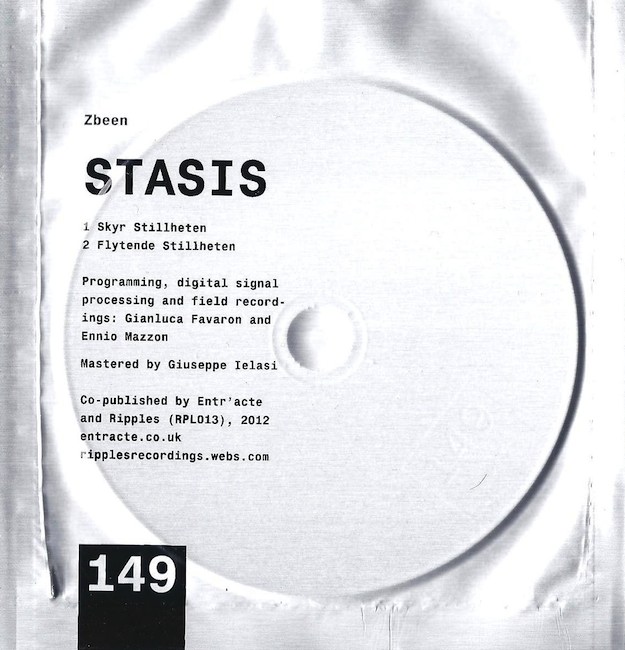
Zbeen - Stasis (Entr'acte)

Zbeen being a project from electronicists Gianluca Favaron and Ennio Mazzon. The first of the two cuts, "Skyr Stillheten" covers fairly common territory in its 32 minutes: an undulating, tonal drone-like pattern is laid done, beguiling and comely, over which all manner of small life forms creep, like the environs of a warm pond, scuttling, flitting and swimming about. Part of me senses an easy gambit--what could go wrong?--but I gave the pair credit for extending it at some length. It's quite easy to lose oneself in; whether or not there's any lasting nutrition supplied is another story. "Flytende Stillheten" is substantially the same, the activity sparser (nighttime on the pond, perhaps). Again, the duration actually helps the piece establish itself though, as before, it goes down a bit too easily, pleasant but forgettable.


Jean-Baptiste Favory - Unisono (Entr'acte)

Interesting idea here, in four stages. First, eight musicians, playing virtual synths, play the same initial score but individually modify certain functions, allowing the piece to splay out in unpredictable directions. The same thing is done in the second piece, with a more complicated score. The third uses the same score as the second, substituting virtual instruments (flute, oboe, English horn, two celli, violin, viola, bass) wherein the parameter shifts enable these "instruments" to far outstrip anything that could be achieved with them in "reality". Lastly, pieces two and three are simply combined.

All well and good, but how gripping is the music produced? Well, making allowance for the necessity of hearing it on stereo as opposed to in situ (where one can easily imagine, at the least, an immersive effect), I don't get so much from it. "Unisono I" quickly gets to a point somewhere between whistling wind and distant air raid sirens, oddly soothing and, again, likely more effective with the sounds aswirl about you but a bit flat here. The second version is indeed more complex and more interesting as well, though some of that complexity is at the cost of introducing very "synthy" sounds, bloops and bleeps, that I have a bit of trouble digesting. Still, it possesses a kind of nervous urgency that's very compelling, courtesy of some shuddering sounds and needling tones. It's fascinating how the introduction of synthesized instruments (which, by and large, do sound very much like their acoustic counterparts) ratchets up the interest level though they're more or less performing the same music. But the colors are much richer, the long, shifting lines much more variegated, really solidifying the work quite beautifully. The combined version reincorporates the pure synth sounds and is fuller thereby, very good, but I prefer the more pared down variation with only the pseudo chamber ensemble.

Entr'acte

Friday, March 22, 2013

(The music below has been issued on cassettes. Patrick Thinsy was kind enough to provide me with CD burns)


Patrick Thinsy - Disappearances (Yanuki)

Two fine electronic tracks form Thinsy, a new name to me. The first shimmers vaguely into existence, the merest wave, gradually developing a slow pulse. A higher pitch is added, almost in sync with the previous pulse but just enough off to provide a delicious quaver. A harsher layer is applied, that pulsation becoming deeper on the one and, generating quasi-beeps on the other. A concise piece that does what it needs to do in 12 minutes and then retires; excellent. The second begins with a lower, deeper thrum, again undergoing a slight additive process. But about four minutes in, a rhythmic tapping emerges, a spare but complex dance between semi-metallic strikes and paired pneumatic sighs. Very effective, very eerie. More so when a calmly speaking female voice enters (in French), eventually, slightly, splitting, becoming the sole element as the piece ends. An impressive, unusual release--try it!


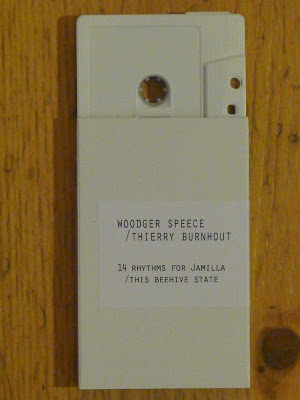
Woodger Speece/Thierry Burnhout - 14 Rhythms for Jamilla/This Beehive State (Tanuki)

Woodger Speece is Pauwel de Buck. His pieces flicker between electronic noise and fractured semi-dance rhythms, all subject to deterioration. The sounds tend toward the sharp and thin, often cackling and yielding high-pitched whines and wheezes. There's a mechanical feel, as of some rickety, jerry-rigged contraption run amok. One sometimes imagines whole crews of miniature street workers with inch-long jackhammers. Not quite up my alley but engaging enough at times. Thierry Burnhout's "This Beehive State" commences with a lovely, low drone adorned with discreet pops; given the title, one is hard-pressed not to think of a hive's hum with the pops representing individual arrivals and departures of worker bees. This continues throughout, the drone changing pitch and timbre periodically, sliding into an organ-y area. It's very comfortable music, not so demanding but an enjoyable wallow, the clicks adding just enough grit to offset any potential cloying aspect. Nice work, would like to hear more from him.


L.E.G. - The Dogs in You (Tanuki)

Spacey hip-hop (trance-hop) by a Belgian group. Well outside my ambit so I'm reluctant to say much. I was a big fan of early 2000s Anticon product and I can hear something of a relationship to that sensibility here but not enough for my taste, a little too much posturing. The effects are sometimes winning, diverging substantially from what one might expect, the last portion of the second of the two tracks traveling especially far out, though it also hits on some excessive wooziness. I'm afraid I can't say much more, though excerpts of this and the previous two releases are available on bandcamp and soundcloud, so hear for yourself.

tanuki


Thursday, March 21, 2013


Insub Meta Orchestra - Archive #2 (Insubordinations)

Admittedly, an ensemble this large (36 by my count, presuming all play on each of the two cuts) that creates music this restrained has me half won over from the get go. In fact, it's hard to believe so many are involved with the first track, "line 1", a steady state piece that maintains an amorphous, organ-like tone throughout, accentuated by very delicate percussive sounds and string scrapings. The sublimation of all the instruments to that sound is quite impressive and the piece acquires a fine, breathing sense of life. Would have loved to have experienced this in a good room. "line 2" begins in a good deal more agitated fashion, a-flutter with whispers, mans, scuttling but again, pitched at a low dynamic and never feeling overly busy. Eventually it works its way back to a situation not so far removed from the previous track but with a more sonorous, ringing tone spread through the orchestra. A bit less satisfying than the first but still tasty. A good effort here, worth hearing.


Abdul Moimême - Mekhaanu - La forêt des mécanismes sauvages (Insubordinations)

In which Moimême subject two prepared electric guitars to simultaneous improvised assaults. In his notes, he refers to industrial working conditions and the sounds to which they often give rise and this sensibility is clearly heard on the seven pieces presented here. They're quite guitar-ish, no attempt at hiding the origins of the sounds, very resonant (one track in which the guitar is laid inside a grand piano) and "stringful", bowed, plucked or scraped. I have a tough time getting a grip on anything more than the surface sounds here, the echoing, chiming kind of tones that I associate with, for example, the freer portions of Frith's first solo recording. The last cut, "Atmosphère Méchanique", manages to transcend these issues, I think by pure dint of effort, almost willing the music beyond the surface limitations, to begin to inhabit and interact with the space in which it was created, to become a powerful form. Listened to thusly, as a search for that moment, the album has an enjoyable (if listener-imbued) narrative. I'd like to hear more in the direction indicated by the journey's conclusion here.


Queixas - Eye of Newt (Insubordinations)

Abdul Moimême (prepared guitars, objects), Cyril Bondi (floortom, objects), D'Incise (laptop, objects). re: the above write-up: I'm often forced to wonder how much the recording details contribute to that sense of "in the space" that I found a bit lacking there. Here, it's not an issue at all, everything seems as though the air in the room is integrated perfectly with the sounds, as if they emerge from the space and aren't imposed on it. Low level but active improvisation is the rule here with a wide range of tones and textures. Bondi has been an asset in every context in which I've heard him and definitely provides substantial starch here, his pulsing, almost-on-rhythm low bangs propelling matters beautifully. On the whole, the music doesn't particularly stand apart from the field but is quite strong, vibrant and alive; often, that's all I need. Solid stuff, worth a listen.

Insubordinations

Wednesday, March 20, 2013


Sarah Hughes - accidents of matter or of space (Suppedaneum)

The first release on this promising new label (which etymology I just researched to find that it's the name of the foot support for a crucified person) arrives affixed to a sheet of heavy paper some 12 x 14 inches, scoffing at my compartments for oversized disc packages. It's put to good use, however, with a side given over to the score of the work and another sheet harboring a fine essay by Dominic Lash, presented in a form that mirrors the structure of the musical work (both in vertical columns and in the spacing of words horizontally, if I'm not mistaken) or, more accurately, three of the four tracks here. The first piece, "Criggion" is a recording of Hughes improvising on zither in the transmission station in the Welsh village of the same name. It's fantastic, an absolutely gorgeous integration of instrument and soundscape, dark rumbles, distant, hollow bangs, penetrated by slender, resonant string plucks. Really, one of the finer examples in this area I've heard in a long time.

The three realizations of (can never exceed unity) are tougher goes, but very rewarding, performed by Rhodri Davies (harp), Neil Davidson (guitar), Jane Dickson (piano), Patrick Farmer (electronics) and Dmitra Lazaridou-Chatzigoga (zither). The score is a kind of meditation on Zeno's paradox, wherein one instrument plays "a continuous tone or sound" for the length of the piece and the others, entering in turn (? I think), play freely but each for a total of half the time of the previous person. SO if the composition lasts 20 minutes, one plays continuously, the second creates ten minutes of sound (spaced freely, I believe), the third, five, the fourth two and a half and the fifth, one minute, fifteen seconds. I may have this wrong!! As they can place the sounds where they will, this results in some silences, or near silences (which would seem to be the case if that first person was playing very quietly. I find I tend to disregard the structure and just listen. The pieces are spare, the sounds often barely glimmering here, roughly buzzing there, with an appealing sense of random overlap. They're oddly knotty, the silences sounding very much "set off", somehow, without the smoothness one, for some reason, expects. This is a good thing. A beautiful recording.


Chen Brothers - Ally (Suppedaneum)

Hitherto unknown in these parts, the Chen brother are, well, brothers, hailing from upstate NY who approached this project in a rather unusual manner. One, Jeremy, created the visual design and determined the number of tracks as well as their titles and durations. Jonathan then put together the sounds to conform to these strictures. In this instance, Jeremy's apparent penchant for brevity (seven cuts, 18 minutes total) seems to match with his sibling's obsession with feedback, as all of the pieces howl, vibrate and screech with such. The general sonic area isn't really my cuppa, granted, but it's one of those sets that I think might work fine in situ, where one could be swathed and/or battered by the assault, something that tends to flatten out on disc. The abandon is there, the depth not so much. Noise fans may well disagree.

Suppedaneum


Socrates Martinis - On motion, stasis and the geometry of desire (antifrost)

A short (17 min.) cassette release containing four fairly impenetrable tracks apparently made up of field recordings, rough enough ones that you could almost mistake them for cracked circuit electronics. On "Unfinished lines of her footsteps", they appear in succession, a different recording occupying several seconds, then ceding way to another, not worlds apart, always urban (I think), gravel-colored. "Flintlock" seems to be similarly constructed though the sources vary more, have a wider tonal and dynamic range; it still sounds more or less industrial but includes gentler areas, like a lovely pseudo-flute episode with vibrating metal in the background at the track's conclusion. Side B of the cassette, "The bronze dress", things continue apace, bell sounds appearing but through a static haze. The last track tends a bit more toward the smoky and soft, but never losing that rough edge entirely. This particular method might pall over a longer stretch or series of recordings, but at this brief length, it's perfectly delectable.

antifrost


Thursday, March 14, 2013


Toshiya Tsunoda - The Temple Recording (edition.t)

Toshiya Tsunoda - O Kokos Tis Anixis (edition.t)

Tsunoda released these two double-disc sets as a pair and I think considers them pendants of a sort, though they're quite different from one another.

"The Temple Recording" is the more immediately entrancing of the two. The idea is simple but resonant: Take stethoscopic microphones, augmented with an additional mic faced toward the environs, affix them to one's temple and concentrate on the landscape at hand. Do this with two persons. The inward mics pick up the individual's blood flow muscle movements and such, the others provide an indication as to what he's experiencing, to some extent causing those interior reactions, resulting in "a record and evidence of our real experience of the landscape". and indeed ones hears s low, soft pulse, presumably the blood coursing through the temples of Toshida and Koichi Yusa, his partner in contemplation, as well as, marvelously separated, birds, breezes, mic movements and other sounds, crisply limned in stereophony, one observer per speaker.

That's all. But as with many of Toshida's projects, there's so much more, ineffable though it tends to be. The tracks total about an hour, the environs shifting, though not enormously so; the comings and goings of the bodily sounds, to the extent one can recognize them, seem to be more affected. But what pervades is an extreme sense of clearly perceived but very, very calm mental acuity, much as if you were participating in the activity and doing so seriously and with relaxed concentration. I like listening to it at low volume, blending in, so that when a sound like the gentle moan (the wind?) in the third track on Disc Two emerges, one is momentarily confused. Not sure what else to day. Ever since "Scenery of Decalcomania", Tsunoda has been responsible for, to my ears, much of the very best field recording work around. This is another.

"O Kokos Tis Anixis" is a different kettle o' fish. A set of eight pieces, total over 144 minutes, wherein the basic units of sound are field recordings (descriptions of which are found in the titles, such as, "the sounds of ashes bursting in the fire built by fishermen"). But Tsunoda has taken tiny slivers of them and formed loops, some quite brief, some longer and re-inserted those loops into the original recording, rather like creating intentional glitches. Just before writing about this, I saw a post from Gerardo Albatros referencing a wooden chest, carved so as to appear as though seen on a glitch-filled video screen. This is something of the feeling I get from these works: a "normal" scene interrupted by electronic brambles made up of fragments from that scene. Admittedly, on first listen, not knowing precisely what to expect, I leapt from my seat, fearing the disc had destroyed my CD player.

It's a toughie. Tsunoda varies the kind of glitch quite widely; I'm not sure if the same burp repeats throughout the set. It's hugely disorienting (when overt--sometimes the insertions are subtle enough to bypass easy notice) and, given the general lush pleasantness of the recorded sounds, one's initial reaction is likely to be displeasure, resenting the "rudeness". I was first concerned that the attack would pall over such length, would be reduced to a kind of gimmick but, rather surprisingly, found that the longer the set lasted, the more I accommodated myself to the interference. Like much of my favorite field recording work, the sounds began to make a kind of sense that was next to impossible to quantify, those sounds here including Tsunoda's manipulation.

Both releases are mysterious and fascinating, wonderful work that should surely be heard.

Available via Erst Dist

Tuesday, March 12, 2013


Tetuzi Akiyama/Jeff Gburek - respect (Spectropol)

One never quite knows what to expect from any project involving Akiyama but this one, a duo with the always intriguing Jeff Gburek, is pitched decidedly toward the quite and contemplatively sad. Akiyama is on acoustic guitar, Gburek on the same plus prepared slide guitar and electronics. The four pieces unfurl slowly and gently, plaintive tones squeezed out like tear, referring to blues traditions but in a way that's perhaps in the Connors lineage but removed a step or two, hazy in the distance like the tree line on the disc's cover. Polish cold marsh blues. Gburek is nicely chary with his electronic insertions, discreet sounds that sizzle on the edges of the guitars. The tone is consistent over the tracks, a welcome aspect, though the details vary more than enough, ensuring that each possesses an individual character. The music is genuine, quite approachable and just a pleasure to experience. No nonsense, heartfelt playing. Recommended.


Andrea Borghi - Musica per Nastro (Tape Music) (Spectropol)

Many a time I hear contemporary electronic music that immediately catapults me back to the classic work of the 60s (Riijmakers, Koenig, et al). I often wonder if I'm being too hasty making those connections. Well, Borghi is explicit about it, so I'm on solid ground, at least about that. Ten short pieces using real-time editing software. Borghi's music is refreshingly subdued and subtle bearing none of the flashy, cool sounds for cool sounds' sake that often infects the genre. While the referents may often ring a bell, the way they're deployed and tinged lend the desired 21st century aura to the work. It's interesting the way it (unintentionally) relates to the Akiyama/Gburek release above: a very similar contemplative sensibility, a fine insistence on non-stridency and inhabiting an indentifiable zone while finding great variety therein. Borghi's incorporation of electric bass into the proceedings serves him well, allowing the gentlest of pulses to buoy the fragile sounds atop. A fine recording, recommended too!

Spectropol


Heddy Boubaker - Dig! (Petit Label)

ok, unfortunate album title; same goes for several track titles...but it's a fairly enjoyable recording. I'm guessing it's solo saxophone, possible alto and baritone, though enough of the sounds could well have been generated via different means. Overall, however, it oddly enough fits in alongside the above two releases, at least in the quiet and contemplative sense. Boubaker, one senses, has a bit of the rascal in him ad their are waggish nods towards birds, dogs, bugs, etc. but it's mostly a considered exploration of his axes, using various extended techniques that, while more or less familiar, are nonetheless well carried out and sustained. Bubbles, buzzes, breath, taps; not as tired as one might guess. "Lazy Unicorn Drips" closes the disc out really nicely with a whole forest of miniature sounds (electronics here for sure, if not elsewhere). A tough row to hoe, but pretty well done, worth a listen.

Petit Label

Tuesday, March 05, 2013

Thought it might be wise to re-post my current mailing address for those inclined to send things and who may have missed the earlier announcement:

Brian Olewnick
3 Rue Henri Dubouillon
Paris 75020
France

thanks!

Monday, March 04, 2013


Kawaguchi Takahiro/Choi Joonyong - Suncheon Hyanggyo (Balloon & Needle)

I'm given to understand that "The Suncheon Hyanggyo [a temple/Confucian school] was constructed in 1407 (7th year of Joseon’s King Taejong) and was moved several times before finally arriving in Suncheon in 1801 (1st year of King Sunjo)". Kawaguchi and Choi conducted an event there in August, 2011. There was news coverage of the occasion and it's well worth watching the video to get a better idea of what occurred than can be gleaned from the recording. What's striking to me is the balance between and art event and a kind of elaboration on "ordinariness" that eventuates. The calm, accepting manner that the duo maintains throughout, constructing loose agglomerations of material, not all of which have to do with sound, is as much a part of the performance as anything else. A metronome is a consistent presence, though not always heard; other sounds include air blown through a long pipe, plastic bags inflated via small motor, little fanlike gizmos (a la Rowe) beating against the metal of a large pile of folding chairs that was the central object, or at least the largest one, passing planes.

As ever, the vast difference between being present at the event (a handful of bemused visitors sat politely and seemed, guessing at their post-happening reactions caught in the newscast, to have more or less enjoyed it) and listening to the audio capture at home raises questions. Had I not seen the video, I'm sure I would have more or less enjoyed the disc but would have had a stronger than usual sense of missing something. It's less concentrated than much of the work from the Seoul crew, clear to see why after viewing the video. Once seen, that relaxedness, the idea of equivalency between empty and full(er) space takes precedence in my mind, and I find myself deriving great enjoyment.

An unusual, (non)thoughtful idea. :-)

Balloon & Needle

Available from erst dist

Friday, March 01, 2013

Yan Jun was kind enough to send me a passel of releases from China, not the most common source of this end of the music spectrum. I was fascinated to hear all these things, regardless of whether I "liked" a given disc or not and thank him very much. Below some all too brief comments:


Intelligent Shanghai Mono University - 7.9 (SubJam)

A band of four Shanghai electronics musicians who go by the monikers, B6, cy, Susuxx and Zoojoo. This is a 2003 release, 14 tracks, about an hour. I might relate it to Otomo's work from the early 90s in that much of the music mashes together shards of noise, found sounds, etc. with more or less rock-based melodic fragments and rhythms. There are spacey interludes; "Tunes by" consists of a woman's voice dreamily chanting, "Fuck you, fuck me" for instance, and also bits of dance hall electronica ("Sand") and a 7-minute blank track. "M1" has a nice Barry Adamson vibe; all of the final four tracks, M1-M4 are essentially warped pop forms. Overall, maybe a bit dated (even in 2003) but a good deal of exuberant fun to be had here.


Ronez - Try It On for Size (SubJam)

Apparently mine is not one of the first 300 copies as there's no enclosed condom, alas. Ronez is Zhou Pei and this is a 2002 collection of 26 tracks not so far removed from the above release in the mixture of noise and rock forms. Again, Otomo seems to be a reference but there's a certain coldness here that causes the tracks to sound more clinical than one would like. Some odd Wayne Horvitz-y sounds here and there. But the basic sounds, rhythms, etc. are kind of thin and mundane. Not so keen on this one.


DDV - Live in China (Kwanyon)

Have to say, I love the cover. DDV seems to be made up of DDV on electronics & voice, Yilichi "on" hanggai (a Chinese folk groupor, one assumes, recordings of same) and the SubJam Jam Band. There's a good bit of throat singing near the beginning, possibly the aforementioned Hanggai, supplemented by ambient noise and someone crooning, "I like the way you mooove...". his 2005 recording is a good bit grimier (in a positive sense) than the two above, sometimes venturing into Lescalleetian realms of wobbly power ("Tribute to Vel"). The distorted groans and sludgy pounding take their toll after a while, though. Fans of the more dismal reaches of the noise scene might enjoy--and I liked a good half of it--but at 70+ minutes, it eventually wore out its welcome.


Yan Jun - Mars Tour Diary (SubJam)

What the title says, as near as I can tell and quite enjoyable, Yan Jun presenting 20 tracks, field recordings if you will, from a 2010 tour, encased in very handsome booklet filled with casual photos from same (Otomo popping up in one). "Zhucago Duo", pits abstract electronics vs. a regular snore. Others seems to capture nothing special but, in their lack of intentionality, are quite winning. Then you'll have pieces like "Hypnotizing Lu Bai" which is hard to imagine being sourced from surrounding environs, sounding more like an excellent piece utilizing electronics, with keening, fluctuating, ear-slicing layers of whines oozing across one's sonic membranes. The variety is excellent, nearly nothing to fairly noisy, tons of tone, almost every track containing something that makes one smile in recognition. If loose field recodings are your thing (and why wouldn't they be?), this is a fine exemplar and right up your alley.


Laurent Jeanneau/KINK GONG - Soundscape China (Kwanyin)

I'm given to understand that Jeanneau (who also goes by KINK GONG) is an accomplished recordist of southeast Asian traditional music, including some of the Vietnamese releases on Sublime Frequencies. This 2001-02 recording simply enough combines swatches of music and sound from the Yunnan region of China with abstract electronics, and does in quite well indeed. Lecturing voices mingle with those of children, interfered with by harsh tones (as in bad radio reception) and more globular, ringing ones. A single, hour-long track that held my attention throughout, the sourced material always balanced with the electronics, the approaches varied, the sound mix often luscious. An excellent recording that makes me want to hear much more from Mr. Jeanneau. Special stuff.


Tim Blechmann - timbre (Kwanyin)

A single 41 minute piece, steady-state, featuring a hollow drone, vaguely metallic, with multiple striations within. Midway through, grainier elements seep in, bits of detritus rolling around in a great, windswept tube. Not sure of the recoding date here; it's similar to other ventures in this neck of the woods but really well done at that, enough that I don't find it particularly tired or cliched. Good focus, good attention to detail, nice sense of forward thrust. As can be seen in the cover graphic, the volume gradually swells; also, the clatter increases as well as some deeply buried harmonics. Enjoyable piece.


Jun-Y Ciao - The Beginning of the Beginning of TheBeginning (Kwanyin)

Ciao plays clarinets and bass clarinet and this is a solo recording. While he uses approaches that are very Braxtonian, he doesn't really sound like Braxton, tending more toward a music very akin to any number of European improvisers from the 80s on. Lyrical, in a very loose, free sense. But nothing really stands out, makes one sit up. And nowhere near the amount of structure or other important qualities to stand alone.


Vavabond - Yellow (Kwanyin)

Vavabond is a young, female laptop artist, formerly known as Wei Wei and associated, among others, with the band Vagus Nerve. That's all I know. The music here is harsh, glitchy and hyperactive, skittering about, bumping into walls, shattering. No pulse, instead several layers of mechanical, rapid rhythm. But as with the Jun-Y Ciao issue above, there's nothing particularly special about it. It has a routine aspect, little sense of exploration, excitement or surprise and, over the course of the disc, the sounds take on a same-y quality and wear thin.


Yan Jun - V (Kwanyin)

Electronics as opposed to the field recordings of "Mars Tour Diary". Quite varied, from wisps to thick torrents of sound, sometimes fading to icy near-silence, all engagingly handled. Unlike the above release, one gets a sense of a firm, underlying structure, of a reason for the sounds (however unquantifiable), implying substantial thought in their dispersal. Some really nice ultra-high frequency work as well in the last few cuts, frosting the room. Good work.


Yan Jun - Music for Listening on the Moon (Kwanyin)

An hour of very spare, though slightly spacey electronics that indeed have something of a selenic aspect. The source is apparently an ongoing installation "in Yan Jun's washroom" (lending an alternate possible meaning of "moon) and one can, in fact, translate many of the sounds into attenuations of drip noises. It's consistent over it's length, all variation occurring within a narrow range, but it works wonderfully, integrating into the room, tickling the vacuum. A fine recording.


Li Zeng Hui - Live at Waterland Kwanyin (Kwanyin)

Solo saxophonics (baritone and, I think, alto) from 2008, very much in free jazz expressionist mode a la Brotzmann et. al. Well outside my range of interest, to be sure and not much I could latch onto even allowing for my antipathy to the area. I remember (unfair, I know) a solo Hamiet Bluiett performance at Environ in 1977, half incredibly angry and raging baritone, half equally angry verbal raging at the loft scene and conditions for musicians generally. Now that was something harrowing and special. This doesn't get anywhere close.


(Various) - Big Can (Kwanyin)

There was this large, abandoned, cylindrical metal object, maybe an oil tank. In 2009, several people cam to the site and made some noise. They were Otomo Yoshihide, Ryu Hankil, Yuen Cheewai, Yan Jun, Sachiko M, Yang Ge, Xian Qiang, Hong Qile, Gogo J, Olivier Heux and Junyuan. The sounds chosen are refreshingly non-obvious, no fist-banging on the interior walls. There are soft clocks and drips as well as a number of sustained sounds--whistling, moaning, keening--that don't sound voice-derived but perhaps are. It's also very open, not overcrowded as might be feared from eleven participants. There's a 27-minute main track then a fun single minute of the troupe waling away...good job.


SubJam/Kwanyin