Sunday, February 24, 2013


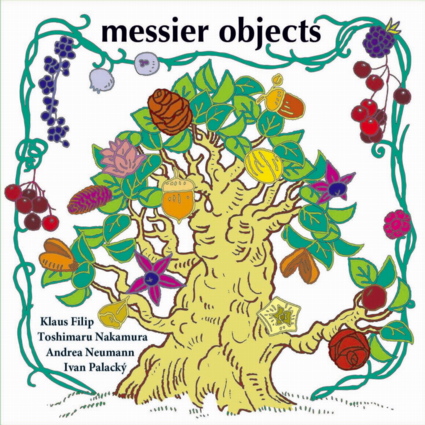
Klaus Filip/Toshimaru Nakamura/Andrea Neumann/Ivan Palacký - Messier Objects (meenna)

Messier objects, as we're all aware, were astronomical detritus that gave the appearance of comets but weren't, aggravating comet hunters like Charles Messier who compiled a list of the things, numbering 45, so as not to confuse him in further cometary quests. Their actual nature varied widely, including several pretty spectacular nebula such as the two titular ones here, the Carb and Trifid.

I'm hesitant to draw any overt connections between a ppooll/nimb/inside piano/Dopleta 180knitting machine colabration and a vast aggregation of starstuff, but there is a really strong sense of structure hear, of tendrils expanding into the void. The mix of sounds is wonderful, Neumann (I assume) early on summoning gamelan-like tones from her stringboard, with rough, grimy rumbles, dry scrapings and other material circulating around and through. The music doesn't dwell more than a few minutes in any particular area, shifting, often abruptly, from relative smoothness to a blocky, harsh sequence, static pops against brutally struck, non echoing strings, for instance. Both tracks, 40 and 16 minutes, the first live the second recorded at Amann Studios on two successive days in October, 2011, embody a kind of improvisation I greatly enjoy, wherein the listener needs to hear the piece in its entirety, mentally calibrating and reconciling it in retrospect, grasping the form and relationships after it's over. The range of sounds is quite impressively enormous here but at the same time there's a cohesion and constant sense of purpose and direction. This is all blurry sounding, I realize, but it's quite hard to describe; the sounds themselves are quite coherent and identifiable but it's their mix and the implied propulsion these mixes provide that gives the music such force and staying power.

Excellent stuff, mandatory purchase.


Katsura Yamauchi/Toshimaru Nakamura - Yokutojin (ftarri)

Things start out well enough, on low simmer with Yamauchi reining in his alto and Najkamura creating some fine, eerie tones and washes, but some eight minutes into this 1/2 hour recording, the pair launch into a wailing, free-jazz explosion that doesn't sit too well. Toshi can be interesting when he works loud (as with Rowe on the sunspot track on 'between') but here it's an unwelcome distraction. They settle down after five or so minutes but have at that point begun to establish more of an episodic set than a cohesive one. A few of the segments work well enough as discrete units but more of them suffer forms saxophonic over-exertion and the whole just never comes together for me.


Katsuyoshi Kou/Satoshi Hironaka - state, state, state (ftarri)

Four tracks of guitar and drums. On "State", Hironaka offers some quite fascinating percussion work, sounding like he's using tuned drums of some kind in an off-kilter, quasi rhythmic manner, almost as if someone had taken a slice of Xenakis' "Rebonds' or 'Pleiades' and irregularly looped it. As it happens, drums and guitar were recorded separately and very brief blank spaces were inserted post-production into the drum tracks, creating beats that are "off" just a bit. Kou's contributions are more staticky noise with the odd pure note, a decent enough offset though it was the drums that held my attention. "sTate" (you get the titular idea), the longest track at 27+ minutes) begins in quietude before moderate guitar squawks appear and that turns out to be more or less the path--small squalls of guitar (it's a solo) really not creating enough tension or filling up of (or emptying) space to quite justify its length. Again, it was treated after the fact, adjustments made to "confound listeners' expectations"; well confounded, perhaps, but not so moved. Then "stAte" returns to the propulsive drumming (solo, overdubbed), here with more of a rock feel, screeching in the distance that I would have guessed was guitar but I suppose is of a cymbalic nature and things work just fine, like a lost Material cut. The final cut, "staTe" (unaltered duo), finds a slightly different path, the drums lighter but still rhythmically skittering, the guitar continuing its oblique, metal-scraping-metal commentary, not bad but leaving me a bit unsated.

Tough album to recommend, just too few really good ideas to latch onto, but curious to hear further music, especially from Hironaka,

ftarri

also available from erst dist

Friday, February 22, 2013


Satanic Abandoned Rock & Roll Society - Bloody Imagination (Mikroton)

Said Society consisting of Tetuzi Akiyama (high-frequecy-resonator guitar with samurai sword. heh), Naoaki Miyamoto (mid-high frequency-electric guitar), Utah Kawasaki (mid-low frequency-analog synth) and Atsuhiro Ito (low frequency-optron). One track, 52 1/2 minutes. It's pretty much a layered hum. As indicated by the frequency distribution, it's separated into four, fairly clear strata, high to low. some ways in, a two note bass figure appears, which is about as close to anything rock and roll that happens. If you can imagine the closing hum of a vigorous track by some particularly noisy band stretched out to this length, you wouldn't be far off. It's the kind of piece that doubtless would be far better served in a live setting, amidst the swirl of tones, where the listener is able to move at least his head, if not walk around. As is, it's a fine slab of sound but one that I have trouble really plunging into. Not satanic enough, perhaps.


Alessandro Bosetti/Chris Abrahams - We Who Had Left (Mikroton)

Intrigued expectations before my first listen. I've had many problems with Bosetti's output over the past few years but, on the other hand, I've greatly enjoyed much of Abrahams'. What would transpire? Actually, something, or things, very different from what I'd heard of either. "We Also Dress Today"combines pointillistic, one-note piano with light electronic clatter, sounding like a pot of small cans being gently stirred. Low, rough tones nudge but the piece stays put; odd and attractive. The following ifs more of a jazzy excursion, something along the lines of late 60s or Circle-era Corea, perhaps, with hostly, swirling electronics behind. Bosetti's voice, something I wasn't looking forward to, makes the first of two appearances on "We Cannot Imagine", iterating a line slowly, often in a very slightly sing-songy manner, Abrahams' delicate piano supporting. It eventually gets to a point not all that far from those mid-70s Mantler adaptations of Beckett, like "No Answer", Bosetti eerily echoing Jack Bruce here and there; good piece. There follows a track akin to the second, but spacier; pretty but a bit hollow. In another oddly allusive cut, "When They Are Overheard" venture into Charlemagne Palestine territory, Bosetti employing very subtle electronics within the piano cascade; strong if, again, a touch to referential. The duo closes with that standard in the eai community, something one hears at every other concert, Bill Evans' "Waltz for Debby". :-) Bosetti sings, near-falsetto but movingly, once more weaving his silvery, flitting sounds between the fine and straightforward piano accompaniment. Well, it's a beautiful composition of course and, I have to say, I'd rather hear this than a rendition by any contemporary "straight" jazz duo I can imagine.

An unusual recording, but overall a winning one.


Barbara Romen/Kai Fagaschinski/Gunter Schneider - Here Comes the Sun (Mikroton)

A 2008 recording with Romen (hammered dulcimer), Fagaschinski (clarinet) and Schneider (guitars). Interesting to hear the dulcimer (often sounding like one) in this kind of context. The music is soft, gray and somber, bearing strong tonal underpinnings, freely improvised but in a pastoral sort of way. I might even go so far as to say that some portions, much of "Feelings Without End" for instance, could constitute an ECM-ish branch of eai...Which isn't to say that it's all pastels. It's highly listenable throughout, some nice pulses feeding in here and there, the colors always clear and refreshing. Fagaschinski, as ever, is wonderfully warm and controlled. I can't recall if this is my first real exposure to Romen and Schneider, but both offer subtle, not overly-instrusive contributions. This said, there's nothing terribly memorable here either, though the final track, "plainchant and Goodbye", manages to transcend the rest, it's calm resolve evoking a mysterious forward motion that's very attractive. It emerges, passes, one experiences a short pleasant sensation and that's it. Maybe enough.

Mikroton

Thursday, February 21, 2013


Just a couple of notes on my first few days in Paris, music-wise.

On Sunday, hooked up with my old friend Jacques Oger (who, happily, lives only a ten-minute walk away) and it turned out that The Ames Room was playing that evening, in a wine cellar of a bar near the center of the city, so off we went. Much fun to surprise Will Guthrie, who I hadn't seen in about five years, maybe. Seeing the trio live made clear the structures they use--not sure if it was apparent on the recordings and I've just missed it. Each player constructs brief phrases, perhaps 2-6 seconds long, and more or less repeats them a varying number of times. This results in a kind of brutalist/cubist effect, a modular interlocking, the phrases being of unequal length, iterated a differing number of times, being essentially different (but always rhythmic in some sense), thus enabling a very exciting, propulsive music, really very different from free jazz for all the surface similarity. Jean-Luc Guionnet was extremely brutal, with short, choppy lines that recalled Roscoe Mitchell at his harshest while bassist Clayton Thomas more often chose calm, deep patterns that reminded me of Malachi Favors. Guthrie was a monster, really an unbelievably furious, intense and exact drummer, creating motif after motif, sometimes with delicious hesitations.

They did two pieces in this fashion for the first set and then loosened the bolts just a tad for the second round, elevating the music significantly. If I have a caveat, it's that part of me thinks, "this is a fine idea for a piece or set of pieces, but do I want to hear this attack time after time or does it reach a point of diminishing returns?" I'm guessing it would pall on me after a while, though I leave open the possibility that by pounding away at it, they could find themselves breaking into some unexpected area, something that could surprise the trio and audience alike. Hard to say.

Fortuitously enough, Les Instants Chavirés was hosting the Eddie Prevost/Sebastian Lexer/Seymour Wright trio last night, providing more than enough impetus to make my first visit to that fabled venue. Nice room! NYC should be so lucky. Had the additional pleasure of meeting Lucio Capece, something I've been looking forward to for many years. With regard to Prevost and Lexer, the music was about what I anticipated: Prevost spent the vast majority of this time bowing either his large gong or hand-held cymbal--he does it so beautifully but I often longed for some different sounds--while Lexer logged many minutes inside the piano, sometimes electronically filtered. Again, wonderfully done but those moments where he returned to the keyboard, especially the softer playing. made you ache for more of the same. Still, that could be part of the deal, to induce such longing. Wright was a bit of a surprise and I'm still wrestling with his contribution. In brief, he was most often very shrill and strident, either when utilizing just the upper portion of his alto or its entirety. He never fell into a free jazz mode, but it was hard to reconcile the super-high, very loud multiphonic squeals and squawks (exquisitely controlled, I should add) with the music from his two companions. Obviously, this was a clear choice on Wright's part and one can easily imagine getting a bit tired of quiet, breathy reed playing and searching for an alternative. Not sure this is it, though there were moments when things jelled very well. Wright ended the first set and began the second with some wonderful low burbles on the detached neck, wryly amusing.

Did I mention that the food here isn't half bad?

Wednesday, February 20, 2013


Michael Pisaro - the middle of life (die ganze zeit) (Gravity Wave)

One of the defining characteristics of Pisaro's music, I find, is that his generally lengthy works really need to be heard/experienced as an entirety, which requires the listener to stand back a bit and to retain memory of a great deal of information and its interrelatedness. Happily, the elements themselves are, in a sense, "simple", easily graspable on their own, making their subsequent conceptual reintegration not quite as daunting as it would be otherwise--but still something of a feat. Listening for the first time to a work like "the middle of life (die ganze zeit)", which has as its central focus lines from that text by Oswald Egger, read by him and others, but interpolated with all manner of sources, including field recordings and music from Julia Holter, one may have the sensation of a string of loosely related vignettes, soft and lovely in and of themselves. The tough part is mentally calibrating all of these episodes into a whole, which whole (in my head, anyway) isn't a terribly graspable object either, more a nodal kind of thing itself, like a relief map indicating irregularly spaced disturbances but all lying within the same substrate.

So you have an opening sine tone, then another, than a very deep one. You hear wind, then Eggers reading his text. Other readers follow at odd intervals, in various settings, in English and not: Taku Sugimoto, Kristin Haraldsdottir, Kunsu Shim, Graham Lambkin, Didier Aschour, Lucie Vitkova and Holter. After the initial text, there's some extremely lovely, spare piano, over which the speakers cycle, their words buffeted by the sounds of the forest referred to in the first line which is itself, I think, from Dante (not sure of the connection): "In the middle of life, I found myself in a forest with no path." (wiki gives the line as: "At the midpoint of the journey of life, I found myself in a dark forest, for the clear path was lost.") There ensues a series of gentle shifts, almost like overlapping film slides, at first very much occupied with that outdoors environment, the odd recitation emerging. An ultra-soft flute is heard accompanied by a faint voice, both combing to sound like a ghostly madrigal, underlaid by sine tones high and deep. That episode ends, about 19 minutes in, introducing a brief pure single-note guitar/sine sequence. Egger reappears, reading various texts, in German, selected by Pisaro, amidst a more urban soundscape laced with sine-age which gradually accumulates into a richer, even dramatic organ-like set of tones. There's distant flute playing from Antoine Beuger that seeps in now and again as well, a wonderful sound, as well as, apparently, an excerpt from Pisaro's "Ascending Series (5.2), though it's beyond my powers of observation to isolate it.

Some 39 minutes in, Holter appears, singing wordlessly, plaintively (again recalling, to these ears, medieval music), soon double-tracked; very unexpected and moving. After a few minutes, Pisaro appears on piano, playing Holter's "For One or More Voices", anther gorgeous/spare piece of music, over which Egger is heard once again, cosseted by recordings evoking the sea, birds, wind, concluding as gently as it had begun. You're left at a different point, though it's hard to discern exactly why it's different.

Endlessly fascinating, resisting easy interpretation.


Michael Pisaro - the punishment of the tribe by its elders (Gravity Wave)

This one is a kind of bifurcated creature. It opens with sets of sine tones buried a mile or two below the surface of the earth. It pulses gently, for a while with surprising regularity, pushing its way toward air, breaking ground in an urban setting, the sound of a classroom down the hall, the laughter of teenagers. The scene shifts, a young girl comments, "It looks like we're in Texas." though in fact, she's in Austria. All of this, even the ghostly laughter, is very somber. Weather occurs, rain and thunder, with a light bell chiming beneath, a faint antecedent of sounds yet to come. The bell sounds more brightly, inevitably imparting a ritual sense, a ragged gong is struck, the bell begins to split, amoeba-like, its shards morphing into sines (this is a very beautiful passage).

Roland Barthes, or someone reading him, talks about power relationships being present in all areas, not just the political ("mon nom est Legion") including the arts, and how the object of the use of that power is made to feel guilt. Serene guitar (Pisaro) ensues, contemplative, with a slightly sour tinge; given what follows and the nature of the Barthes quotes, one is tempted to hear this passage as a kind of sacrificial lamb to the forces of the adolescent, innately misogynist power chords of rock, here sampled from the Rolling Stones and Black Sabbath (I think. I did have fun imagining Pisaro flailing away at his axe...). When they arrive--and it's quite a shock, the volume and incongruity--they possess that swagger, the eight-second chords relentlessly surging, annihilating everything in their path, a hollow, pounding beat buttressing them from beneath. It's exciting at the same time as being disturbing, the way one almost automatically reacts to such strength in rock and then (perhaps, hopefully) questions the nature of one's reaction. Pisaro takes over once again, hear in a more Loren Connors mode, the machismo having been drained somewhat, the melancholy remaining.

The work closes with a complex series of low hums, sines and, I suspect, much else, a compressed clay of sound, a taffy-like conglomerate baring rueful overtones. including echoes of the guitar strutting as if to say, "These things aren't easily shaken off".

This and the above release were conceived of as a pair of sorts, an opposite pair--Pisaro likens them to dark and light branches on the same tree--and that feeling comes through. Both are powerful works, though that power doesn't dominate, but seeps in and merely awaits recognition. Very highly recommended, both.

Gravity Wave
Also available from Erst Dist

Sunday, February 17, 2013


Pretty big change and change of address

So, without going into unnecessary personal detail, I am now in Paris and will likely be here for the next 1 /2 to 2 years, at least.

An immediate impact is that you kind souls who send me CDs and vinyl to review will have to up date your address books.

The new address is:

Brian Olewnick
3 Rue Henri Dubouillon
75020 Paris, France

I'm sure, unfortunately, that there will be some items delivered to Jersey City that I'll never see. Apologies for those--feel free to get in touch (brian.olewnick@gmail.com) to see if that's the case and hopefully we can arrange a resending.

Looking forward to some face-to-face time with my European friends...heading out this evening with Jacques Oger to see the Ames Room!

thanks, take care

Brian

Monday, February 11, 2013


Grisha Shakhnes - leave/trace (Glistening Examples)

When writing about contemporary electro-acoustic music, there are terms that are invariably overused, perhaps none so much (at least by this writer) as, “grain”. But it and its relative, “granular”, are so good, so connotative of such a salient aspect of our lives, from the natural grain of rock, wood and metal to the electronic grain of video screens and other pixilated objects to, of course, the sound world, that it’s tough to do without.

I’ve surely used the term in the past as one descriptive of Grisha Shakhnes’ music, under his own name or his nom de musique, Mites (small bits!). It was just so clear, the layers of particles, of specks that made up the sounds, giving the impression of being open to a burrowing, fractal inspection of their qualities, of there always being more strata below, just outside the audible range. With grain tends to come a certain amount of opacity, not necessarily a negative thing at all but it’s fascinating when, as in the release at hand, that torrent of small morsels begins to be interwoven with streams of air and light. Not entirely transparent by any means, but with a quotient of new a medium, free space, interwoven to a degree.

“leave/trace” begins with rapid scratches, possibly 78rpm vinyl, thin but relentlessly iterating, before things burble up from beneath. More so, I think, than in prior releases (at least more overtly), Shakhnes utilizes field recordings here, contributing to that more open feel. As the clicks fade, the offset between mysterious clanks and the wonderful sound of wind against mic comes into the foreground, the kind of apposition that forges a true spatial sensation and, in some of us, occasions shivers of sensual delight. That first track intensifies, element after element being introduced but always—and this is hard to quantify—with a sense of space surrounding these “objects”. Kind of like an apparently solid piece of matter, a lump of coal say, that yields upon close inspection the revelation that it’s filled with airy passages. This piece take up most of Side A and, rather abruptly, trails off in some muffled speech and a return of the initial click before sliding into a brief (if one so chooses) encounter with an entirely other environment, what seems to be a playground replete with squeaking equipment (swings? see-saws?) and cavorting kids, though a background hum of engines casts a slightly threatening shadow. After only a couple of minutes the side ends, but in a locked groove. Now, I’ve been a sucker for these things since Escalator Over the Hills days but they’re often an awkward device. Not here. The loop is seamless and absorbing; I generally let it play for at least five minutes…

Side B opens with the album’s densest, most aggressive and strongest track. A cruel electric hum and somewhat anguished rumbles begin a piece that only gets darker and more…voluminous. This may be more akin to earlier work from Shakhnes, a similar tightly-packed feel but with a huge surge toward its conclusion, a massive swell that picks up all the accumulated detritus (including those swing sets and youngsters!) and hurls it against the breakwater. Repeated listens cause me to thin that there may be more internally recycled material in play than was apparent at first blush. The closing track seems to recapitulate some of them, backwards perhaps, but in more relaxed and meditative manner, once again returning to that relatively oxygen-filled realm. This sounds closest to “traditional” work in the area, recalling Ferrari, his beach now overrun with heavy boats and a thrumming power plant. The breathing quality of it is stunning, brooding but at peace, a fine way to conclude.

Fine work, among Shakhnes’ best.

Glistening Examples

Sunday, February 10, 2013


Atolon - concret (Intonema)

A welcome return from Atolon--Ruth Barberán (trumpet, objects), Ferran Fages (acoustic turntable, objects) and Alfredo Costa Monteiro (accordion, objects). A single, 35 minute performance from a bit over two years ago, it largely dwells in an area full of keening groans, the accordion wheezing, the trumpet emitting low flutters and the acoustic turntable doing whatever it is that hose devices do. Dronish in character, in the sense of long sounds, but within those tones there's great irregularity and the overlaps also follow no perceptible pattern, resulting in a fine, rich shifting-sands feel, with vast amounts of welcome impurities. The steady state occupies the first 20 or so minutes, drifting into a lovely place where one hears flute-like tones, the accordion respiring beneath, at which point there's an eruption, the turntable splintering into extremely sharp shards, howling. It subsides, not without anxiety and pinpricks, resuming the nervous flow, Barberán's steady horn providing the signposts.

Well-structured, solid and forthright in its trek, happy to hear them again.
Intonema

Cremaster/Komora A - Haz/Crystal Dwarf Opens His Eyes (Monotype) http://www.boingboing.net/filesroot/Picture%201-111.jpg

Split 45rpm vinyl. The Cremaster side (Ferran Fages, feedback, mixers and Alfredo Costa Monteiro electroacoustic devices) is as excellent as it is aggravatingly short. Careening, echoing blasts and howls sounding as though you're on a gurney ripping through a collapsing, subterranean power plant. Tempted to play it at 33 to draw it out some more...It's rare that I've found a 7" release in this neck of the woods (ie, non-pop) that's both excellent and of perfect duration. More often, it's a cruel tease. That's the feeling I get here: would've loved to have heard more but am satisfied, I guess, with this dollop. Very tasty

Komora A is Karol Kosniec (electronics), Dominik Kowalczyk (laptop) and Jakub Mikolajczyk (modular synth). Their track is quite different, swirling electronics with enough bitterness to maintain interest and a suggestion of pulse that recalls Gunter Muller, Voice Crack, etc. Again, the brevity intrudes a bit, though it's impossible to say whether the essentials of the piece had already been delivered.

A smidgen, necessarily, but worth it for Cremaster fans.

Monotype

Thursday, February 07, 2013

The latest batch from our friends at Creative Sources


Christophe Berthet - Malval (Creative Sources)

Six pieces for solo soprano or alto saxophone. Nicely controlled, somewhere in a post-Braxton continuum to my ears. Not that "post-" really, as much of it sounds as though it could have been plucked from a random Brax concert from, say, the early 90s. Berthet does a good job of keeping things reined in for the most part and you can hear a serious investigation of timbres and long tones, with a kind of pleasant, hollow whistling aspect to much of the sound but I can't quite pick up much that hasn't been done elsewhere. He may be post-Braxton but he's still slightly pre-Butcher, for example. Well played and earnest but not essential.

'

IKB -Monochrome bleu sans titre (Creative Sources)

A 14-piece ensemble in homage to Yves Klein--Ernesto Rodrigues (harp/inside piano), Guilherme Rodrigues (cello), Miguel Mira (double bass), Rogerio Silvs (trumpet), Eduardo Chagas (trombone), Bruno Parrinha (clrinets), Nuno Torres (alto sax), Pedro Sousa (tenor and baritone sax), Abdu Moimeme (prepared electric guitar), Carlos Santos (computer, microphone), Ricardo Guerreiro (computer), Nuno Morao (percussion), Monsieur Trinite (percussion) and Jose Oliviera (percussion). Four tracks, the first a fine, quietly ringing piece with high, suspended harmonics hovring over delicately scurrying percussion and several strata between, an entirely enjoyable AMM-ish exercise for large group. The work slowly gains volume though the activity is never frantic, more a gradual awakening. But things never get above a good simmer, the ensemble demonstrating fine control, varying the colors widely but not excessively. I'm not sure if there was a guiding force behind the set or if it was more purely a group improv but, either way, the results make for excellent deep listening. Good job.


Bobun - Suite pour machines à mèche (Creative Sources)

I believe Bobun is the name of the duo consisting of Frantz Loriot (viola, objects) and Hugues Vincent (cello, objects). The cover may presage something of a Ross Bolleter excursion but I hear mostly the strings, no ancient piano in range. Six pieces, the first a very effective set of drones, rising to wails, plummeting to groans, overtly dramatic in perhaps an old-fashioned way but nonetheless, gripping. Things grow more disjointed thereafter, the pair, on the next track, scrabbling about on one instrument, wispily bowing the other, nervous, sometimes over-busy but a solid low tone anchoring affairs now and then. The music veers into a bout of efi-ish work midstream, circles back to the more contemplative, powdery rubs and bowings and I think I hear a few tinkles from that piano...or perhaps a music box. The final returns to the lamentative state of the opening piece, less droning, wavier, quite moving. SOme really strong work in here, even if there are inconsistencies. I get the impression that, like a number of musicians engaged in free improvisation (which this is), they're better served hewing closer to so-called traditional forms than forcing themselves ostensibly outward; there's still much beauty to be found therein.


PascAli - Suspicious Activity (Creative Sources)

Things that give me pause: an awkwardly constructed name (formed from bassists Sean Ali and Pascal Niggenkemper) and 22 tracks on an improvised disc. They explain the latter in notes, differentiating between live performances, where the pieces are lengthier, and the recording where they "wished to present the listener with musical vignettes that could show the variety and diversity of music created with two prepared double basses". Really, not necessary. Interspersed here and there are some strong cuts, especially when the pair get to the darker, woodier realms of there iinstruments, but there's also a lot of busy and effects-driven work with little or no sense of idea development. Hopefully the decide to issue more extended pieces in the future.


Ernesto Rodrigues/Katsura Yamauchi/Carlos Santos - Three Rushes (Creative Sources)

Rodrigues once again on harp (and objects), Yamauchi on alto and Santos wielding computer and piezos. Nice, quiet improv in three parts. Rodrigues' harp work (first I've heard it, I think, on the recording above and this one) is well considered, more recognizable than one might expect (a good thing, in this context). Yamauchi is restrained as well, adding brief daubs of gentle color and Santos electronics tinge and tickle the canvas; all grays and tans with hints of pink and orange. It's very calm and enjoyable; nothing earthshaking but doesn't strive to be and that's fine. A good recording.


Harold Rubin/Alexander Frangenheim - Suite (Creative Sources) Mostly a duo of clarinetist Rubin and bassist Frangenheim, with electric bassist Mark Smulian guesting on three of the twelve tracks. Easily my least favorite of this batch. Just everything that doesn't interest me in improv, sounding like a humdrum Braxton/Holland date from the 70s, all filigrees and swirls--"rococo" isn't a bad term, in fact. No space, everything active all the time, the playing very "emotive", I guess you could say. I find it an avant version of kitsch. Others may differ.

Christoph Schiller/Lea Danzeisen - 47º13' N 7ºE(Creative Sources)

Oh no! Not another spinet duo! :-) I guess the basic sound is midway between a piano and a harpsichord not that you'll hear the spinet's "normal sound very often here. But there are remnants of that metallic, buzzing twang in the rustles, rubbings and plucks encountered herein. Much of the music is active and skittering, but the duo manages to exercise restraint at the same time, creating a strong sense of consciousness of the moment and surroundings, something evidenced on the occasions when they pause and allow the sounds to linger and dissipate. It's astringent and full at once, no mean feat. They go astray every so often, scratching about for a minute or two to no great effect, but by and large this is a surprisingly effective recording. Whoda thunk?

Creative Sources

Sunday, January 27, 2013


Scott Cazan - Swallow (Care of)

Cazan is a California-based composer who has studied with, among others, Michael Pisaro, Mark Trayle and Morton Subotnik. This fascinating and highly enjoyable vinyl release contains two works. "Swallow", for six strings, metal and feedback spends half its time in what might be described as a "standard" extended bowing foray, a rich, slightly stringent sound field wherein one might imagine a half-dozen Eddie Prevosts at play. But somewhere along the line, it subtly, almost imperceptibly expands into something larger. The clattering metal, like cans buffeted by the wind, which I think was always there, assumes a bit more prominence, the ringing tones splay out into a complex web, a slow throb makes its presence felt. Happily, it doesn't "climax", but continues to splinter out, receding but widening as it does so, ending in a disturbing (wonderful) series of soft beeps that sound like warning alarms, evoking a strong sense of longing in this listener. A piece that ends up having far more emotional impact than you would have imagined at its inception.

"In Rooms Bodies" is a piece, as far as I can concern, for field recordings and sine tones, reminiscent in a sense of Pisaro's "Transparent City" series, though the sounds are more urban, conversational, etc. (the bodies in rooms, one suspects) but with a similar, silvery tone wending it's way through. Scenes shift rather abruptly though and the music intensifies and diverges, hisses and harsh groans entering. It doesn't get out of hand but instead seethes for quite a while with something of a Lescalleet feel.

Two strong pieces; this is my first exposure to Cazan's work and I'm anxious for more.


Boris Hegenbart - [#/Tau] (care of)

Subtitled, "First/Dew The Hikuioto Selection 2012", Side A contains six tracks, Side B, one. The Japanese aspect is readily apparent with taped voices manipulated and woven with hums within a dark, malevolent atmosphere. A disembodied and authoritarian metro voice warns to "Mind the gap", the train leaves, the sound cuts in and out, a Japanese female voices offers advice more officiously, sounds whir, disturbingly dreamlike. A comforting, minimalist electric keyboard figure slithers through every so often. Things buzz, grind, beep. Voices emerge and disappear. An interesting suite, these sic pieces, unnerving enough.

Side B, "Music for Cicadas (Cut)", pretty much lives up to its title, sounding like a looped corruption of the Ramayana Monkey Chant with many other layers worked in. If the actual sound is a bit off from the cicadas I've experienced, the incessancy is on the mark. The music becomes absorbing (though I'd guess many would find it maximally irritating) and there's the added grace note of a lovely song fragment which appears just at the end.

Care Of Editions
My understanding is that these releases are limited to 118 copies and 45 downloads, after which they disappear....


Leo Svirsky - Songs in the Key of Survival (Ehse)

It's not the easiest of paths, to construct political songs in a contemporary classical vein, though I have more sympathy with prior attempts than many reading this, I imagine, tending to enjoy Cardew and Rzewski when in that vein at least, with regard to the former, when he pulls up short of "Smash the Social Contract!" as a refrain. Svirsky's set of songs is marginally closer to Rzewski, I'd say, if only because he's also clearly a virtuoso pianist and the structures and technique owe more to avant classical history than workers' songs. Svirsky sings as well, however, in a reedy voice that recalls another political musician, Robert Wyatt. He also eschews the catchy melodies of The People United.. or the North American Ballads, opting for gentler, often lovely ones that perhaps recall the Feldman of "Only". "Profound Boredom and Rage" for instance, my favorite piece here maybe, has that delicacy. It also, oddly, reminds me of the quieter work of Gastr del Sol circa Upgrade & Afterlife (more Grubbs than O'Rourke, I think). Between and amongst these songs are flurries of pianistics, tending toward clouds and clusters, surging; this might be where the Rzewski attack shows, though Svirsky lacks the iron fingers and more than compensates with touch and grace. The songs glimmer and usually resist easy grasp though, standing back, several are quite songful, just slightly ethereal.

It's a very enjoyable recording, ably achieving its goal of political art-song, no mean feat, and offering a complicated, unique voice besides. Check it out.

ehse

Boris Hegenbart - Instrumentarium (Monotype)

Wherein Hegenbart performs his variation on dub utilizing recordings provided by 19 musicians, to wit: Michael Vorfeld, Martin Siewert, Stephan Mathieu, David Grubbs, Jan Thoben, Bernhard Gunter, Sascha Demond, Fred Frith, Hannes Strobl/Hanno Leichtmann, Oren Ambarchi, Marc Weiser, Martin Brandlmayr, Christophe Charles, Ed Osborn, Felix Kubin, F.S. Blumm, Boris Hauf and Ulrich Krieger. Hard to make a general statement except that Hegenbart's contributions to the track tend toward the low range (as befitting dub), often echoey, and injecting elements either rhythmic or indirectly so. The characteristics of the sources impart a certain flavor to each track, but I hear more of Hegenbart than them (to the extent I can recognize their manner, which isn't always the case), which is fine. The underlying hum and throb that's often heard here brings to mind 90s recordings on Made To Measure, Benjamin Lew and others. There's also something of a Radian/Trapist vibe at times. If, for my taste, it's all a bit too much on the easy listening side of things, it's readily digestible and not untasty. A good entry drug, but likely not for those whose listening runs toward the more rigorous end of things.


Sultan Hagavik - 9 Symphonies (Monotype/Bôłt/Glissando/Niklas)

Googling Sultan Hagavik yields numerous citations of an IKEA-produced mattress. Further research turn up a tape-oriented Polish band, which I'm pretty sure is what we're dealing with here. And tape manipulation is the operative thing with Mikołaj Laskowski and Jacek Sotomski each wielding a pair of cassette machines. Not sure of the sources, aside from Schubert and Gorecki who get citations, but the sound is not so dissimilar from their Polish forebears, some of whom are represented in the "Blanc et Rouge" collection I wrote about prior. There are more vague allusions to rock and its rhythms here as well as the noise scene generally, though the relatively pastoral interludes are attractive in a Jon Hassell-y way. That said, there's little that holds my attention, the taped sounds having a thinness and an unsurprising aspect, the occasionally surfacing beats coming across as banal. Seems like more sought for effect than thought, overly infected by a pop sensibility. Nice cover though...

Monotype

Saturday, January 26, 2013


(Various) - Blanc et Rouge (Bôłt)

A fairly massive (3-disc, 3 1/2 hour) sampler of Polish avant-garde music ranging from 1962 - 1989, all recorded at the Polish Radio Experimental Studio in Warsaw.

CD 1 - Eugeniusz Rudnik's "Lesson II" (1965) combines taped sounds with electronics and excerpts from broadcasts, often containing dire allusions to missile launches, countdowns, explosions and the like, offset with children's voices. Maybe a bit heavy-handed but, for the time, a forceful work. The doyen of Polish experimental music of the 60s, Krzystof Penderecki, is represented by "Death Brigade" (1964), a piece I'd never heard, inspired by the Holocaust, written several years after his Threnody. For speaker and tape, it's a very impressive, dark work. The spoken text is subtly worked, sometimes doubled, slightly reverberated, accompanied by whispers.The electronics (and, I think, taped orchestral sounds)sometimes pulse, elsewhere whine, everything very much of a piece and solid, propulsive though without rhythm. Fantastic piece; would that Penderecki had stayed on this path and visited the sites it opens to rather than fall into that religious morass...Keeping with the theme, the final piece on this disc is another of Rudnik's, "Elegy to the Victims of War" (1982), which uses tapes of Catholic masses interspersed with electronics and orchestral samples. There's often a good, somber tone, but the arrangement of elements comes off as more kitschy than deep.

CD 2 begins with several minutes of radio announcements (in Polish) before veering into a group (Josef Patkowski, Rudnik and Krzysztof Szlifirski) tribute to the 20th Anniversary of the Polish Workers' Party, an interestingly disparate work, flitting from drum rolls to isolated beeps and plucks to skittering vibes-like tones. We then hear the first of two works by Elzbieta Sikora, who so impressed on the KEW set released by Bôłt last tear. "Rhapsody for the Death of the Republic" (1979), takes recordings from atomic bomb trials, slivers of what sound like a military chorus and other ominous sources and weaves an Andriessen-ish hocketing structure, severe and frightening. It references patriotic motifs from various states but never wallows in them--very effective. Her "Janek Wisniewski - December - Poland" (1982-83) is also quite impressive, a bee-swarm of electronics, harsh, hurtling, intended to portray the descent of her country into chaos. Other pieces by Bohdan Mazurek, Rudnik and Maria Pokrzywinska are somewhat more routine, solid if unexceptional.

The final disc includes two works by another KEW member, Krzysztof Knittel as well as one more by Rudnik, "Guillotine DG" (1989), an odd march-based work with French song about the device, piccolo and ersatz "tribal" drumming. Knittel's "Dorikos" (1976-77), for string quartet (the Wilanow String Quartet) and tape is fascinating, the musicians operating in a relatively traditional mode (Dorian with, to my ears, echoes of Shostakovich) while the tape hurls all manner of "everyday" sounds, crunchy noise, animal and children soundscapes, crashing waves, a weary old man speaking, raucous laughter, shattering glass. Strong piece. His "Gluckspavillon for Cathy" (1978) begins with some ferocious tuba (Zdzislaw Piernik) in a generally ghostly ambience, sounding a bit like something George Crumb might have dreamed up. But over its 36 minutes, it ranges quite widely, using speech, traffic sounds, orchestral snatches and much more, concluding with an extended tape from, perhaps, a bar somewhere, with conversation and muted lounge music. Intriguing work, and an interesting, if uneven set of discs.


Corneliu Dan Georgescu - Horizontals/In Perpetuum (Bôłt)

Georgescu, born in 1938, has studied with a host of luminaries, including Kagel, Ligeti, Stockhausen, Wolff and Xenakis. Here, were presented with his second symphony, his tenth string quartet and

Tomasz Kaminski's liner notes compare his music to that of Feldman. I don't hear it particularly, in the symphony (titled, "Horizontals"). There's far too much attachment, in the symphony, to earlier, more Romantic forms. In fact, though this is hardly my area of expertise, I hear something of a mishmash, with nods to film scores, Prokofiev, minimalism and much more. It's very colorful but structurally meandering, seemingly wanting to be more abstract and stasis-oriented, but always veering back into eclat and shiny effects; too much bravura for my taste. The string quartet fares much better, calmer but with just as much color, though more subtly applied (I'm thinking that's Georgescu's forte). Not Feldman, no, more traditional still--perhaps comparable to some of Volans. Often mysterious, sometimes humorous, this work holds together wonderfully, with finely balanced pizzicato and eerie drones, living up to its moniker, "In Perpetuum"

"Et Vidi Caelum Novum" is for orchestra and chorus and, inevitably, with the spiritual haze implied by the title and the extended vocal techniques, recalls Penderecki. Percussion and brass are up front, leading us back into the general territory of the first piece. As with that piece, the sounds here are impressively arrayed and quite ear-friendly, but I still feel the lack of an underlying rigor. I've no idea how representative these compositions are of Georgescu's music, but with only this to go on, I prefer him in his more circumspect guise.


Sławomir Kupczak - Report (Bôłt)

"Report" is a sound text piece, the words provided by Pawel Krzaczkowki, spoken (in Polish) by Irmina Babinska and Jacek Paruszynski, amidst computer-generated sound by Kupczak.

All aspects of the sound-worldvary over the length of the work, the voices altered, warped, echoed, sped up a bit and otherwise processed, the surrounding electronic vortex incorporating taped public spaces but more directly referring to classic 60s tape music. Occasionally, things mellow out a bit, a soft drone offset by typewrite-like clicks, backgrounding an apparent complaint by the male speaker. The text is stylishly bleak, Tarkovskovian perhaps (an English translation is supplied), often enunciated with bitterness. Somewhat past the midway point, a surprising, lounge-ish bass line emerges, with piano accompaniment, a noirish effect that's at once a welcome change but a bit ill-fitting. More than anything else, I'm reminded of those old Heiner Goebbels/Alfred 23 Harth collaborations, though sans the odd excellent musician. The music becomes increasingly straightforward as the disc progresses,ending in a swirl of Roger Powell proportions (look it up).

Listenable, overall, but a bit scattershot for my tastes, not much to really chew on.
Phonos ek Mechanes - C+- (Bôłt)

Trio electronics with Cezary Duchnowski (piano, computer), Pawel Hendrich (guitar, computer) and Sławomir Kupczak (violin, computer). Not to generalize, but if there's a reasonably consistent characteristic about a good deal of the contemporary music feature on this label, it's that it perhaps owes to much of a debt to its predecessors, particularly the strain of electronic tape music prevalent elsewhere in the 60s and 70s that apparently took very strong hold here. There's something of the anachronistic in play that you don't here outside of academe in, say, the US, where the outside world manages to seep in, explicitly or otherwise. Not wanting to be too facile, but if you can imagine the driest Richard Teitelbaum work given some welcome Slavic spice, you'd be close to the music here. It's more interesting than the wan electronic academic work one can often hear but still retains an excess of reverence for a kind of classical tradition that no longer seems relevant. It sometimes sounds as though the musicians have heard nothing else but music in their "field", which obviously isn't the case, but the sense of insularity is strong.

The sounds are solid, well structured and not unenjoyable, just too listless for me, at least now. Maybe I'm missing something.

Sunday, January 20, 2013

(photo: Yuko Zama)

One of the many amazing and, if not unique, damn rare things about Keith Rowe is his way of looking at an event or series of events in a wider context, usually several wider contexts. I recall when he played at Tonic with Christian Fennesz (2004?). The set order was to be Rowe solo, Christian solo then the pair. Spending the day with Fennesz, Rowe was aware of his intense excitement about the upcoming evening and surmised that his, Fennesz', set would be loud, surging, onrushing. So, with the view of all three sets and their "exterior" structure, he fashioned his own set very much as a prologue, keeping things subdued with a gradually rising ramp, if you will, to lead into Christian's set and to provide a platform of sorts from which he could launch. Which he did.

Knowing that he was to play four sets in two nights, three in duo and finally solo, he had several areas of concern. One, expressed to some of us, was to make sure he had four different approaches, four relatively discreet areas of sound. But on the whole I had the impression of two pairs, similar but offset from each other, like stairs:

____ -------

____ -------

wherein the first set of each evening was the subtler, softer and more graceful of the two and the second the more visceral, confrontational one. Moreover, almost as a linkage, day two's first set culd fit between day one's two performances and the finale, the solo, extended the second set from the first evening, giving a 1-3-2-4 retrospective nesting.

But perhaps that's just me...Rowe certainly looked at the sets as four portions of a larger work.

I'm not sure if this was Michael Pisaro's first live improvised set though I imagine it's been at least since his AACM-inspired days as a guitarist from Chicago. The day before, the pair had agreed on one parameter, at Pisaro's suggestion, that the set be 49 minutes long (Michael likes that number). Both of Tuesday's sets were difficult to anticipate for different reasons. Pisaro's playing on his own pieces and, from what I've heard, on those by others had always resided in a relatively small, if nuanced pool: quiet, full of ebow induced hums, sometimes gentle taps, very rounded. And, augmented by some soft sine tones and at least one noticeable patch of field recording (birds and car engines predominant) that's pretty much the area in which he chose to dwell, Rowe also remaining fairly quiet but much rougher, utilizing his stalwart scrub pad to good effect. It was quite subtle, bearing (I'm sure) more layers and connections than could be heard at first blush; I'd very much like to hear it multiple times. As is, I found it both relaxing and moderately absorbing. If anything, Rowe was leaning a bit toward Pisaro's territory and, given that, my favorite moments were toward the end when, instead of reciprocating in kind, Pisaro chose to lean a little bit the other way, playing a handful of two, three and four note melodic phrases, implying a song form--lovely and unexpected.

As was the case with the first set, Rowe/Lambkin was also a first meeting though you might not have known it from the way they came prepared. Both, independently, had chosen to bring drawing and other art materials to the show, amplifying them quite severely. Sitting side by side at separate tables, they fashioned something of a busily active workshop scene, scribbling, rubbing, tearing, scissoring and taping their way through the construction of a visual art form (which may find its way into the recording they're working on for Erstwhile on the day this is being typed). Rowe turned on a (very good) salsa station for much of the set while Lambkin, having realized it was the birthday of the late Don Van Vliet, at one point flipped on a cassette recording of "Well" from Trout Mask Replica, lovingly swathed in layers of static. It was all very brusque, sometimes close to violent, though the pair went about their business like two craftsmen on adjacent benches, churning out creative industrial product. It was massively entertaining, sight and sound, with a great sense of depth and play, entirely absorbing and perfectly placed. Elegance where you wouldn't expect it.

[Pausing to note that on the first night, about 180 people crammed the Temp Gallery to the brim, maybe 120 the second, each a far healthier turnout than normally achieved in these parts]

Hardly a first meeting, Christian Wolff and Rowe have performed together, in AMM and elsewhere, many a time since 1968, most recently in Philadelphia the preceding Sunday. Here, no piano in the room, Wolff brought his electric guitar, placed flat on the table, with a few objects in tow, notably a small cookie tin. He had also, I think, tied a piece of thick ribbon to one of the guitar strings which he occasionally bowed, indirecting stimulating those strings. The improvisation was quiet but rougher-edged than the previous evening's opener with Pisaro, Wolff, in Rowe's mind, playing more viscerally than he'd heard him before, certainly without much of the quasi-melodic delicacy he showed on Sunday. But he retained the wonderful habit of cutting off a phrase at a very unexpected point, at some precise fraction of the length the listener expected it to dwell. The performance reached a number of brief, one or two minute planes of sublime stasis, then would move calmly on. One of those involved Wolff doing a wonderful double-tap on the aforementioned tin with his bow, string/wood, string/wood, softly, in a regular rhythm, just seven or eight times. Elegant and beautiful.

Finally, Rowe played solo. It was an amazing set, Rowe as brutal as I've ever heard, beginning by grinding his trusty scrub pad into the strings of his Lap-Stick (a kind of lap-steel practice fretboard, analogous to the violin one he'd used previously) with huge pressure, bringing radio sound (mostly a soul station with some great tracks and a Barry White-voiced announcer) in and out in thick, plastic bursts, attacking the strings with the mini-fan, stones, knives, really creating a thick, almost miasmic atmosphere, very rough, bubbling and viscous. Through it all, though, was threaded a 1935 recording of Casals playing a Bach cello partita, so lovely, offering the listener multiple connections to discover between it and the music being created 78 years later. The piece possessed huge physical volume, real three-dimensionality, felt very much like you could stick your arms into it an knead the elements. He ended with a complicated, bitterly beautiful drone, bleak but resolute. Very intense and very much a climax of sorts for the two evenings. I do think that, ideally, one would hear the four sets in sequence, as movements of a single work. If we're lucky, perhaps we will one day...

Would that all festivals could be this solid and inspirational Great stuff.

Sunday, January 13, 2013

(Various) - v-p v-f is v-n (winds measure)

Two discs, eighteen tracks from fifteen different artists, all in the field recording area. For this listener, an interesting little laboratory from which to approach the eternally vexing question, "Why does this one work [for me] and not that one "? Given the historic quality of the winds measure label, I figured on getting more of the former than the latter, true enough.

Disc I

Daniel Blinkhorn - "coral-cnidaria" (I'm admittedly a sucker for any words beginning with "cn"--this is an aquatic phylum that stings its prey). Water at first, with muffled voices out there somewhere, then the addition of a crackling sound, fire-like but not, one assumes. Good flow and variation, juicy distinction between sounds, kept me pretty rapt!

Martin Clarke - "gate" Strong wind, rusty swinging gate--a perfect match. Great whistling sound, vibrating the metal of the gate, something one could sit and listen to for hours. Wonderful.

Hideki Umezawa - "oil stove" Droll piece, in a way, beginning with a screech (the old door to the stove?) then the kind of clicks you get as heat courses through old metal. An abrupt band (the door closing? and hand swatting the stove?) and slower clicks, along with a more liquid, pulsing sound. Fascinating for it's 2 minutes plus, alternately scary and funny.

Renato Rinaldi - "aqve" Interior water sounds, as though sloshing through some large vat, deep in a cellar. One of those that would so clearly be more immersive in situ, it works well enough for a while here but palls after a few minutes.

Daniel Blinkhorn - crab-coenobita ("coe" when pronounced as "s" works too). Crab noice, I imagine and very subtle. Something nags at me, though, something to documentarian and not inherently fascinating, though possibly my fault. Maybe feel that unquantifiable need for greater sonic space between "objects".

Ben Owen - "thames gate" Brief (a little over a minute), obscure, swashes of sound, dark. I like it. Love the mystery.

Jason Kahn - "in place: panorama weg, Zurich (excerpt)" OK, here we have a decided departure from the field recording norm. Kahn, instead of presenting a recording, verbally describes what he has been experiencing in Zurich, the sounds her's hearing and thoughts about hearing and listening. It's not entirely dissimilar to something I did, in written fashion, while participating in a realization of Cage's "49 Waltzes for the Five Boroughs" a few years ago, finding myself in the equally beautiful and exotic milieu of Staten Island...Very interesting, very glad to have thi s kind of thing available, at least once. Now, what if someone does it again...?

jez riley french - "bathroom then barn estonia" The former possesses a high, vaporous whine and an almost impossible to hear, deep flutter. The barn is more expansive, even huge-sounding, rattled by wind, creaking, tools hanging on walls, banging. Impressive recording.

Disc II

Eric La Casa - "night train in montlouis"Kind of steady-state sound, hard to pinpoint, perhaps blurred urban but just as possibly rural, or some mix between. Fuzzy and prickly at the same time, woolen even, I enjoyed it.

Sally Ann McIntyre - "waiorua rotations" Waiorua is a place in New Zealand...here, an irregularly clanging metal sound amidst birds and wind that would seem to be a gate of sorts. I actually love this, can immediately place myself there and know I'd be doing the same thing as McIntyre: balancing the buffeting of the wind in my ears, a very physical thing, and the dull bangs of the object. The odd passing vehicle added as seasoning. Fine, fine work.

Daniel Blinkhorn - "small glacier from shoreline". Funny, had this been titled "oil stove, I may not have batted an ear, mentally morphing the pops from the ice into those produced by hot oil. Beautiful range of sounds here, massive space between akin noise. One automatically recalls "concret ph". Lovely.

Simon Whetham - "estonian swamp" contains insects abuzz, birds a-chirp and a-hoot and surrounding sounds. Hard to imagine it wasn't assembled from numerous recordings; either that or transcribed in an extraordinarily rich environment. Still, this is an example of field recording that's a bit too pretty and, at the same time, too flat, like someone's instagram of the scene.

Patrick Farmer - "coed-y-dinas" It falls into a similar category, for me, as the Whetham above. I get the sense that my processing system demands more differentiation of sounds, that massed fauna and flora doesn't usually do it. My loss, no doubt.

Ben Owen - "8524 oto-date", a lovely, very brief piece, concise and mysterious, imparting a sense of largeness and enormous activity looming somewhere "out there". Excellent.

Michael J. Schumacher - "air conditioner duct" Fascinating work--I take the title at face value and can imagine the oddly amplified sounds working their way through the piping, sounding like mini industrial repair crews. Love it.

Alan Courtis - "amsterdam-brussels train" (one is always obliged to wonder when a track comes in at precisely 4'33"...). A soft, whooshing train, smooth and shimmering. Good sound, but the kind that really requires 3-d immersion. still, very enjoyable.

Ben Owen - "864-1 elbe" Water dripping or lapping, quietly, irregularly. As with the McIntyre, framed in a manner that I can easily place myself there, lying beside the source, calmly listening. Fine. A soft boat motor begins, as does birdsong; they fit beautifully.

Lasse-Marc Riek - "lake" Inevitably recalling Ferrari, but effectively so. Also, for some reason, getting an image of one of those blurred black and white Richter paintings of a banal seen made strange and beautiful. The sounds sometimes feel as though leaked through a different dimension, hazily recognized. Excellent work.

All in all, a very fine compendium with great range and a few real gems embedded. Plus the requisite gorgeous winds measure packaging to boot! Give a listen.

winds measure

Wednesday, January 09, 2013


Ok, so this business again.

In 2012 I was entirely lackadaisical about maintaining any listing of my favorite recordings but trawling through the years posts, these are the releases I enjoyed the most, entirely beautiful work for which I deeply thank the musicians and label owners (alpha order, received by me in 2012):

Antoine Beuger - s'approcher, s'eloigner, s'absenter (Erst Live)
John Cage (organized by Antoine Beuger) - Empty Words (Edition Wandelweiser)
Lucio Capece - Zero Plus Zero (Potlatch)
Morton Feldman - Crippled Symmetry (frozen reeds)
Reinhold Friedl - Mutanza (Bocian)
Will Guthrie - Sticks, Stones and Breaking Bones (Antboy)
Eva-Maria Houben - druids and questions (Edition Wandelweiser)
Catherine Lamb - three bodies moving (Another Timbre)
Radu Malfatti - darenootodesuka (b-boim)
Michael Pisaro/Taku Sugimoto - D Minor/Bb Major (Slub)
Michael Pisaro/Toshiya Tsunoda - crosshatches (Erstwhile)
Vanessa Rossetto - Exotic Exit (Kye)
Keith Rowe - September (Erst Live)
Keith Rowe/John Tilbury - Tension and Circumstance (Potlatch)
Jakob Ullman - Fremd Zeit Addendum (Editions RZ)
Christian Wolff/Keith Rowe - s/t (Erst Live)


If I were forced to choose one, it's likely "crosshatches"

And special mention for "wandelweiser und so weiter" (Another Timbre), necessarily somewhat inconsistent given its size, but the best pieces there, including those by Beuger, Pisaro, Sfirri and Malfatti every bit as glorious as those cited above.

Other releases I also loved:

Marc Baron - ∩ (Cathnor)
Alfredo Costa-Monteiro - Umbralia (Triple Bath)
Cremaster/Angharad Davies - pluie fine (Potlatch)
Angharad Davies/Tisha Mukarji/Dimitra Lazaridou-Chatzigoga - outwash (Another Timbre)
Jürg Frey (R. Andrew Lee) - Piano Music (Irritable Hedgehog)
Eva-Maria Houben - orgelbuch (Edition Wandelweiser)
I Treni Inerti - luz azul (Flexion)
Martin Küchen - Hellstorm (Mathka)
Andrew Lafkas - Making Words (Sacred Realism)
Catherine Lamb/Bryan Eubanks - Untitled #2 (Sacred Realism)
Jason Lescalleet - Songs About Nothing (Erstwhile)
Mites - Passing Resemblance (Copy for Your Records)
Seijiro Murayama/Kazushige Kinoshita - 59:01:68 (ftarri)
Andrea Neumann/Bonnie Jones - Green just as I could see (Erstwhile)
Jin Sangtae - Sacrifice 2 (Ghost & Son)
Tandem Electrics - big hearts, small rats (Copy for Your Records)
Manfred Werder/Bruno Duplant - deux trois choses ou presque (Engraved Glass)
Anna Zaradny/Burkhard Stangl - s/t (Bocian)


And special citation to Bôłt Records for their endlessly fascinating issuance of obscure (to me) Polish contemporary music.

Deep thanks and appreciation to all.

Monday, January 07, 2013

Chris Abrahams/Sabine Vogel - Kopfüberwelle (Absinth)

I imagine there's a more idiomatic translation of the disc's title than "headlong wave" but that'll do for now. Pipe organ and flutes--such a sound! "Roadless" wins one over right off the bat, long interlacing tones, the heady reediness of the organ adjacent to the (here) somewhat woody quality of the flute--just gorgeous. Eleven minutes of this long breath, no extra "structure" necessary, just the listener placing him/herself inside a space with these sounds whistling past. More than enough. They don't dwell there, though, moving to a piece filled with small pools of sound, "handwriting"--an additional 11 minutes but in very different space, not so serene as might be thought on first blush, but troubling. And that trouble blossoms into "luftleere raume" (evacuated space), all stridency for the first few minutes, tumbling into silence like an alarm that loses power. Yet another sideways turn ensues, "floating head over" getting a wee bit spacey, nodding to throat-singing techniques (I take it it's Vogel doing something similar on flute) but also, oddly, summoning up memories of Partch's Blo-Boy, with its stepped upon bellows and three organ pipes attached, a lonesome plains feel (not sure how many of those there are in Germany....). "aufauchend" (emerging) recall the second track somewhat but the organ is almost humorous in its puffs, like a softly tooting tugboat, the flute a swallowtail whipping about its stacks; very engaging. Finally, "companions for the river journey" takes things home superbly, with heaving sighs from the organ and flute, end of day breaths, slow exhalations, the odd tootle marking time. Almost an alap, haunting, echoes of Hariprasad. This and the first cut are exceptionally beautiful and everything in between solid as well. A rich, exciting recording, can't wait to hear more.

absinth

Sunday, January 06, 2013

Eva-Maria Houben - orgelbuch (Edition Wandelweiser)

There's something about Houben's music. It's so pared down yet so moving, so endlessly fascinating that I feel I could spend days and weeks listening. I'm hesitant to bring up Agnes Martin once again, but the aspects of certain kinds of regularity, the endless wealth of stuff dwelling in apparently vacant areas, the tonal range; well, it's difficult not to.

In, "orgelbuch" Houben has limited herself to three sets of fourteen combination of manual and pedal stops (2/1, 3/2 and 4/3) and chosen a third of those for this release (6, 4, 4). the tones are only several seconds long for the most part, maybe one to four, but act like shifting, tinted planes, calmly passing across each others face, altering colors and positions slightly. The notes tend toward the breathy, but are also flute-like and, often enough, what we normally think of an organ sounding like. The pieces are fairly short as well, between about four and seven minutes. Within this sparse territory, there exists ample room for drama (Ozu comes to mind) as when, at the beginning of "trio VIII b" or during "quatuor I b", the deep bass note enters bearing all the portent of a Bach fantasia but, of course, leading to an entirely different, more contemplative area. The clearly perceived calm here is very striking.

There is something at hand of, simply, the inquisitive search, seeing just what will happen when this stop is laid alongside that one, or those two. In this sense, I feel a kinship with Lucier, though Houben never even approaches the slightly "science experiment" cast that can sometimes be the case with his work. Houben always maintains a strong emotive content, sublimated though it may be which elevates her music beyond the merely experimental. Combined with rigor and just a wonderful sensibility of tonal color, it makes this music endlessly absorbing and quite timeless.

Beautiful work.

C. Kenneth Lee - dialogues with environments (Edition Wandelweiser)

Three works for solo piano in a kind of homage to Cage's "4'33"", insofar as the room in which the recordings took place is accorded coequal prominence, at least as the stated intention of Lee. So one hears various rustles, coughs and whatnot while the beginning of the last track, "Piano Solo No. 5" (2011) sounds as though recorded in close proximity to a number of aging fluorescent bulbs. More to the point, the piano sound is noticeably different in the three spaces.

The music itself doesn't seem to owe all that much to Cage, at least directly. Had I listened not knowing the source, I might have guessed Tom Johnson. Some of the music has a similar ungainly minimalist aspect, clusters more or less repeating but slightly off and rarely very smooth. Then again, there's attractive tonal, semi-melodic work as well, though not of the Cagean Sonatas and Interludes variety. In these sections, I think a little more of Hobbs or the more acerbic music of Skempton. As has been my experience with some of Johnson's music, I often find the idea more interesting than the results. Here, the music doesn't quite stand out for these ears, though I get the feeling that, were I attending the live show and in tune with the room vibe, it might have been just fine.

Hildegard von Bingen/John Cage - hildegard von bingen:john cage (Edition Wandelweiser)

I admit to being woefully ignorant about all things von Bingen. I managed to miss the bandwagon (late 80s?) when her work was making a resurgence among new music types. Since then I've heard the odd piece on radio or elsewhere, but I couldn't reasonably make any assessment of Irene Kurka's performance here except to say that it sounds pure, committed and non-anachronistic to me. The salient matter here, of course, is that it's paired with Cage's "Sonnekus 2", for solo voice. Nine von Bingen compositions are presented first, then "Sonnekus 2", also in nine sections. I wasn't familiar with this work of Cage's either. The texts are derived from Mosaic sources (arranged so that the word, "Sonneries" appears acrostically). Kurka sings them in a style that clearly echoes von Bingen; I'm not sure how much, if any, freedom the performer has here. There's a video available on You Tube with Susanne Hille singing it in almost this manner; perhaps there was a direct reference on Cage's part?

After each is presented separately, they're heard again, intertwined, one von Bingen, one Cage, all nine songs from each (I assume the same performances). You get a nice can of flutter effect; the tones are quite similar but with differing tinges between each. Kurka's soprano is pure and very rich, balancing the ethereal and the earthly. Connecting Cage to medieval music--nice idea, very well handled here in an unusual and worthwhile recording.

Edition Wandelweiser

Available from Erst Dist

Saturday, January 05, 2013

Marc Behrens - Unit (and/OAR)

A 42-minute recording of a sound installation wherein speakers hung over fiver pair of frame drums emitted pre-recorded sounds from several sources (including rocks, crickets and cymbals), causing them to resonate. Man, would I love to have experienced this in situ. The sounds themselves are wonderful, having a rounded, liquid aspect, the fullness of the drums' tone reverberating thickly in the room. The sequencing is large-scale irregular though with small nuggets of iteration, if not "rhythms" per se. There's abundant space between segments, imparting a Noh kind of feeling (though the inspiration derived from a trip through the Qinghai province of China). The listener feels (gently) propelled between the speakers; given their appearance, it's not hard to think in pinball terms, a slow, soft pinball machine. Again, the desire to more directly experience the installation is quite strong, but the disc performs quite ably and fills one's room with fascinating and intricate sounds.

Giovanni di Domenico/Arve Henriksen/Tatsuhisa Yamamoto - Distare Sonanti (either/OAR)

Di Domenico (piano, Fender Rhodes, synths, electronics, editing), Henrikesn (trumpets, electronics), Yamamoto (drums, percussion). Leaps into a post-60s Miles thing from the get go and attractively so, with Henriksen (from Supersilent) veering toward a much more Jon Hassell-like approach. It's almost unfair using a Fender Rhodes--those of us of a certain age are cast directly back to the glory days of Corea and Jarrett with Miles. The trio play so solidly and impart just enough of a new spin on things that they manage to pull off what could easily have been a pastiche. Listeners familiar with and enamored of that tract between Miles of that period and Fourth World-era Hassell will find much to enjoy here. And that includes me.

and/OAR

Tuesday, January 01, 2013

Rale - I sit by the window and watch walls and ceiling (monorail trespassing)

One of those interesting cases where it might be tough to essentially differentiate this music from much that has come out of the drone/noise scene except...this is really well done. Rale (William Hutson) offers seven tracks, culled from improvisations done between 2007 and 2011 and reassembled, that bleed together but vary, not unusually, from coursing dronage to full-fledged noise assaults, nothing very unfamiliar but very well constructed and paced, making the disc thoroughly enjoyable and somehow feeling fresh. Odd how that happens. The first section, wind-tones giving rise to hollow metallics, later adorned with radio captures and spatters is, on the one hand, something we've heard before but you just don't get any direct sense of a recurring event; it sounds new, the angle varied just enough to cast not only a different light but one with some importance, a slant previously missed. This is the case throughout, augmented by a subtle "narrative" structure with a couple of false endings and revivals. Not a dull moment to be heard, each section carrying something, several things of value. Good work.

monorail trespassing

Joseph Hammer/Jason Crumer - Show Em the Door (Accidie)

I've been duly chastised for not (as far as I can remember, which may not be very far) having been previously aware of Joseph Hammer's work. Situation rectified. I take it that, at least to some extent, he utilizes tape loops in various conditions with all sorts recorded material etched therein perhaps somewhat in a Lescalleetian manner, resulting in a slow pulse, iterated feel. That's certainly the case right from the beginning of this very fine recording, a collaboration with Crumer, who hails from the noise scene. My immediate point of reference upon hearing that first track, "Banner Drop" (one of four, all about 12-14 minutes in length) with it's repeated horn fanfare-like sound, was Ground-Zero's classic "Consume Red", not a bad starting point. I do get a feel of Otomo's 90s work in general here, that harsh noise/drone mix. "Guitar" is far crunchier, though the rapid-fire whizzes and bangs almost constitute a pebbly drone stream themselves, before settling into a very attractive and unexpectedly tranquil conclusion. The title cut begins as a noise-filled chugger, imploding impressively, before segueing into and odd, almost cello-like pattern, intricately rhythmic, reminding me, of all things, of Kevin Volans' work in the late 80s. "TB Blues" begins with a squeezebox melange with loose minimalist overtones, acquiring crumbs and dust as it rolls along before collapsing, with an audible cry of exhaustion.

Extremely enjoyable, well worth a listen.

Accidie

João Pedro Viegas/Paulo Chagas/Paulo Curado - Wind Trio (Creative Sources)

Eleven pieces, largely if not entirely improvise, by Viegas (soprano and bass clarinets), Chagas (flutes, oboe, sopranino clarinet) and Curado (flute, soprano and alto saxophones). the language is pitched somewhere between efi and the sort of post-Third Stream music initiated by the Davis/Newton/Wadud trio back when, iffy territory for these ears, though handled quite well here. That kind of loosely jazz-based, abstract lyricism is a rough go for me; I kind of feel the need to hear something on a Giuffre level, surely an unfair standard but one that nags. As ably as the instruments are played (and they are) and as lovely as the resultant textures have a tendency to become (and they often do), I can't help but think that a greater underlying melodic sensibility, however masked, would have helped. The trio dances around it but stays outside. For these ears, if you're not obliquely referencing the blues, as a similarly constituted Hemphill/Lake/Mitchell trio would have, it's not a bad idea to offer an acknowledgement of one's own tradition, or *a* tradition. Otherwise, as attractive as some of the pieces here are, there's an insubstantiality that's hard to brush aside. Not meaning to be overly critical--fans of this area of music will likely find much to enjoy here--I think it's a tough avenue to take nowadays. Creative Sources